2nd order system | Step response | CS | Control Systems | Lec-41
TL;DR
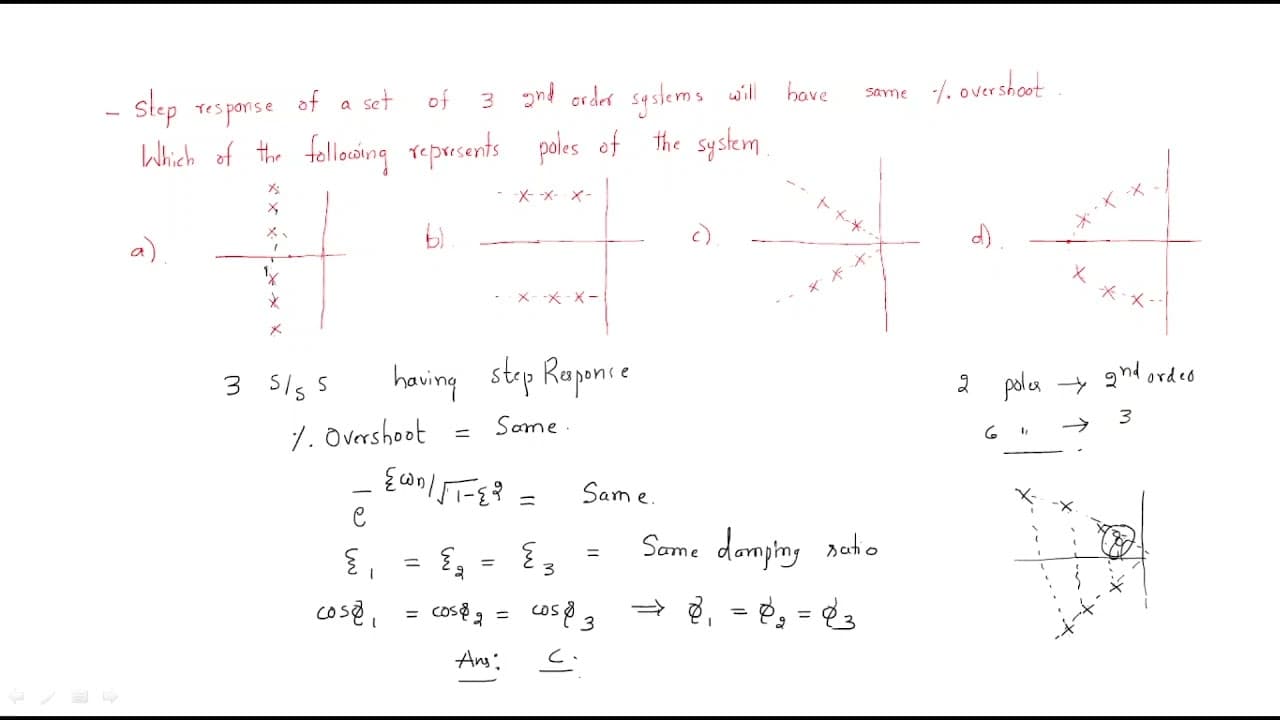
This session discusses step responses for three second order systems with the same percentage overshoot.
Transcript
[Applause] hello everyone in this session we will discuss some problem regarding the responses of the second order system here the problem is step response of set of three second order system will have the same percentage of overshoot which of the following represents poles of the system so in this case the most important thing is it has the three ... Read More
Key Insights
- 🪈 The concept of percentage overshoot is central to the analysis of second order systems, depicting system stability and performance.
- 💈 Consistent poles across different systems are essential for ensuring similar dynamic behaviors, influencing performance metrics like overshoot and settling time.
- 🎮 The differentiation of step responses to obtain impulse responses highlights a fundamental relationship in control system theory that describes system dynamics.
- 🥳 Understanding the nature of real and imaginary parts of the poles provides insights into the time characteristics and frequency responses of the systems.
- 📡 Relationships between various signal types, such as impulse, step, and ramp signals, are foundational in solving control system problems effectively.
- 🖐️ Each system's damping frequency plays a vital role in determining how quickly oscillations are damped, which is critical for system stability.
- 🥳 Maintaining common damping ratios across systems is essential for analysis, promoting a straightforward comparison of dynamic behaviors.
Install to Summarize YouTube Videos and Get Transcripts
Explore YouTube Video Summarizer or Get YouTube Transcript Extractor
Questions & Answers
Q: What is the significance of the damping ratio in second order systems?
The damping ratio is critical in defining the behavior of second order systems. It influences the percentage overshoot, settling time, and oscillatory response of the system. In this session, having the same damping ratio across multiple systems ensures they exhibit identical overshoot characteristics, making it easier to analyze their performance.
Q: How are the poles related to the percentage overshoot in a system?
The poles of a second order system directly affect its dynamic response, including the percentage overshoot. Each pole represents a combination of damping and natural frequency, and maintaining the same location of poles ensures that different systems have the same damping ratio and thus the same overshoot characteristics.
Q: Can you explain how to derive the impulse response from a step response?
To derive the impulse response from a step response, one can differentiate the step response with respect to time. This process transforms the step response into an impulse response, revealing the system's immediate reaction to an instantaneous input instead of a gradual one.
Q: What does a constant imaginary part signify about a second order system?
A constant imaginary part in a second order system represents a uniform damping frequency across different systems. This condition is vital for ensuring that all systems respond similarly during oscillations, leading to predictable behavior in their transient response.
Q: What happens when the real part of the poles remains constant?
When the real part of poles remains constant, it indicates that the time constants of the systems are identical. This uniformity ensures similar settling times and other time-dependent characteristics across the analyzed systems.
Q: How do we determine the correct option in the presented analysis?
By evaluating the criteria of constant damping ratios, imaginary parts, and real parts, one can ascertain the correct options. The analysis involves examining each option's poles and assessing the overall characteristic response to identify the correct formulation.
Summary & Key Takeaways
-
The discussion focuses on analyzing step responses of three second order systems, emphasizing that all systems have the same percentage overshoot, determined by their damping ratios.
-
Poles of the systems play a crucial role in maintaining the same damping ratio, impacting the systems' response characteristics and time constants.
-
The process of deriving impulse responses from step responses is illustrated, along with essential relationships between different signal types in control systems.
Read in Other Languages (beta)
Share This Summary 📚
Summarize YouTube Videos and Get Video Transcripts with 1-Click
Try YouTube Summary with ChatGPT & Claude or YouTube Transcript Generator