Doppler measurement | Range | Radar Systems | Lec-24
TL;DR
The video explains range and Doppler measurement using different radar systems.
Transcript
hi everyone in this video I am going to explain about range and Doppler measurement till now we have seen pulse radar and CW radar the purpose of pulse radar is used to measure the range of the target what is the distance between the Target and the radar system that we can calculate only range using pulse radar using CW radar we can calculate only ... Read More
Key Insights
- 🖤 Pulse radar is effective for determining the distance of a target, but lacks the ability to calculate its velocity.
- 🧡 CW radar excels in measuring the velocity of moving targets through the Doppler effect, though it cannot measure range.
- 👻 The FMCW radar system merges the advantages of pulse and CW radar technologies, allowing for simultaneous measurements of distance and speed.
- ❓ The calculation of Doppler frequency is crucial for velocity determination and is achieved using specific formulas related to the radar's operating characteristics.
- 💓 For stationary targets, fair predictions can be made using the beat frequency derived solely from range frequency in FMCW radar.
- 💁 The signal waveform reflected by a target provides essential information regarding its position and movement dynamics.
- 🧡 Understanding the modulation of radar signals is fundamental for effective range and Doppler measurements.
Install to Summarize YouTube Videos and Get Transcripts
Explore YouTube Video Summarizer or Get YouTube Transcript Extractor
Questions & Answers
Q: What are the main differences between pulse radar and CW radar?
Pulse radar focuses primarily on measuring the range to a target by sending out pulses and measuring the return time. It cannot determine velocity. Conversely, CW radar continuously transmits a signal, allowing it to calculate the target's velocity through Doppler frequency shift but does not ascertain the range. This disparity highlights the unique strengths and weaknesses of each radar type.
Q: How does FMCW radar improve upon pulse and CW radar systems?
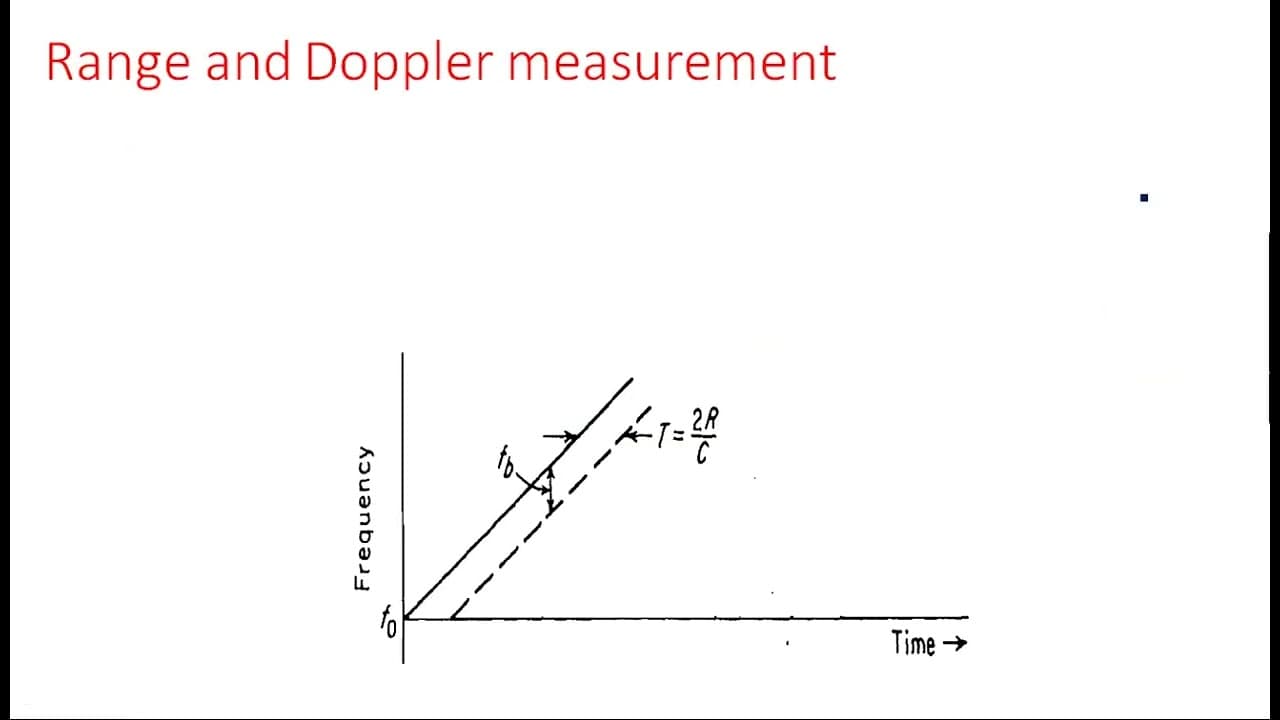
FMCW radar integrates the functionalities of both pulse and CW radar by emitting a continuously modulated signal. This enables it to measure both the distance to a target and its velocity. The combination of range frequency and Doppler frequency provided by FMCW radar makes it more versatile and widely applicable for various radar measurements.
Q: Can you explain how Doppler frequency is calculated and its significance?
Doppler frequency is calculated using the formula FD = 2v_r / λ, where v_r is the relative velocity of the target and λ is the wavelength. This frequency shift indicates how far the target is moving and in which direction. It is significant for understanding the motion dynamics of the target, especially in applications like traffic monitoring and aircraft tracking.
Q: What is the formula for calculating range frequency in FMCW radar?
In FMCW radar, range frequency (FR) can be calculated using FR = 2R / C * F' where R is the range to the target, C is the speed of light, and F' is the rate of frequency modulation. This relationship emphasizes the dependency of range frequency on the distance and the modulation characteristics of the radar signal.
Summary & Key Takeaways
-
The video discusses the differences between pulse radar, CW radar, and FMCW radar, highlighting their specific capabilities in measuring range and velocity.
-
Pulse radar measures the distance to a target but cannot calculate velocity, while CW radar measures velocity indirectly using Doppler frequency shift without measuring distance.
-
FMCW radar combines the strengths of both systems, enabling the calculation of both range and velocity, making it a versatile tool in radar technology.
Read in Other Languages (beta)
Share This Summary 📚
Summarize YouTube Videos and Get Video Transcripts with 1-Click
Try YouTube Summary with ChatGPT & Claude or YouTube Transcript Generator