Synchronous Induction Motor | Maximum power input | Synchronous Machines | Lec-39
TL;DR
The content discusses power flow equations in synchronous motors, focusing on active and reactive power calculations.
Transcript
even in the last session we discussed about the power flow equations of the synchronous motor so in that we will get some equations that is the apparent power s equal V Square by z s at an angle of theta minus E V by Z is at the angle of Del plus T okay next we will continue the same thing that is so we will divide into we will divide into active p... Read More
Key Insights
- ✊ The power flow equations provide a framework for understanding how synchronous motors operate and handle power.
- ✊ The separation of active and reactive power is fundamental for diagnosing system inefficiencies and ensuring balanced load conditions.
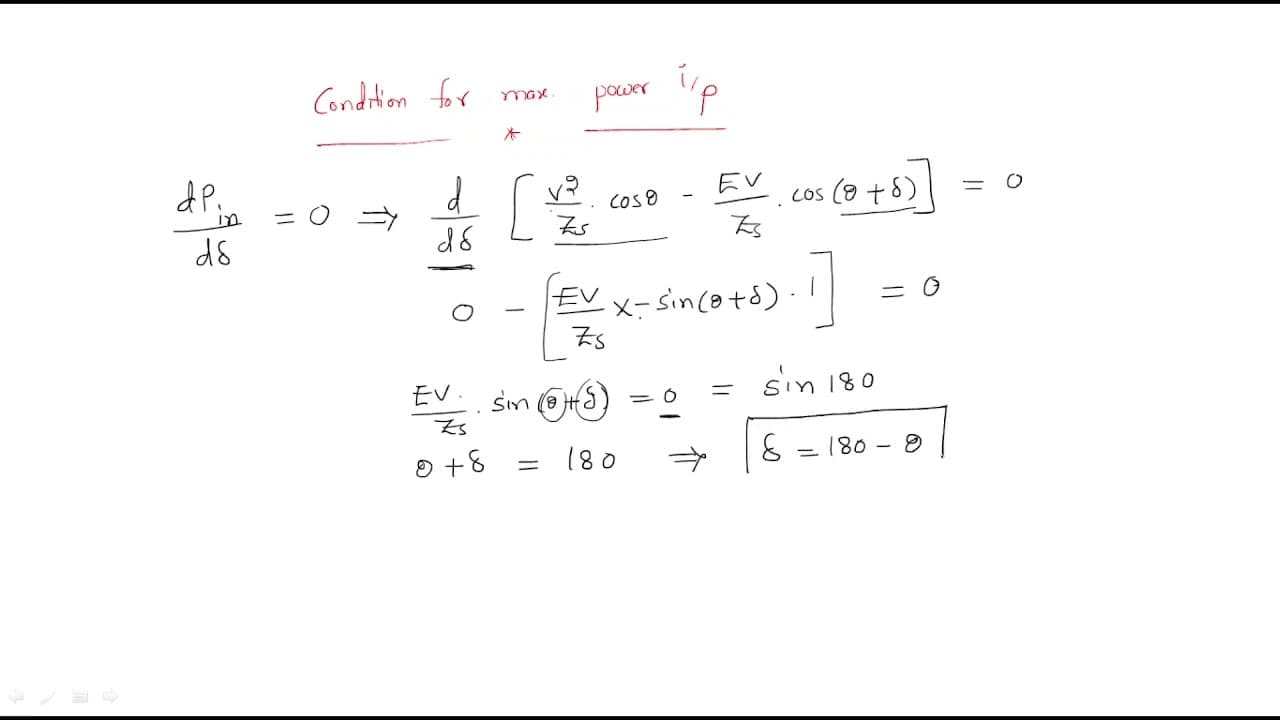
- 👻 Maximum input power conditions can be derived mathematically, allowing electrical engineers to optimize motor performance.
- ✊ Understanding the relationship between load angle and power factors helps in maximizing output performance in synchronous motors.
- ✊ The formulation of mechanical power developed informs engineers about the efficiency of the energy conversion process within motors.
- 🈸 The application of trigonometric identities in power calculations showcases the interplay between electrical engineering principles and practical applications.
- ✊ Knowledge of synchronous impedance and its effects on power distribution is vital for effective motor design and analysis.
Install to Summarize YouTube Videos and Get Transcripts
Explore YouTube Video Summarizer or Get YouTube Transcript Extractor
Questions & Answers
Q: What are the main components of the power flow equations discussed?
The main components include the apparent power, active power (P), and reactive power (Q), which are derived from voltage (V), synchronous impedance (Zs), and angles (theta and delta). These components help in analyzing the performance and efficiency of synchronous motors.
Q: How can we determine the maximum input power for a synchronous motor?
The maximum input power can be found by differentiating the input power equations concerning the load angle (delta) and setting the derivative to zero. This leads to the condition where the sum of angles, theta and delta, approaches 180 degrees, optimizing power input from the motor's operation.
Q: What is the significance of separating active and reactive power in analysis?
Separating active and reactive power is crucial because it allows engineers to assess power efficiency and system stability. Active power contributes to useful work done, while reactive power, although not doing work, is essential for maintaining voltage levels and supporting inductive loads in electrical systems.
Q: Can you explain how mechanical power is developed in synchronous motors?
Mechanical power in synchronous motors is generated from the active component of the induced EMF and the armature current. By analyzing these factors, particularly in terms of reactive power and angles, we can derive specific formulas to quantify the mechanical power developed, which is critical for performance assessments.
Summary & Key Takeaways
-
The content elaborates on the power flow equations of synchronous motors, breaking down the apparent power into active and reactive components using complex trigonometric equations for calculations.
-
It provides insight into deriving formulas for maximum input and mechanical power developed in synchronous motors, emphasizing the significance of load angle differentiation in optimizing power.
-
The session concludes by summarizing the active and reactive power equations, reinforcing the importance of these concepts in electrical engineering and practical applications in motor systems.
Read in Other Languages (beta)
Share This Summary 📚
Summarize YouTube Videos and Get Video Transcripts with 1-Click
Try YouTube Summary with ChatGPT & Claude or YouTube Transcript Generator