How to Determine Maximum Force on Stacked Blocks
TL;DR
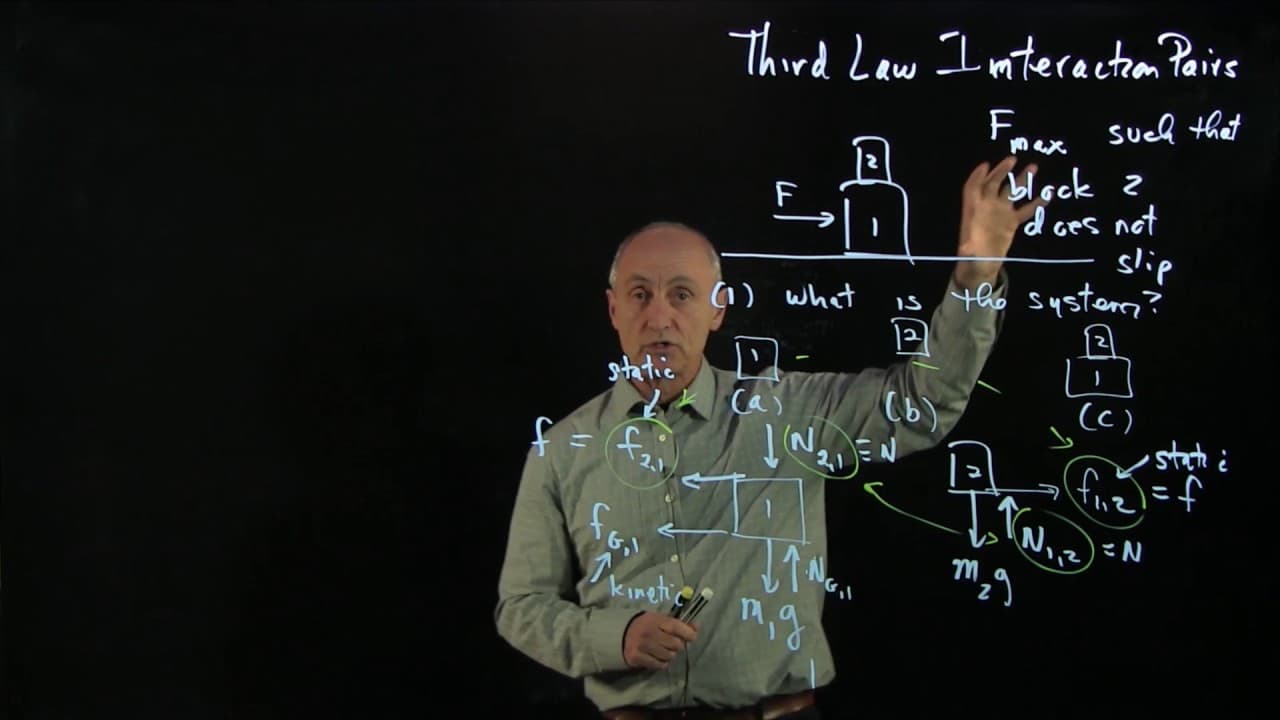
To determine the maximum force that can be applied to stacked blocks without causing slipping, analyze the third law interaction pairs and free-body diagrams for each block. The maximum force depends on the static friction and normal forces between the blocks, considering both the forces acting on each block and the overall system dynamics.
Transcript
One of the big difficulties students have in a problem that involves many objects is to successfully identify third law interaction pairs. So today, I'd like to look at a problem which shows us how to think about that. So what we're going to look at is third law interaction pairs. Now, the problem I'd like to consider is the following. Suppose we h... Read More
Key Insights
- 🧑🏭 Identifying third law interaction pairs is essential in analyzing the forces acting on multiple objects in a problem.
- 👻 Breaking down the problem into different systems allows for a better understanding of the forces and interactions within each system.
- 💋 The maximum force that can be applied without causing slipping can be determined by considering the forces of friction and normal forces between the blocks.
- 🆘 Vector decomposition and choosing appropriate unit vectors help in resolving forces in different directions.
- 🥶 Double-checking free-body diagrams is crucial before applying Newton's laws.
- 🧑🏭 The analysis of the forces acting on each block individually helps in determining the accelerations and equations of motion.
- 🖐️ The concept of static friction plays a significant role in understanding the movement of blocks.
Install to Summarize YouTube Videos and Get Transcripts
Explore YouTube Video Summarizer or Get YouTube Transcript Extractor
Questions & Answers
Q: What is the main difficulty students face in problems involving multiple objects?
One of the main difficulties is successfully identifying third law interaction pairs, where each action has an equal and opposite reaction. This is crucial in understanding the forces acting on different objects in the problem.
Q: How does the content suggest approaching the problem of determining the maximum force?
The content suggests breaking down the problem into different systems, such as considering block one, block two, or both blocks together as separate systems. This allows for analyzing the forces and interactions specific to each system.
Q: What are the different forces acting on block one in the example problem?
The forces acting on block one include the gravitational force, friction between the ground and block one, the normal force of the ground on block one, and the friction force between block two and block one that opposes the applied force.
Q: How does the content explain the movement of block two to the right?
The content explains that static friction between block one and block two is responsible for making block two move to the right. This friction acts as the force that counters the applied force on block one.
Summary & Key Takeaways
-
The content explains how to identify third law interaction pairs in a problem involving multiple objects.
-
It illustrates an example problem where a force is applied to one block, and the maximum force that can be applied without causing the other block to slip is determined.
-
The process of breaking down the problem into different systems and analyzing the free-body diagrams of each block is demonstrated.
Read in Other Languages (beta)
Share This Summary 📚
Summarize YouTube Videos and Get Video Transcripts with 1-Click
Try YouTube Summary with ChatGPT & Claude or YouTube Transcript Generator
Explore More Summaries from MIT OpenCourseWare 📚


Summarize YouTube Videos and Get Video Transcripts with 1-Click
Try YouTube Summary with ChatGPT & Claude or YouTube Transcript Generator