PLP (Pyridoxal Phosphate) Reactions
TL;DR
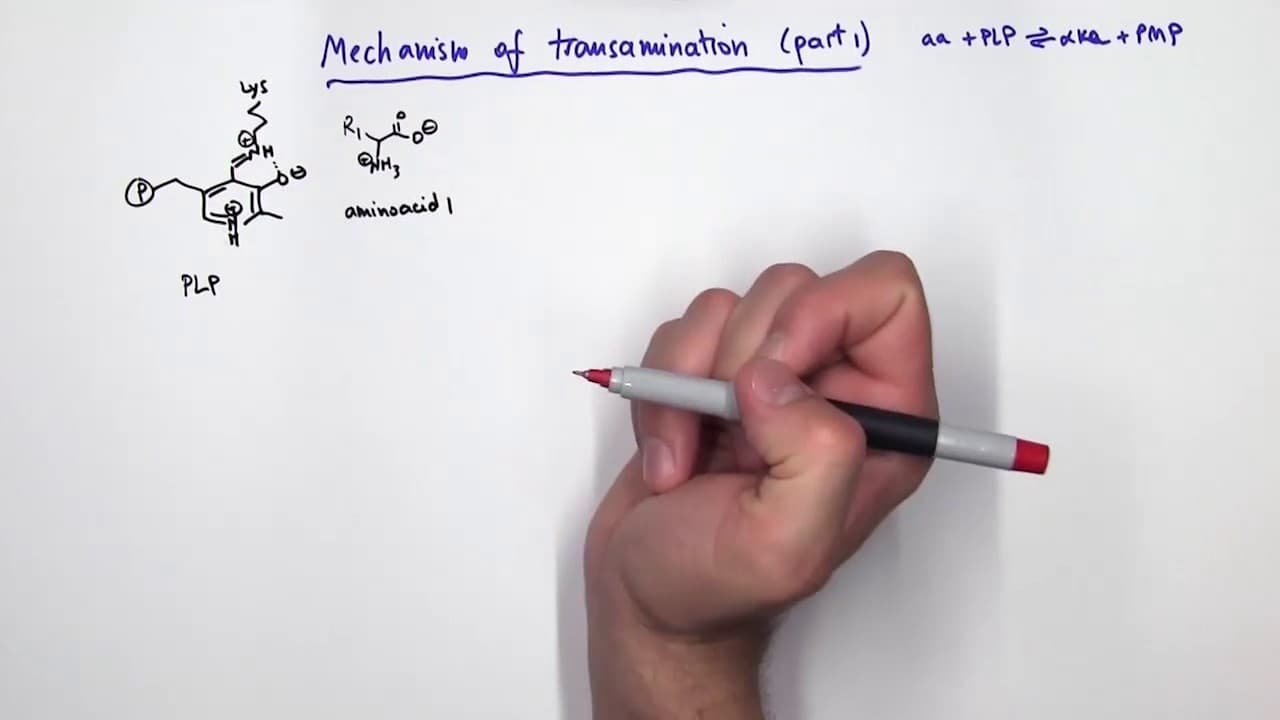
This content discusses the role of pyridoxal 5 phosphate (PLP), a cofactor derived from vitamin B6, in various metabolism reactions, particularly transamination. It explores the structure of PLP, its mechanism of action, and its involvement in racemization and de-carboxylation reactions.
Transcript
The following content is provided under a Creative Commons license. Your support will help MIT OpenCourseWare continue to offer high quality educational resources for free. To make a donation or view additional materials from hundreds of MIT courses, visit MIT OpenCourseWare at ocw.mit.edu. BOGDAN FEDELES: Hello and welcome to 5.07 Biochemistry onl... Read More
Key Insights
- ❓ PLP is an ancient cofactor derived from vitamin B6 and is crucial for various biochemical reactions.
- ❓ Transamination is one of the most important reactions involving PLP and is essential for amino acid metabolism.
- 👥 PLP-catalyzed reactions occur in two steps: amino group transfer to PLP and then transfer from PLP to an alpha keto acid.
- 🥹 PLP can also catalyze racemization reactions, converting L-amino acids to D-amino acids, and de-carboxylation reactions, such as the conversion of glutamate to GABA.
- 💪 Abnormal PLP-dependent enzyme levels can serve as biomarkers for liver or muscle damage.
- 🖐️ PLP plays a role in neurotransmitter synthesis, making it relevant to neurological disorders.
- ❎ The mechanism of PLP-catalyzed reactions involves proton transfers and the stabilization of negative charges through resonance structures.
Install to Summarize YouTube Videos and Get Transcripts
Explore YouTube Video Summarizer or Get YouTube Transcript Extractor
Questions & Answers
Q: What is PLP and why is it essential for metabolism?
PLP is a cofactor derived from vitamin B6 that plays a crucial role in various metabolic reactions. It is involved in the transfer of amino groups between amino acids and alpha keto acids, which is essential for amino acid metabolism.
Q: How does PLP contribute to the transamination reaction?
In the transamination reaction, PLP acts as a catalyst by forming a Schiff base with the amino acid. It facilitates the transfer of the amine group from the amino acid to the alpha keto acid, resulting in the formation of a new amino acid and alpha keto acid.
Q: What are some other reactions that PLP can catalyze?
Besides transamination, PLP can catalyze racemization reactions, converting L-amino acids to D-amino acids. It can also facilitate de-carboxylation reactions, such as converting glutamate to gamma aminobutyric acid (GABA).
Q: What are the clinical implications of PLP-catalyzed reactions?
PLP-catalyzed reactions have clinical significance as they are involved in various metabolic pathways. For example, abnormal levels of PLP-dependent enzymes can serve as biomarkers for liver or muscle damage. Additionally, PLP plays a role in neurotransmitter synthesis, making it relevant to neurological disorders.
Summary & Key Takeaways
-
PLP is an essential cofactor derived from vitamin B6 and is involved in a wide range of biochemical reactions.
-
One of the most important reactions involving PLP is transamination, which facilitates the transfer of the amine group between amino acids and alpha keto acids.
-
PLP-catalyzed reactions occur in two steps: transfer of the amine group to PLP, followed by the transfer of the amine group from PLP to a different alpha keto acid.
Read in Other Languages (beta)
Share This Summary 📚
Summarize YouTube Videos and Get Video Transcripts with 1-Click
Try YouTube Summary with ChatGPT & Claude or YouTube Transcript Generator
Explore More Summaries from MIT OpenCourseWare 📚


Summarize YouTube Videos and Get Video Transcripts with 1-Click
Try YouTube Summary with ChatGPT & Claude or YouTube Transcript Generator