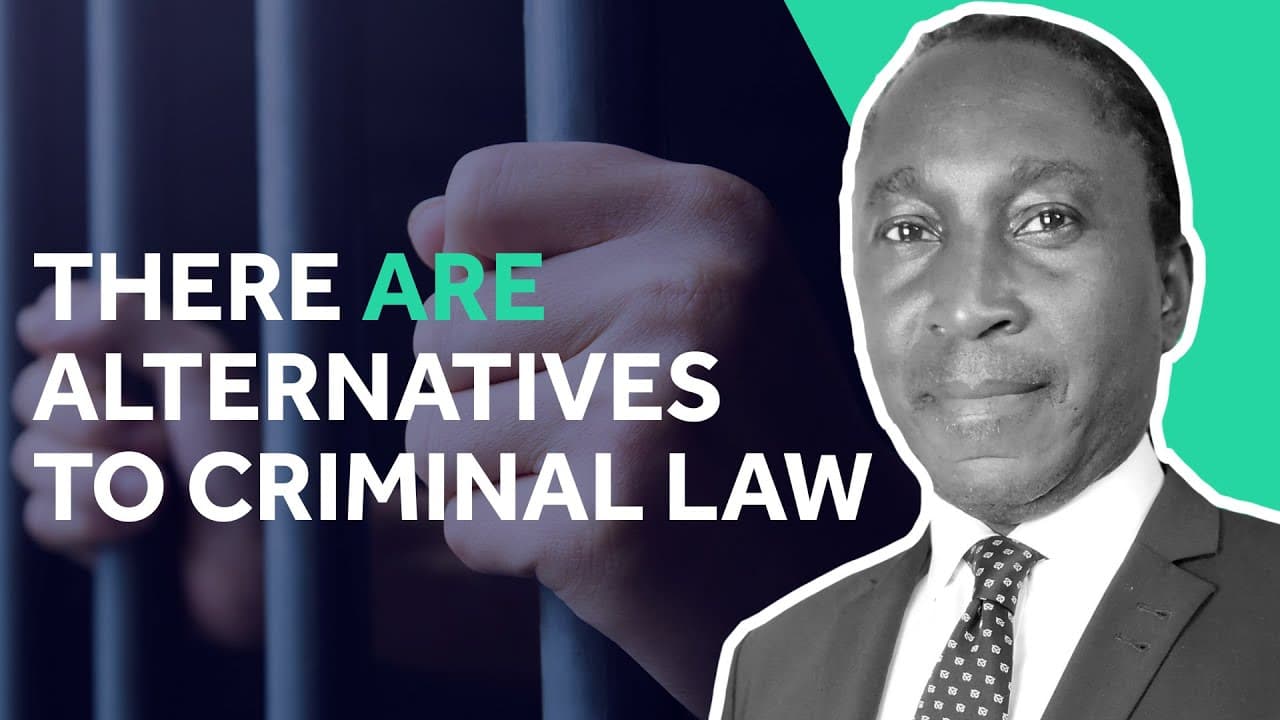
Criminal Law: There are alternatives
TL;DR
The current Criminal Justice System has major issues, but it is necessary to consider whether it should be reformed or abolished.
Transcript
do we need criminal law this requires us to choose between abolitionism and reformism we've seen that there are major problems with every aspect of Criminal Justice System as it currently exists classes it's ableists it's racist but that doesn't address the question can it be reformed or should it be abolished in itself it's not controversial to sa... Read More
Key Insights
- 👨⚖️ Restorative justice is valuable but has limitations in terms of fact-finding and addressing structural causes of crime.
- 👨⚖️ Transformative justice seeks to address root causes through social and political change, emphasizing healing and community-based solutions.
- 🪡 Balancing the desire for punishment with the need for structural change is a challenge in the abolitionist approach.
- 🥺 Adequate social support systems, such as education, housing, jobs, and healthcare, are crucial for addressing the underlying issues that lead to crime.
- 👨⚖️ Exploring alternatives to the current criminal justice system provides valuable perspectives on its limitations and possibilities for improvement.
- 👨⚖️ Vigilante justice may arise in the absence of a criminal justice system, highlighting the need for careful consideration of abolitionist goals.
- 👨⚖️ Gross inequality and structural racism contribute to societal harm and conflict, which should be challenged alongside the reform or abolition of the criminal justice system.
Install to Summarize YouTube Videos and Get Transcripts
Explore YouTube Video Summarizer or Get YouTube Transcript Extractor
Questions & Answers
Q: What is the difference between restorative justice and transformative justice?
Restorative justice focuses on repairing harm through dialogue and reconciliation, while transformative justice seeks to address underlying causes of crime through social and political change.
Q: Can restorative justice alone adjudicate guilt and innocence?
Restorative justice is not equipped with an extensive fact-finding process, making it unsuitable for determining guilt or innocence on its own.
Q: What are the criticisms of the abolitionist approach to justice?
Critics argue that victims and the public often demand punishment for serious crimes, and immediate abolition may lead to vigilante justice. However, these criticisms should not be ignored in considering public policy decisions.
Q: How can criminal punishment be ineffective in solving underlying social problems?
Criminal punishment cannot address the structural inequalities, injustice, and societal conflicts that contribute to crime, often exacerbating these problems instead of resolving them.
Summary & Key Takeaways
-
Restorative justice is widely acknowledged as a positive approach, but it is not a complete replacement for the criminal justice system.
-
Transformative justice aims to address root causes of crime through social and political change, emphasizing community-based solutions and healing.
-
While immediate abolition may not be feasible, exploring alternatives offers valuable insights into the limitations of the current system and possibilities for change.
Read in Other Languages (beta)
Share This Summary 📚
Summarize YouTube Videos and Get Video Transcripts with 1-Click
Try YouTube Summary with ChatGPT & Claude or YouTube Transcript Generator
Explore More Summaries from Gresham College 📚


Summarize YouTube Videos and Get Video Transcripts with 1-Click
Try YouTube Summary with ChatGPT & Claude or YouTube Transcript Generator