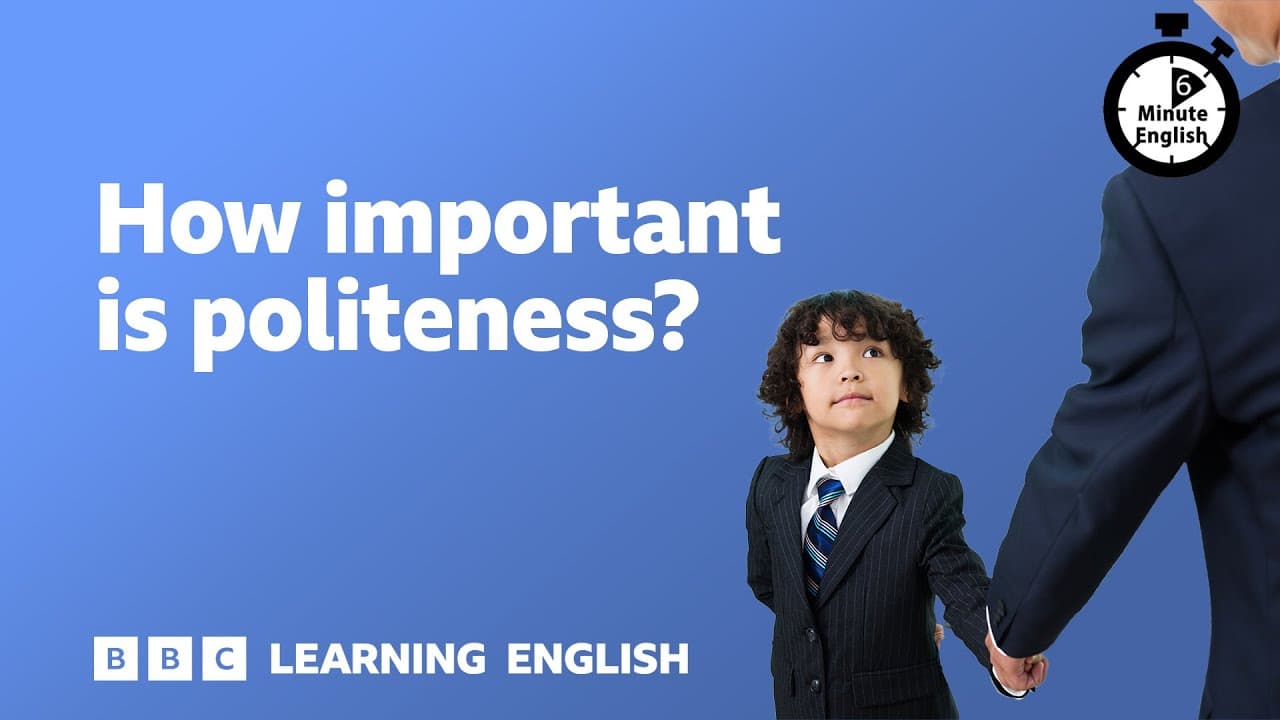
How important is politeness? ⏲️ 6 Minute English
TL;DR
Politeness is subjective and context-dependent.
Transcript
Hello, this is 6 Minute English from BBC Learning English. I'm Neil. And I'm Beth. In this programme, we're talking about politeness. Britain has a reputation for being a polite place where children are told to say please and thank you, but in real life that isn't always true. You, give me that pen! I'm sorry. That was a bit rude. Well, what should... Read More
Key Insights
- Britain is often seen as a polite nation, but real-life interactions may not always reflect this stereotype.
- Politeness can be subjective, depending on the individual's perception and the context of the interaction.
- Michael Rosen's experience with a boy using informal language highlights the subjective nature of perceived politeness.
- Professor Louise Mullany suggests that politeness involves both the speaker and the listener's interpretation.
- Teaching children politeness helps them integrate and be accepted within societal norms.
- Parents may feel embarrassed when their children do not conform to expected polite behaviors.
- The idiom 'mind your Ps and Qs' is used in English to remind someone to be polite.
- Politeness involves using specific language and manners, which can vary across cultures and situations.
Install to Summarize YouTube Videos and Get Transcripts
Explore YouTube Video Summarizer or Get YouTube Transcript Extractor
Questions & Answers
Q: What does Michael Rosen's experience illustrate about politeness?
Michael Rosen's experience with a boy who used informal language highlights the subjective nature of politeness. The boy's greeting, 'Hey, you're thingy, innit!' was perceived by Rosen as non-threatening and civil, despite breaking traditional politeness rules. This illustrates that politeness can depend on personal interpretation and context.
Q: Why do we teach children to be polite?
Teaching children to be polite is important for helping them integrate into society and be accepted by others. Politeness is seen as a social norm that facilitates positive interactions and relationships. By learning polite behaviors and language, children can navigate social situations more effectively and gain approval from peers and adults.
Q: How does Professor Louise Mullany view politeness?
Professor Louise Mullany views politeness as involving both the speaker and the listener's interpretation. She explains that politeness is not just about following conventional rules, but also about how the listener perceives the interaction. This perspective highlights the subjective nature of politeness and the importance of context in determining what is considered polite.
Q: What is the significance of the idiom 'mind your Ps and Qs'?
The idiom 'mind your Ps and Qs' is significant as it serves as a reminder to be polite and mindful of one's manners. It reflects the cultural emphasis on politeness and proper behavior in social interactions. This idiom underscores the importance placed on etiquette and the expectation to adhere to social norms in communication.
Q: How did Professor Louise Mullany feel about her daughter's behavior?
Professor Louise Mullany felt embarrassed when her daughter did not say hello to an adult at her nursery school. She made excuses for her daughter's behavior, attributing it to tiredness and teething. This anecdote illustrates the pressure parents feel for their children to conform to polite behaviors and the discomfort when they do not.
Q: What does the use of informal language, like 'thingy' and 'innit', indicate about politeness?
The use of informal language, such as 'thingy' and 'innit', indicates that politeness is not solely about formal language but also about the intent and perception of the interaction. While such language may break traditional politeness rules, it can still be perceived as non-threatening and civil, depending on the context and the listener's interpretation.
Q: Why might parents feel embarrassed about their children's behavior?
Parents might feel embarrassed about their children's behavior when it does not align with societal expectations of politeness. This embarrassment stems from the desire for their children to be accepted and viewed positively by others. When children fail to exhibit expected polite behaviors, parents may feel judged and responsible for their children's actions.
Q: What role does societal norms play in teaching politeness?
Societal norms play a crucial role in teaching politeness, as they establish the expected behaviors and language for social interactions. By learning these norms, individuals can navigate social situations more effectively and gain acceptance within their community. Politeness is often taught to children to help them integrate and build positive relationships with others.
Summary & Key Takeaways
-
Politeness is a complex social construct that varies depending on context and individual perception. In Britain, known for its polite society, real-life interactions may not always align with this stereotype. Michael Rosen's encounter with a boy highlights how informal language can be perceived differently based on personal interpretation.
-
Professor Louise Mullany emphasizes that politeness involves both the speaker's intent and the listener's perception. Teaching children politeness helps them navigate societal norms and gain acceptance. However, parents may feel embarrassed when their children do not adhere to expected polite behaviors, as illustrated by Mullany's personal anecdote.
-
The idiom 'mind your Ps and Qs' serves as a reminder to be polite. Politeness encompasses specific language and manners, which can differ across cultures and situations. Ultimately, politeness is subjective, shaped by individual experiences and societal expectations.
Read in Other Languages (beta)
Share This Summary 📚
Summarize YouTube Videos and Get Video Transcripts with 1-Click
Try YouTube Summary with ChatGPT & Claude or YouTube Transcript Generator
Explore More Summaries from BBC Learning English 📚
Summarize YouTube Videos and Get Video Transcripts with 1-Click
Try YouTube Summary with ChatGPT & Claude or YouTube Transcript Generator