What Is a Cathode Ray Oscilloscope and How Does It Work?
TL;DR
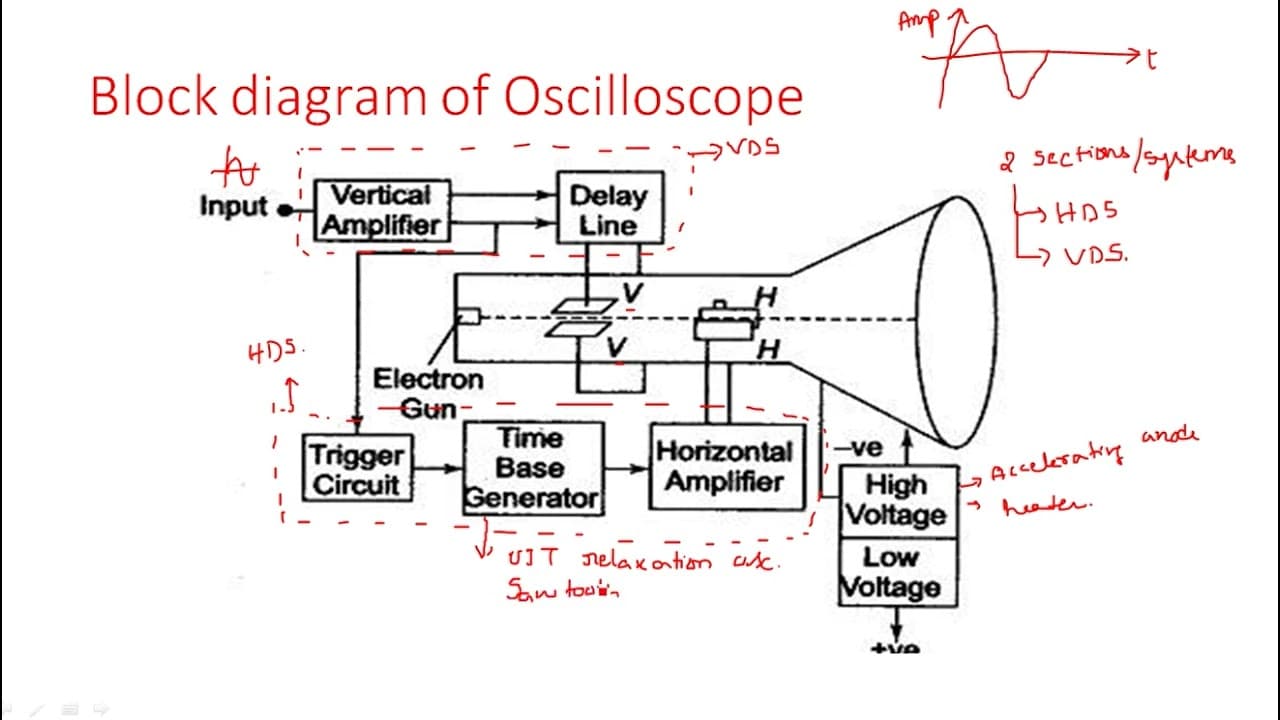
A Cathode Ray Oscilloscope (CRO) visualizes electronic signals using two main systems: the vertical deflection system, which amplifies signals, and the horizontal deflection system, which controls the sweep of the electron beam. Synchronization of these systems is crucial for accurate waveform representation, managed through components like vertical amplifiers, trigger circuits, and time base generators.
Transcript
in this video i will discuss about various blocks involved in the oscilloscope like uh cathode ray oscilloscope so this is the block diagram complete block diagram of oscilloscope and in the next coming classes i will discuss a simple cro a block diagram of a simple cro it is looking the name looks simple but it is having complete and detailed arch... Read More
Key Insights
- 📡 The Cathode Ray Oscilloscope (CRO) is essential for visualizing electronic signals and analyzing waveform characteristics.
- 🤩 The CRO features two key systems – horizontal and vertical – each performing specific tasks to accurately display signals.
- 🚦 Vertical amplifiers amplify incoming signals for the vertical system, while the time base generator controls horizontal movement.
- 🫥 Synchronization between horizontal and vertical systems is critical for accurate waveform representation, achieved through the delay line.
- ⌛ The trigger circuit enhances precision by aligning the time base with the input signal, facilitating clear visual feedback.
- ⚡ High voltage and low voltage power supplies are crucial components that support the operation of the CRO's electron gun and amplifiers.
- 😒 Understanding the function of each block within the CRO aids in effective troubleshooting and proper use of the oscilloscope.
Install to Summarize YouTube Videos and Get Transcripts
Explore YouTube Video Summarizer or Get YouTube Transcript Extractor
Questions & Answers
Q: What is the primary purpose of a Cathode Ray Oscilloscope?
A Cathode Ray Oscilloscope (CRO) is a device used to visualize electronic signals on a screen. It translates voltage signals into a corresponding graphical representation, allowing engineers to observe waveform shapes and analyze the characteristics of the electrical signal, such as amplitude and frequency over time.
Q: What components are involved in the vertical deflection system?
The vertical deflection system comprises primarily the vertical amplifier and the delay line. The vertical amplifier is responsible for amplifying the incoming electrical signal, while the delay line helps synchronize the vertical and horizontal signals, ensuring that the waveform is accurately displayed on the oscilloscope screen.
Q: How does the horizontal deflection system work?
The horizontal deflection system includes the time base generator, trigger circuit, and horizontal amplifier. The time base generator creates a sawtooth waveform that controls how the electron beam sweeps horizontally across the screen, while the trigger circuit generates pulses that synchronize horizontal deflection with the incoming signal.
Q: Why is a delay line necessary in a CRO?
A delay line is essential in a CRO to synchronize the output signals from vertical and horizontal deflection systems. This ensures that the displayed waveform on the screen accurately represents the input signal. Without proper timing, the waveform would appear distorted or misaligned.
Q: What role does the time base generator play in oscilloscope operation?
The time base generator produces a sawtooth voltage that controls the horizontal movement of the electron beam. It determines the time interval for the beam to sweep across the screen, thus defining the time scale for the displayed waveform and enabling accurate timing representation of the input signal.
Q: How is synchronization achieved between the vertical and horizontal systems?
Synchronization is achieved by delaying the vertical deflection signal to match the timing of the horizontal deflection. The delay line temporarily holds the vertical signal until the horizontal system completes its sweep, ensuring both signals reach their respective plates simultaneously for a coherent display.
Q: What are the main functions of the trigger circuit?
The trigger circuit's primary function is to convert the incoming signal into trigger pulses that dictate the start of the horizontal sweep. It establishes synchronization by ensuring that the sweep timing corresponds to specific features of the incoming signal, facilitating a clear and stable waveform display.
Summary & Key Takeaways
-
The video introduces the structure and functions of a Cathode Ray Oscilloscope (CRO), detailing the essential blocks and their roles.
-
It explains two main systems: the vertical deflection system and horizontal deflection system, emphasizing their significance in signal display.
-
The operation of components like vertical and horizontal amplifiers, trigger circuits, and time base generators is illustrated for signal synchronization.
Read in Other Languages (beta)
Share This Summary 📚
Summarize YouTube Videos and Get Video Transcripts with 1-Click
Try YouTube Summary with ChatGPT & Claude or YouTube Transcript Generator