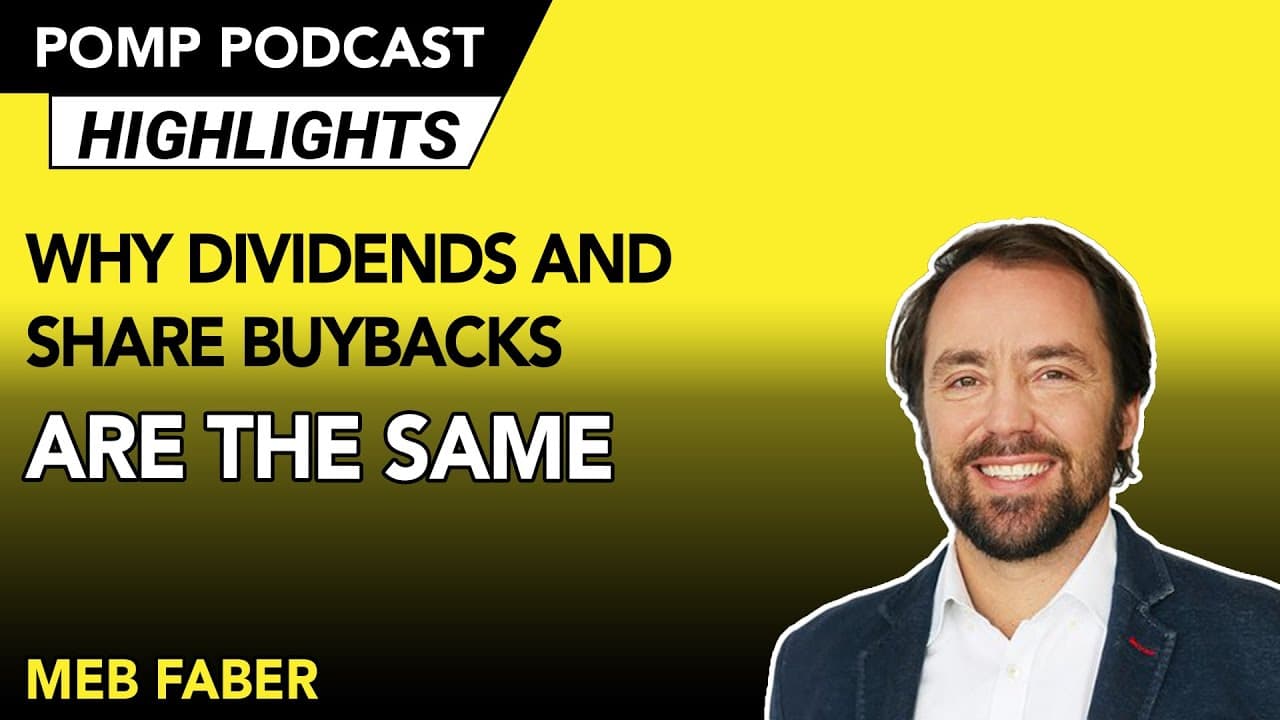
Why Dividends and Share Buybacks Are The Same
TL;DR
The content discusses corporate financial practices, particularly around buybacks and dividends, urging objective understanding.
Transcript
again I try to ban this topic because it's an emotional one it's like talking about religion it's like talking about cryptocurrencies right people end up on these totally irrational so listeners come into this please with an open mind and try to understand and be objective I'm a quant right there's no emotions here I have no heart so I always joke ... Read More
Key Insights
- 🔠 Companies largely have five avenues to manage capital: reinvestment, M&A, debt reduction, dividends, and buybacks.
- ↩️ Historically, dividends were introduced to make stocks more appealing compared to bonds, ensuring returns to investors through cash payouts.
- 😣 Buybacks have increased since the 1980s due to legislative changes that facilitated companies’ ability to repurchase shares without severe risk.
- 🥺 Misunderstandings about the function and implications of buybacks often lead to negative perceptions, rather than an informed view of their financial context.
- 🚕 Buybacks offer more flexibility and tax efficiency than dividends, making them increasingly favored among large corporations.
- ❓ There is a significant historical and cultural dialogue around buybacks, often colored by emotional responses rather than economic rationale.
- ↩️ The distinction between stock buybacks and dividends should be understood in the context of total shareholder returns rather than as separate phenomena.
Install to Summarize YouTube Videos and Get Transcripts
Explore YouTube Video Summarizer or Get YouTube Transcript Extractor
Questions & Answers
Q: What are the five primary ways companies can utilize their capital?
Companies can utilize their capital through five primary avenues: reinvesting in the business, engaging in mergers and acquisitions (M&A), paying down debt, paying dividends to shareholders, or conducting stock buybacks. Each option carries implications for a company's growth strategy and shareholder returns, which align with the company's financial health and market conditions.
Q: Why have buybacks become more prominent since the 1980s?
Buybacks gained prominence since the 1980s due to legislation that provided companies with safer practices regarding share repurchase programs. This shift allowed firms to return capital to shareholders more flexibly and in a more tax-efficient manner compared to dividend distributions, which were seen as less favorable by both companies and investors.
Q: How do buybacks and dividends function similarly, and what distinguishes them?
Buybacks and dividends both represent methods for returning capital to shareholders, yet the primary distinctions lie in flexibility and tax treatment. Buybacks can be executed at various times and stopped, offering firms more control, while dividends impose continuous cash payouts, often carrying heavier tax implications for recipients.
Q: What are some criticisms of buyback practices?
Criticisms of buybacks often focus on the potential for CEO manipulations tied to earnings per share compensation and claims of shareholder value detriment when companies face economic downturns. However, these criticisms usually stem from broader governance issues rather than the buyback strategy itself, advocating for better regulatory frameworks on executive compensation instead.
Summary & Key Takeaways
-
The main focus is on the various ways companies can manage their capital, which include reinvestment, mergers, debt repayment, dividends, and stock buybacks, each serving different strategic purposes.
-
There is a historical overview of dividends and buybacks, highlighting how companies have favored buybacks since the 1980s due to their flexibility and tax efficiency compared to traditional dividends.
-
Common misconceptions associated with buybacks are addressed, emphasizing that criticisms often stem from misunderstandings of the underlying financial mechanics rather than the practice itself.
Read in Other Languages (beta)
Share This Summary 📚
Summarize YouTube Videos and Get Video Transcripts with 1-Click
Try YouTube Summary with ChatGPT & Claude or YouTube Transcript Generator
Explore More Summaries from Anthony Pompliano 📚
Summarize YouTube Videos and Get Video Transcripts with 1-Click
Try YouTube Summary with ChatGPT & Claude or YouTube Transcript Generator