What Is the Ramsauer-Townsend Effect?
TL;DR
The Ramsauer-Townsend effect describes how transmission probabilities of low-energy electrons through a spherical potential well oscillate and can reach one at specific energy levels. This phenomenon, first observed in 1921, highlights significant variations in reflection coefficients based on energy, indicating resonant transmission. Understanding this effect is crucial for grasping concepts in quantum mechanics and particle interactions.
Transcript
PROFESSOR: If you have potential transmission coefficient for a potential where z0 is equal to 13 pi over 4. That's a square well of certain depth, and we represent it in this way. Remember n must be greater than or equal than 2z0 over pi. So this will be 13/2. And 13/2 means that we can start with n equals 7, 8, 9, and all those. Remember, this n ... Read More
Key Insights
- ❓ The transmission coefficient for a potential well depends on the energy and depth of the well.
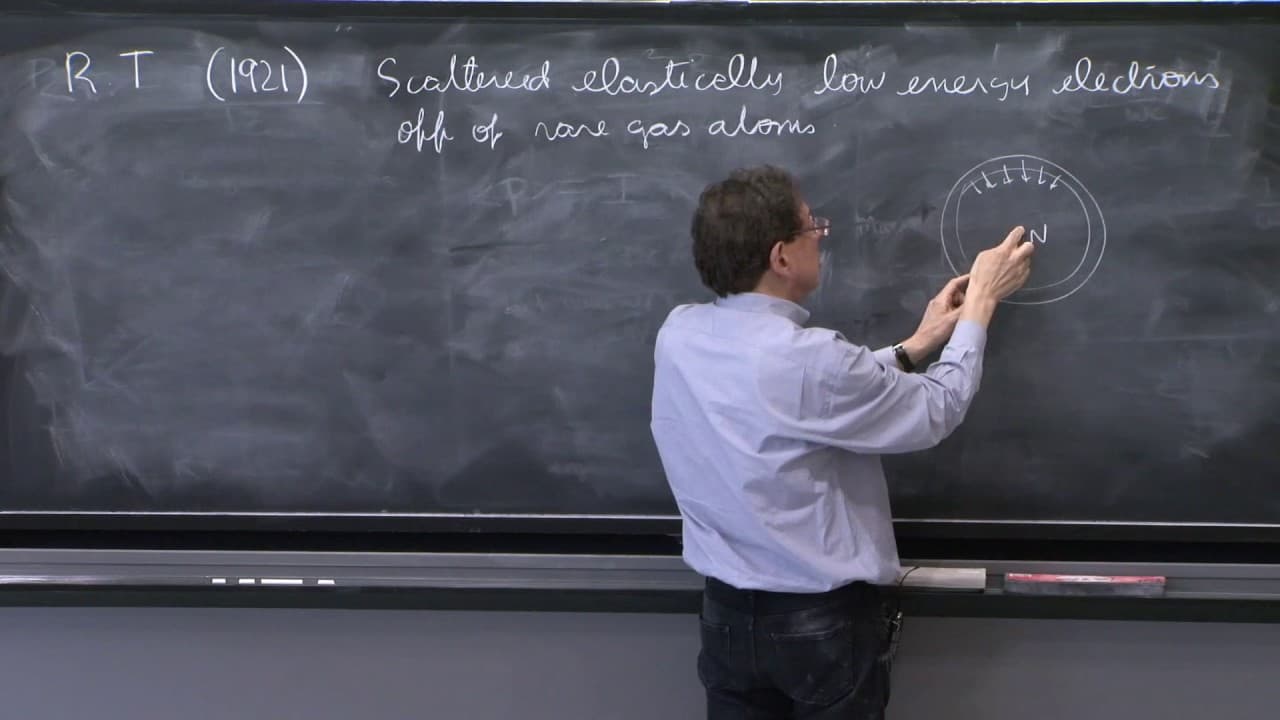
- 😘 Ramsauer and Townsend's 1921 experiment with low energy electrons scattering off rare gas atoms revealed unexpected variations in the reflection coefficient with energy.
- ❓ Resonant transmission was later identified as the cause of the unique reflection behavior observed in the experiment.
- 📈 The transmission probability graph in the experiment exhibited oscillations, with the probability reaching 1 at certain energy values.
- ⌛ The amplitude of the oscillations decreased over time, indicating a tendency towards complete transmission.
- 👋 Ramsauer and Townsend's experiment played a role in the development of wave mechanics and the understanding of quantum phenomena.
- ❓ A more precise spherical model of the potential well is necessary to accurately calculate the transmission probability.
Install to Summarize YouTube Videos and Get Transcripts
Explore YouTube Video Summarizer or Get YouTube Transcript Extractor
Questions & Answers
Q: How can the transmission coefficient for a potential well be calculated?
The transmission coefficient for a potential well can be calculated using the formula n ≥ 2z0/π, where n represents the bound state of the infinite square well. This allows the determination of the energy value E n/v0.
Q: What did Ramsauer and Townsend's experiment in 1921 involve?
Ramsauer and Townsend's experiment involved the elastic scattering of low energy electrons off rare gas atoms. The experiment aimed to investigate the behavior of these electrons when interacting with inert, noble gas atoms.
Q: Why did the reflection coefficient observed in the experiment vary with energy?
The reflection coefficient observed by Ramsauer and Townsend exhibited significant variations with energy, contrary to expectations. This behavior was later explained as a result of resonant transmission, where certain energies allowed the particles to pass through the potential well without scattering.
Q: How did the transmission probability graph look like in Ramsauer and Townsend's experiment?
The transmission probability graph in Ramsauer and Townsend's experiment showed oscillations, with the probability reaching 1 at specific energy values. The amplitude of the oscillations became smaller over time, but overall tended towards 1.
Summary & Key Takeaways
-
The transmission coefficient for a potential well can be determined using a formula that depends on the energy and depth of the well.
-
Ramsauer and Townsend conducted an experiment in 1921, where low energy electrons were elastically scattered off of rare gas atoms.
-
The experiment revealed a reflection coefficient that significantly varied with energy, suggesting the presence of resonant transmission in the spherical potential well.
Read in Other Languages (beta)
Share This Summary 📚
Summarize YouTube Videos and Get Video Transcripts with 1-Click
Try YouTube Summary with ChatGPT & Claude or YouTube Transcript Generator
Explore More Summaries from MIT OpenCourseWare 📚


Summarize YouTube Videos and Get Video Transcripts with 1-Click
Try YouTube Summary with ChatGPT & Claude or YouTube Transcript Generator