What Is Multiple Linear Regression and How Does It Improve Predictions?
TL;DR
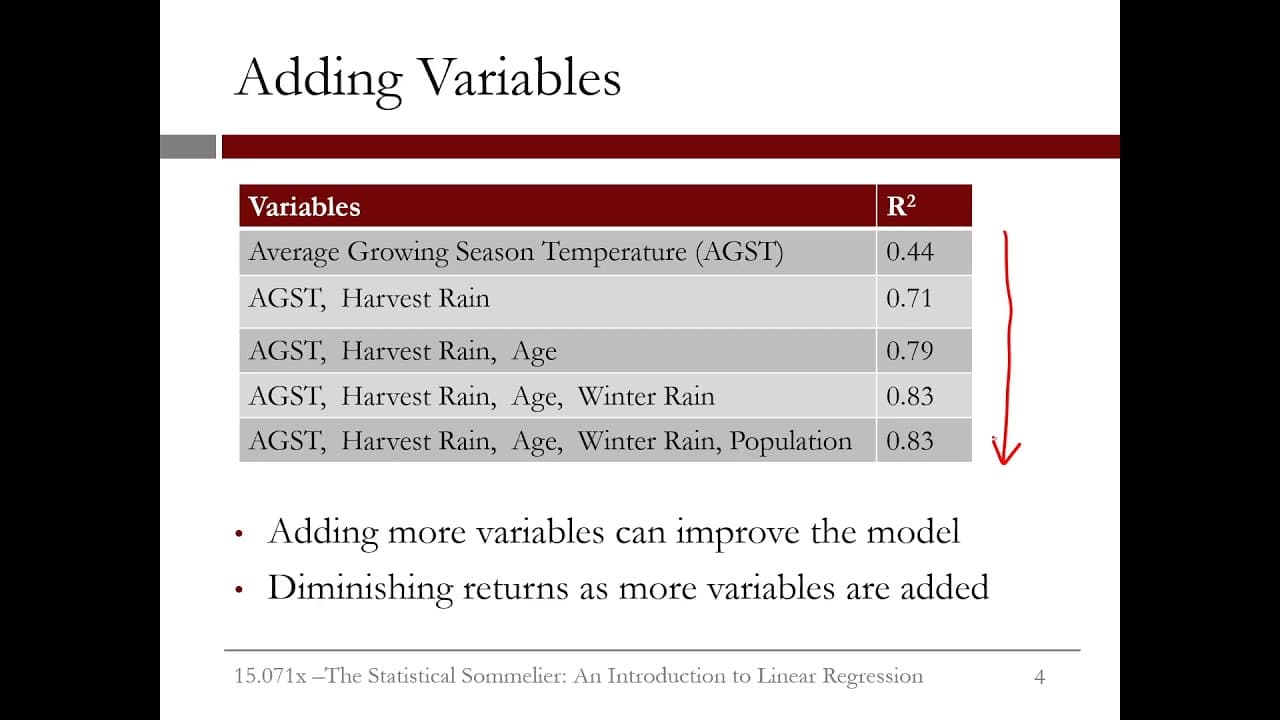
Multiple linear regression improves prediction accuracy by using several variables simultaneously, such as average growing season temperature, harvest rain, and wine age. While the model shows enhanced R-squared values, adding more variables may lead to diminishing returns and a risk of overfitting, necessitating careful variable selection.
Transcript
In the previous video, we only used one independent variable, but there are many different variables that could be used to predict wine price. We used average growing season temperature, but we also have data for other weather-related variables-- harvest rain and winter rain. Additionally, the age of wine is suspected to be important, and many othe... Read More
Key Insights
- 🍷 Average growing season temperature is the most significant variable for predicting wine price, followed by harvest rain, age of wine, and France's population.
- 🧠 Winter rain has a weak correlation with wine price, while the baseline model performs only slightly better than using winter rain as a variable.
- 🤢 Multiple linear regression allows for the use of multiple variables and can significantly improve the R squared of the model.
- 🥺 Adding more variables to the regression model leads to diminishing returns, as the marginal improvement decreases.
- 🎭 A careful selection of variables is necessary to avoid overfitting, as overly complicated models can perform well on training data but poorly on unseen data.
- ✊ The selection of variables should consider the availability of data and the trade-off between complexity and predictive power.
Install to Summarize YouTube Videos and Get Transcripts
Explore YouTube Video Summarizer or Get YouTube Transcript Extractor
Questions & Answers
Q: What variables were considered in the regression model for predicting wine price?
The variables considered include average growing season temperature, harvest rain, winter rain, age of wine, and the population of France. Each of these variables was used individually in one variable regression models.
Q: Which variable showed the highest R squared value in the one variable regression models?
The one variable regression model using average growing season temperature showed the highest R squared value of 0.44.
Q: How does multiple linear regression improve the predictability of the model?
Multiple linear regression allows the use of multiple variables simultaneously, which can capture the combined effects of these variables and improve the model's predictability.
Q: What is overfitting, and why should it be avoided?
Overfitting occurs when a model performs well on the data used to create it but performs poorly on unseen data. It should be avoided because it indicates that the model may have captured noise or idiosyncrasies specific to the training data, rather than true patterns.
Summary & Key Takeaways
-
The previous video used average growing season temperature as the only independent variable to predict wine price, but other weather-related variables like harvest rain and winter rain, as well as the age of wine and population of France, could also be used.
-
When using one variable, average growing season temperature showed the highest R squared value of 0.44, followed by harvest rain with an R squared of 0.32. France's population and age had models with an R squared around 0.2, while winter rain had a low R squared of 0.02.
-
Multiple linear regression, using multiple variables simultaneously, can improve the model's predictability, but adding more variables leads to diminishing returns and potential overfitting.
Read in Other Languages (beta)
Share This Summary 📚
Summarize YouTube Videos and Get Video Transcripts with 1-Click
Try YouTube Summary with ChatGPT & Claude or YouTube Transcript Generator
Explore More Summaries from MIT OpenCourseWare 📚


Summarize YouTube Videos and Get Video Transcripts with 1-Click
Try YouTube Summary with ChatGPT & Claude or YouTube Transcript Generator