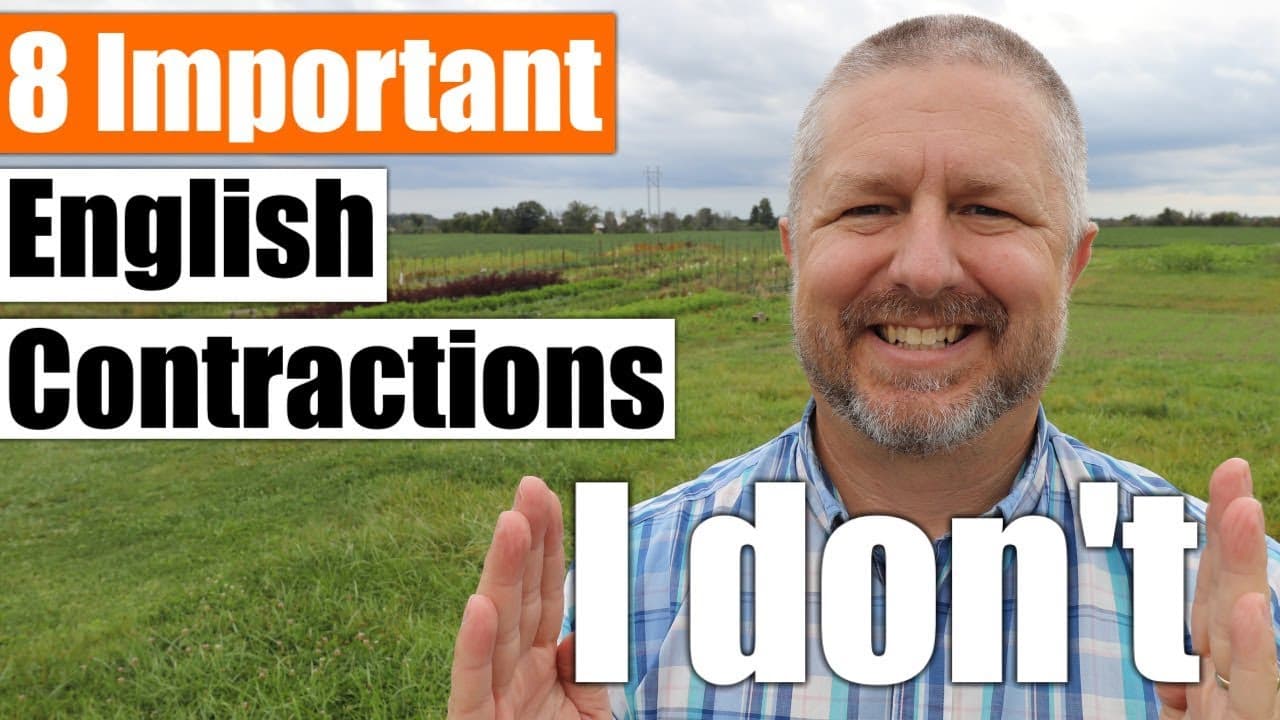
Learn How to Use Contractions to Sound Like a Native English Speaker
TL;DR
Mastering English contractions is essential for sounding like a native speaker and involves combining two words into one.
Transcript
Hi, Bob the Canadian here. Welcome to this English lesson on contractions. If you don't know what a contraction is, it's when we take two words like "do" and "not" and we combine them together into "don't". Sometimes when you're learning English, this can be a bit of a challenge, but using contractions can really help you sound like a native speake... Read More
Key Insights
- 🔇 Contractions help English learners sound more like native speakers by combining words into one.
- ❓ Common contractions include "don't," "can't," "didn't," "won't," "haven't," "wasn't," "I'm," and "I'll."
- 👂 Contractions change the tone and fluency of sentences, making them sound more natural in spoken English.
- ✍️ Contractions should be used appropriately in informal language but may not be suitable for formal writing.
- 🙊 Learning and practicing contractions is essential for mastering spoken English and improving your language fluency.
- 👂 English learners should listen to native speakers and pay attention to how contractions are used in conversations.
- 🥌 Contractions are often used interchangeably with their full word counterparts but convey a different level of formality and tone.
Install to Summarize YouTube Videos and Get Transcripts
Explore YouTube Video Summarizer or Get YouTube Transcript Extractor
Questions & Answers
Q: Why are contractions important in English?
Contractions are important because they help you sound like a native English speaker, making your speech sound more natural and fluent. They are commonly used in spoken language.
Q: How can contractions change the meaning of a sentence?
Contractions combine two or more words into one, which can change the emphasis or tone of a sentence. For example, "I will not drive over the speed limit" becomes "I won't drive over the speed limit," which sounds more casual and less formal.
Q: Can contractions be used in formal writing?
Contractions are generally avoided in formal writing, such as academic essays or professional documents. However, they are commonly used in informal writing and speech.
Q: What are some examples of contractions?
Some examples of contractions are "don't" (do not), "can't" (cannot), "didn't" (did not), "won't" (will not), "haven't" (have not), "wasn't" (was not), "I'm" (I am), and "I'll" (I will).
Summary & Key Takeaways
-
Contractions help you sound like a native English speaker and are commonly used in spoken language.
-
Common contractions include "don't" for "do not," "can't" for "cannot," "didn't" for "did not," "won't" for "will not," "haven't" for "have not," "wasn't" for "was not," "I'm" for "I am," and "I'll" for "I will."
-
Using contractions changes the tone and fluency of your English sentences.
Read in Other Languages (beta)
Share This Summary 📚
Summarize YouTube Videos and Get Video Transcripts with 1-Click
Try YouTube Summary with ChatGPT & Claude or YouTube Transcript Generator
Explore More Summaries from Learn English with Bob the Canadian 📚




Summarize YouTube Videos and Get Video Transcripts with 1-Click
Try YouTube Summary with ChatGPT & Claude or YouTube Transcript Generator