Learning to Execute
TL;DR
This video discusses using LSTMs and curriculum learning to predict Python program outputs.
Transcript
this video will explore a really interesting paper learning to execute on the power of sequence of sequence encoder/decoder long short term memory networks to predict the output of Python programs which perform addition multiplication subtraction and division with structures such as if statements are for loops in addition to an interesting problem ... Read More
Key Insights
- 🎮 The video effectively demonstrates the application of LSTM architecting through the exploration of curriculum learning in predicting Python program outputs.
- ❓ A structured approach to training through curriculum learning significantly enhances model accuracy as compared to training without a defined curriculum.
- 🛀 Different curriculum strategies provide varied levels of efficacy, with the combined curriculum showing the most promise in adapting to complex problem structures.
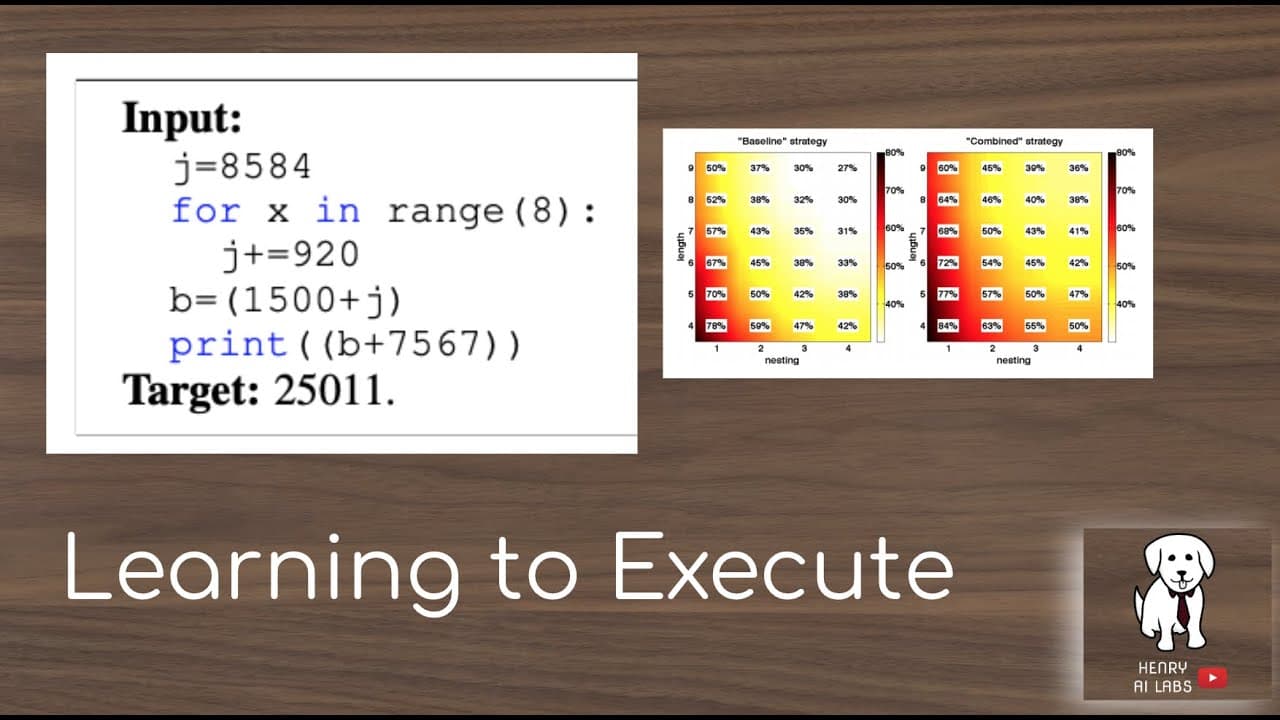
- 🦻 Visual aids, such as heatmaps, illustrate the performance differences between various strategies and help convey the research findings more effectively.
- 👨💻 Understanding character-by-character input processing reveals the intricate workings of how RNNs can model programming logic without executing code.
- 🚂 The balance between memorization and learning to generalize is critical in effectively training neural networks for predictive tasks.
- 🫨 The research highlights how neural networks can demonstrate complex behaviors akin to executing programs through predictive learning.
Install to Summarize YouTube Videos and Get Transcripts
Explore YouTube Video Summarizer or Get YouTube Transcript Extractor
Questions & Answers
Q: What is the main objective of the research presented in the video?
The primary aim of the research is to explore how sequence-to-sequence encoder/decoder LSTMs can be utilized to predict the output of Python programs without executing the code. The study specifically targets basic arithmetic operations and control structures, showcasing how neural networks can learn to replicate Python program behavior through character-by-character analysis.
Q: What are the different curriculum learning strategies discussed in the paper?
The paper discusses four main strategies: a baseline with no curriculum, naive curriculum learning which begins with easy tasks and progresses in difficulty, a mixed strategy that randomly samples difficulties, and a combined approach that synthesizes both structured progressions and random sampling. The paper shows that the combined strategy yields the best accuracy across various task complexities.
Q: How does the sequence-to-sequence framework function in this context?
In this framework, each Python program is processed by an encoder that translates the input code character by character into a hidden state, which is then used by a decoder to predict the output. The design employs LSTMs equipped with gates that manage information flow to retain essential data across longer sequences, ensuring the model captures dependencies effectively during computation.
Q: Why is curriculum learning beneficial according to the video?
Curriculum learning is beneficial because it allows the model to first grasp simpler tasks before tackling more complex ones, thereby facilitating better generalization. By using structured curricula that gradually increase in difficulty, models can leverage their entire representational capacity, improving their performance on harder examples and reducing the likelihood of memorization failures.
Q: What experimental results support the effectiveness of the curriculum learning strategies?
The experiments reveal that the combined curriculum strategy substantially outperforms both the baseline and other curriculum approaches, achieving notably higher accuracy in predicting outputs with challenging program structures. Heatmaps illustrate that under difficult nesting and length conditions, the combined method significantly increases performance, demonstrating the clear advantages of well-structured training.
Q: Can you elaborate on the hidden state allocation hypothesis mentioned in the video?
The hidden state allocation hypothesis posits that as LSTMs engage in tasks with varying digit lengths and nesting complexities, they need to restructure their memory representations. Engaging first with easier tasks allows the neural network to utilize its hidden states effectively, which promotes better performance in subsequent, more difficult tasks as the model faces more extended sequences.
Summary & Key Takeaways
-
The video focuses on a paper exploring how sequence-to-sequence LSTMs can predict outputs of Python programs performing basic arithmetic and control structures like loops and conditionals.
-
It highlights the significance of curriculum learning, demonstrating that structured training yielded better performance compared to random or unstructured approaches in a sequence-to-sequence framework.
-
The author explains various curriculum learning strategies, including a combined method that samples progressively harder problems alongside easy and hard random samples, which greatly enhances the model's accuracy.
Read in Other Languages (beta)
Share This Summary 📚
Summarize YouTube Videos and Get Video Transcripts with 1-Click
Try YouTube Summary with ChatGPT & Claude or YouTube Transcript Generator
Explore More Summaries from Connor Shorten 📚
Summarize YouTube Videos and Get Video Transcripts with 1-Click
Try YouTube Summary with ChatGPT & Claude or YouTube Transcript Generator