Rotor construction | Salient Pole & Cylindrical | Synchronous Machines | Lec-03
TL;DR
This session covers the construction of salient and cylindrical rotors in synchronous machines.
Transcript
hello everyone in this session we will discuss about the construction of the synchronous machine in the last session we already discussed about the so last week we last session we discussed about the construction of the star now in this session we will discuss about the rotar construction generally when you are looking at the construction of the ro... Read More
Key Insights
- 🕴️ Synchronous machine rotors are either salient pole or cylindrical, each suited for different operational speeds.
- 💈 Salient pole rotors utilize poles that project outward, benefiting low-speed alternator applications.
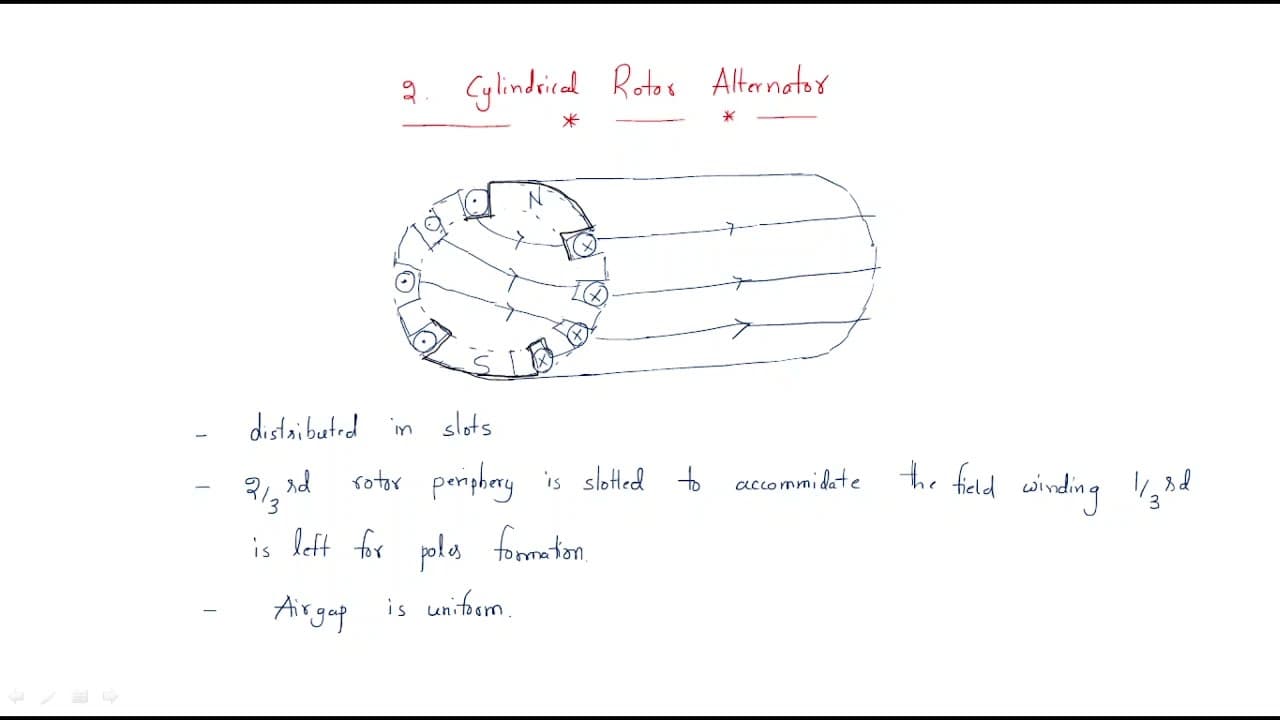
- 🚄 Uniform air gaps in cylindrical rotors contribute to operational consistency and efficiency in high-speed applications.
- 🎰 The design of rotor dimensions significantly impacts the centrifugal forces experienced during operation and overall machine performance.
- 🎨 Universities and industries often focus on these designs to meet specific energy demands and efficiency standards in electrical engineering.
- 🐻❄️ The interaction between polar and interpolar axes greatly influences magnetic flux behavior and efficiency.
- 👷 The materials used for rotor construction are critical for maintaining strength and longevity under operational stresses.
Install to Summarize YouTube Videos and Get Transcripts
Explore YouTube Video Summarizer or Get YouTube Transcript Extractor
Questions & Answers
Q: What are the two main types of rotor construction in synchronous machines?
The two main types of rotor construction are salient pole and cylindrical pole construction. Salient pole rotors feature poles that project outward and are typically used in low-speed applications, while cylindrical rotors are more uniform and suitable for high-speed applications, resulting in different designs and efficiencies.
Q: How does the air gap length vary between salient pole and cylindrical rotors?
In salient pole rotors, air gap length varies with the pole's position, being minimum at the poles and maximum in the quadrature axis. In contrast, cylindrical rotors maintain a uniform air gap throughout, which helps in achieving consistent performance and efficient operation under high-speed conditions.
Q: What is the significance of the pole axis and interpolar axis in rotor design?
The polar axis refers to the alignment of poles (north and south) in synchronous machines, while the interpolar axis is the space between these poles. Understanding these axes is crucial for analyzing magnetic flux distribution and optimizing rotor performance in generating electrical power.
Q: Why are salient pole rotors preferred in low-speed alternators?
Salient pole rotors are preferred for low-speed alternators (50 RPM to 1,000 RPM) because their design accommodates a higher number of field poles, enhancing flux generation. This makes them effective for specific applications, such as hydroelectric power generation, where low rotational speeds are common.
Q: How does the mechanical strength of cylindrical rotors improve?
The mechanical strength of cylindrical rotors is enhanced by using solid steel forgings and alloys like nickel-chromium. These materials withstand high rotational speeds and the resulting centrifugal forces, ensuring durability and reliable performance in high-speed applications, such as turbo alternators.
Q: What is the typical speed range for cylindrical rotor alternators?
Cylindrical rotor alternators generally operate within a speed range of 1,500 to 3,000 RPM for 50 Hz applications and 1,800 to 3,600 RPM for 60 Hz applications. This high-speed capability is essential for applications requiring efficient energy generation and consistent output.
Summary & Key Takeaways
-
The construction of synchronous machine rotors involves two types: salient pole and cylindrical construction, each with unique design features and applications.
-
Salient pole rotors have projected poles, and are primarily used in low-speed alternators, while cylindrical rotors are designed for high-speed applications and have uniform air gaps.
-
Understanding air gap relationships and rotor dimensions is crucial for optimizing power output and maintaining mechanical strength in synchronous machines.
Read in Other Languages (beta)
Share This Summary 📚
Summarize YouTube Videos and Get Video Transcripts with 1-Click
Try YouTube Summary with ChatGPT & Claude or YouTube Transcript Generator