What Is Memory Hierarchy and Why Is It Important?
TL;DR
Memory hierarchy optimizes data access by using cache between the CPU and main memory, significantly improving access times. It incorporates secondary storage, like hard disks, to offer non-volatile, high-capacity options, while virtual memory systems efficiently manage data movement. Effective strategies, such as high associativity and write-back policies, minimize costly access to secondary storage.
Transcript
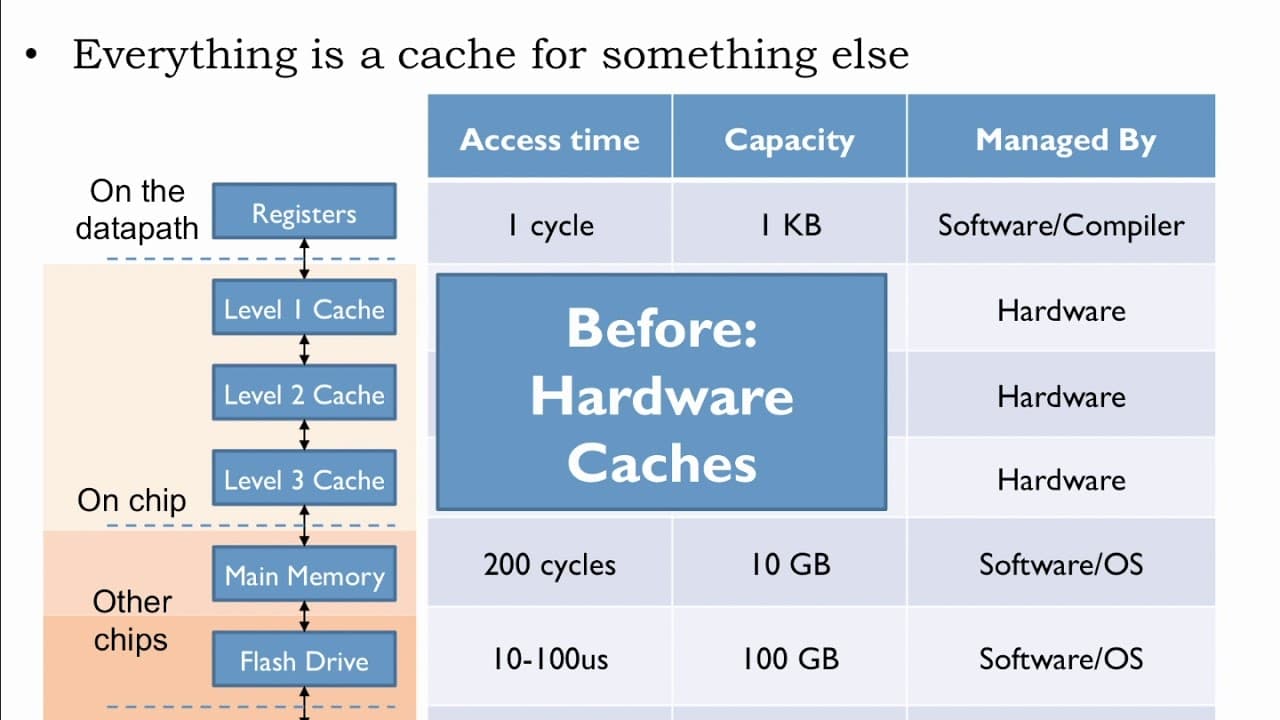
In this lecture we return to the memory system that we last discussed in Lecture 14 of Part 2. There we learned about the fundamental tradeoff in current memory technologies: as the memory's capacity increases, so does it access time. It takes some architectural cleverness to build a memory system that has a large capacity and a small average acces... Read More
Key Insights
- ♿ Caches in the memory hierarchy improve access time by storing frequently accessed memory locations.
- ✋ Secondary storage, such as hard disks, provides high-capacity storage but has much longer access times compared to main memory.
- 💽 Virtual memory systems automatically move data between secondary and primary storage to minimize disk access.
- ✋ High associativity, large block size, and write-back strategies are essential for optimizing the virtual memory system.
- 💩 Memory management in hardware handles hits, while misses are managed in software.
- 🎮 The organization of main memory and accesses to secondary storage can be controlled through software.
- 🏃 Virtual memory systems are crucial for securely running multiple programs on a single CPU.
Install to Summarize YouTube Videos and Get Transcripts
Explore YouTube Video Summarizer or Get YouTube Transcript Extractor
Questions & Answers
Q: What is the role of cache in the memory hierarchy?
Cache acts as a hardware subsystem between the CPU and main memory, providing fast access to frequently accessed memory locations. It reduces the average access time by storing a small number of memory locations.
Q: How does the principle of locality help caches work effectively?
The principle of locality suggests that if the CPU accesses a memory location, it is likely to access nearby locations in the future. Caches are organized to hold nearby locations simultaneously, using associative addressing to quickly find matching addresses.
Q: How does secondary storage differ from main memory in terms of capacity and access time?
Secondary storage, like hard disks, has a much larger capacity than main memory but significantly longer access times. The access time difference between the first word and successive words on a disk is even more dramatic.
Q: Why is a low miss rate crucial in the virtual memory system?
With the substantial penalty of accessing secondary storage, a low miss rate is necessary to minimize the average memory access time. A cache miss requires accessing disk, resulting in a longer latency.
Summary & Key Takeaways
-
Memory hierarchy involves the use of cache to improve access time between the CPU and main memory.
-
Caches store frequently accessed memory locations, and their contents are managed automatically.
-
Secondary storage, such as hard disks, provides high-capacity storage that is non-volatile, and a virtual memory system is used to efficiently move data between secondary and primary storage.
Read in Other Languages (beta)
Share This Summary 📚
Summarize YouTube Videos and Get Video Transcripts with 1-Click
Try YouTube Summary with ChatGPT & Claude or YouTube Transcript Generator
Explore More Summaries from MIT OpenCourseWare 📚


Summarize YouTube Videos and Get Video Transcripts with 1-Click
Try YouTube Summary with ChatGPT & Claude or YouTube Transcript Generator