What Is Nutation in Gyroscopes and Its Effects?
TL;DR
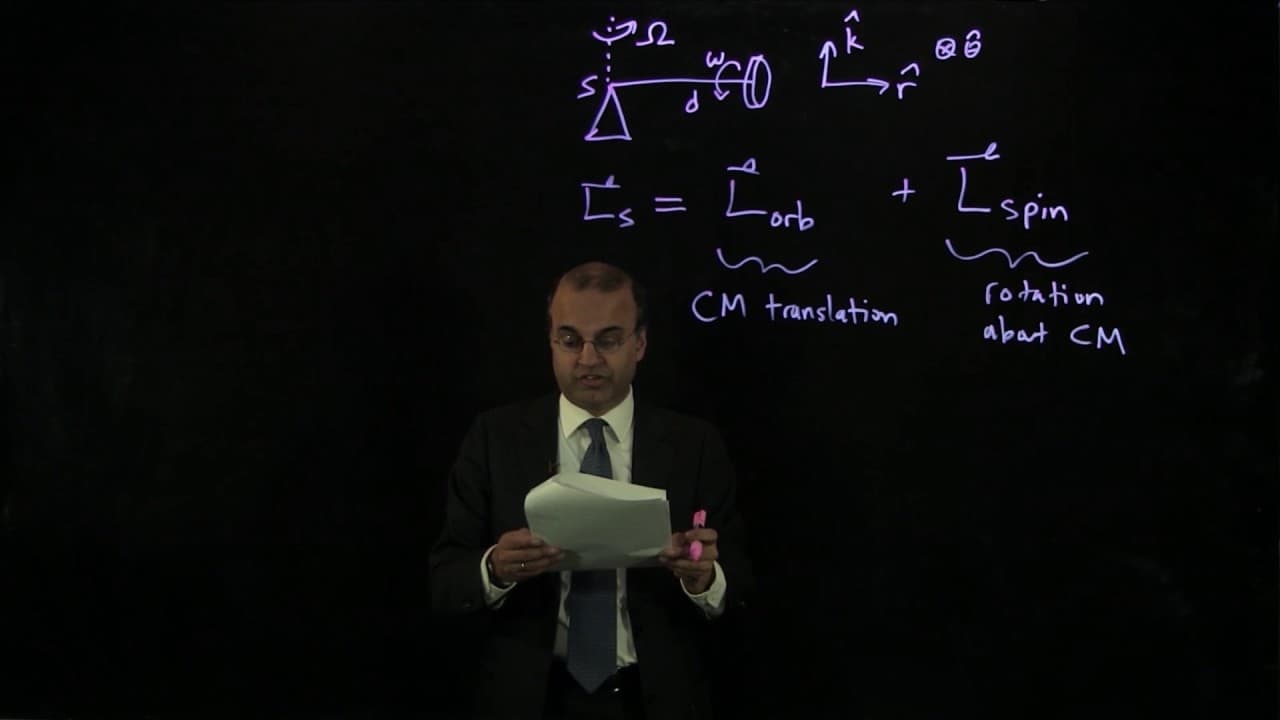
Nutation in gyroscopes refers to the small nodding motion during steady uniform precession, caused by a torque when the gyroscope is released. This motion decays quickly due to friction at the pivot, but it contributes to the overall angular momentum, which consists of both spin and orbital components. Angular momentum is conserved, and the effects of nutation are more pronounced in frictionless conditions.
Transcript
Now, we've been discussing steady uniform precession, which is the simplest possible case of a phenomenon that can be much more complicated. As an example and the case we've been discussing so far where we release a gyroscope from rest when it's horizontal, very careful measurements would show that the initial motion isn't just steady precession bu... Read More
Key Insights
- 😥 Gyroscopes experience nutation, a nodding motion, which decays quickly due to friction at the pivot point.
- 🤠 A torque in the theta hat direction causes the gyroscope's angular momentum vector to rotate.
- 👈 The gyroscope's center of mass motion contributes a component of angular momentum pointing in the k hat direction.
- 🔺 The small dip angle of the gyroscope balances the angular momentum due to the center of mass motion.
- 📐 Angular momentum is conserved in a gyroscope, with the larger spin angular velocity resulting in a smaller dip angle.
- 📐 The total angular momentum of the gyroscope consists of orbital and spin angular momentum components.
- 🍉 The gyroscopic approximation assumes that the rotating term dominates the angular momentum equation.
Install to Summarize YouTube Videos and Get Transcripts
Explore YouTube Video Summarizer or Get YouTube Transcript Extractor
Questions & Answers
Q: What is nutation in a gyroscope?
Nutation is the nodding motion observed in a gyroscope during steady precession, which decays rapidly due to friction at the pivot point.
Q: Why does the gyroscope have an additional angular momentum in the k hat direction?
The gyroscope's dip angle, caused by a small initial downward dip, contributes a negative component of the spin angular momentum to balance the z-axis angular momentum due to the center of mass motion.
Q: How does the gyroscope maintain conservation of angular momentum?
The total angular momentum of the gyroscope is the sum of orbital (due to translational motion of the center of mass) and spin (due to rotation about the center of mass) angular momentum components.
Q: What is the gyroscopic approximation?
The gyroscopic approximation states that the rotating term dominates over the other two terms in the angular momentum equation, indicating that the spin angular velocity is much larger than the angular speed of precession.
Summary & Key Takeaways
-
Gyroscopes in steady uniform precession exhibit nutation, or a nodding motion, which decays quickly due to friction at the pivot point.
-
When released from rest, the gyroscope experiences a torque in the theta hat direction, causing the angular momentum vector to rotate.
-
The gyroscope's center of mass orbits around the z-axis, resulting in a component of angular momentum pointing in the k hat direction.
Read in Other Languages (beta)
Share This Summary 📚
Summarize YouTube Videos and Get Video Transcripts with 1-Click
Try YouTube Summary with ChatGPT & Claude or YouTube Transcript Generator
Explore More Summaries from MIT OpenCourseWare 📚


Summarize YouTube Videos and Get Video Transcripts with 1-Click
Try YouTube Summary with ChatGPT & Claude or YouTube Transcript Generator