Clippers | Transistor | Wave forms | Pulse Digital Circuits | Lec-31
TL;DR
This video covers how transistor clippers function to clip input signals on both positive and negative sides.
Transcript
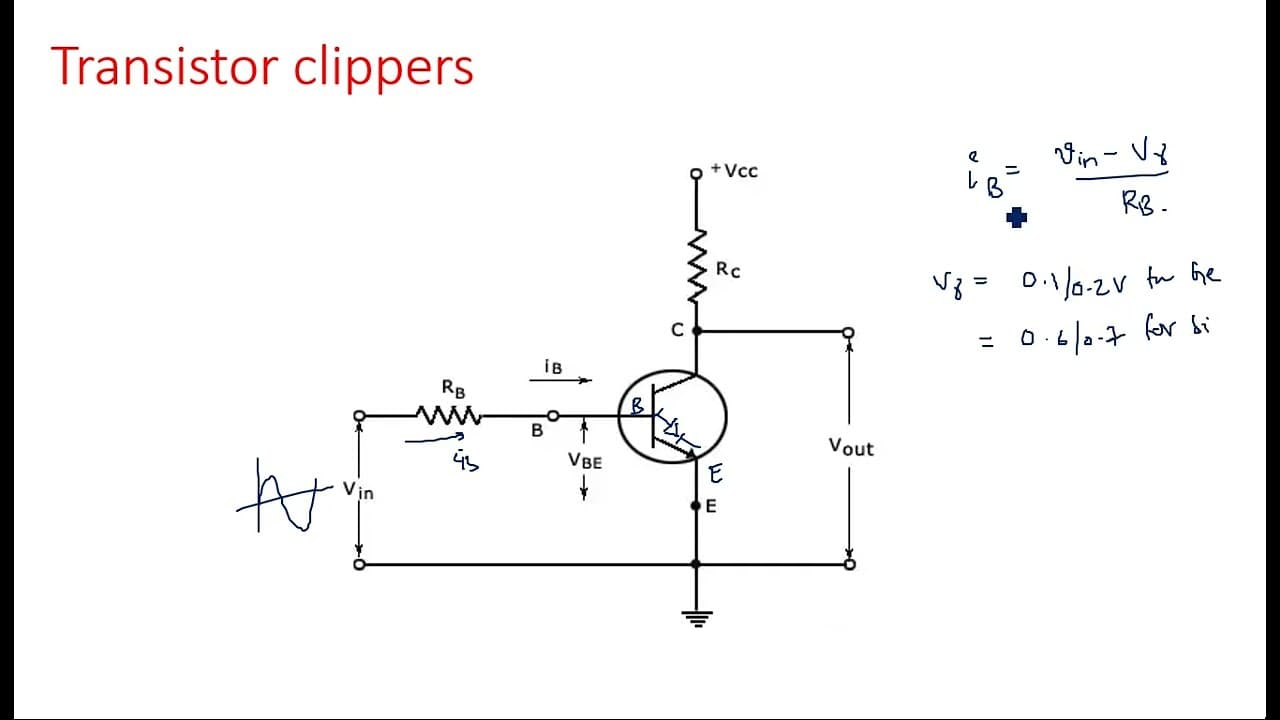
hi everyone so in this video you are going to learn about transistor Clippers previously you have explained about non-linear Clippers which are made up of diodes series type Clippers shunt type flippers and also we have seen noisy Clippers which are made up of diodes itself now transistor Clippers so in a non-linear device used to clip the portion ... Read More
Key Insights
- 📡 Transistor clippers provide a versatile option for signal modulation, enabling clipping on both positive and negative signal peaks effectively.
- 👻 The common emitter configuration is pivotal for integrating input and output voltages, allowing for efficient signal manipulation in clippers.
- 😥 Proper positioning of the Q point is essential for optimal clipping behavior; an incorrect Q point can lead to unwanted distortion in output signals.
- ⚡ Understanding the cutting voltage is important for defining the operational limits of the transistor, impacting the clipped output waveforms.
- 📶 Moderate input signal strengths can avoid excessive clipping, ensuring that important signal details remain intact without distortion.
- 👻 The phase inversion characteristic of transistors allows them to act as inverters in clipper applications, providing an additional dimension of signal processing.
- 🎨 Knowledge of circuit components like the RB resistor is crucial for designing reliable clipping circuits that maintain transistor performance.
Install to Summarize YouTube Videos and Get Transcripts
Explore YouTube Video Summarizer or Get YouTube Transcript Extractor
Questions & Answers
Q: What are transistor clippers used for?
Transistor clippers are used to modify signals by cutting off portions of the input waveform. They can clip both positive and negative amplitudes of sinusoidal signals, allowing for controlled signal shaping which is crucial in various electronic applications.
Q: How does the common emitter configuration work in a transistor clipper?
In a common emitter configuration, the emitter terminal is common to both the input and output. The input signal is applied between the base and emitter of the transistor, while the output voltage is collected across the collector and emitter, influencing the clipping behavior based on the input characteristics.
Q: What is the importance of the Q point in transistor circuits?
The Q point (quiescent point) determines biasing in transistor circuits, affecting the clipping action. If not positioned correctly, clipping may occur excessively or insufficiently, which can alter the expected output waveform, making it critical for the desired functioning of clippers.
Q: What happens when the input signal exceeds the maximum limit in a transistor clipper?
When the input signal exceeds the maximum limit, the transistor enters saturation, causing the output signal to clip at its maximum or minimum values. This limits the output waveform disproportionate to the input, resulting in a distorted signal which is a characteristic of clipping.
Q: How does the cutting voltage affect the transistor's performance as a clipper?
The cutting voltage, or Vbe, is the minimum voltage required to turn on the transistor. It determines when the transistor switches from the off state to the on state, influencing the clipping threshold for the input signal. A higher cutting voltage can result in a greater portion of the input signal being clipped.
Q: Can you explain the relationship between input and output waveforms in a transistor clipper?
In a transistor clipper, there is often a phase shift of 180 degrees between the input and output waveforms. While positive peaks on the input lead to certain negative output values, negative input peaks result in the corresponding positive output peaks due to the transistor's amplification and inversion properties.
Q: What role does the input resistor play in the transistor clipping circuit?
The input resistor, RB, serves as a current-limiting component that helps ensure safe current levels to the base of the transistor. It is crucial for stabilizing the transistor's operation and preventing excess current which could lead to saturation or damage.
Q: What is the next topic of discussion mentioned in the video?
The video hints at a forthcoming explanation of emitter-coupled clippers, a specific type of configuration often used in transistor clippers, which will further explore their functionality and applications in electronic circuits.
Summary & Key Takeaways
-
The video introduces transistor clippers as devices that utilize transistor configurations to clip portions of sinusoidal signals, similar to diode clippers but capable of clipping on both sides.
-
A detailed explanation of the common emitter configuration of transistors is provided, describing how input and output voltages interact, including details about biasing supply and base-emitter junction characteristics.
-
The discussion includes the significance of the Q point in transistor clipping action, outlining how varying input signals can affect output waveforms and describe how transistors can function as inverters.
Read in Other Languages (beta)
Share This Summary 📚
Summarize YouTube Videos and Get Video Transcripts with 1-Click
Try YouTube Summary with ChatGPT & Claude or YouTube Transcript Generator