6.2.1 Finite State Machines
TL;DR
This content introduces the concept of sequential logic and finite state machines, explaining their components and design considerations.
Transcript
In the last chapter we developed sequential logic, which contains both combinational logic and memory components. The combinational logic cloud is an acyclic graph of components that obeys the static discipline. The static discipline guarantees if we supply valid and stable digital inputs, then we will get valid and stable digital outputs by some s... Read More
Key Insights
- 🔠 Sequential logic combines combinational logic and memory components to process input sequences and generate outputs.
- 🏪 State registers store the current state of the sequential logic, which influences its operation.
- 🎰 Finite state machines (FSMs) are used to describe the behavior of sequential systems, with inputs, outputs, and transition rules between states.
- 🔢 Designing an FSM involves determining the required number of states and making tradeoffs regarding inputs and outputs.
- 🫦 Bit-serial inputs and outputs can reduce signaling hardware but introduce sequential transmission delays.
- 👻 FSMs allow for designing complex sequential systems independently of their implementation details.
Install to Summarize YouTube Videos and Get Transcripts
Explore YouTube Video Summarizer or Get YouTube Transcript Extractor
Questions & Answers
Q: What is the purpose of state registers in sequential logic?
State registers remember the current state of the sequential logic and capture the relevant history of the input sequence. They are updated by the combinational logic and store information that influences the operation of the sequential logic.
Q: How do designers determine the required number of states in an FSM?
Designers consider the tradeoff between the number of state bits and the complexity of the internal combinational logic. They need to balance the need for sufficient states to capture different behaviors with the desire for a simpler implementation.
Q: What are the considerations when choosing inputs for an FSM?
Designers need to decide between having multiple inputs delivered simultaneously or using bit-serial inputs where information arrives sequentially. Bit-serial inputs can reduce the signaling hardware but increase the time required to transmit the information.
Q: Can the outputs of an FSM depend on both the current state and the inputs?
Yes, in general, the outputs of an FSM can be a function of both the current state and the current inputs. However, it is often simpler if the outputs are strictly determined by the current state.
Summary & Key Takeaways
-
Sequential logic consists of combinational logic and memory components. Combinational logic generates stable digital outputs based on valid inputs, while state registers store the current state of the sequential logic.
-
Designers of sequential logic systems need to determine the desired output sequences, develop a functional specification, and create a circuit diagram.
-
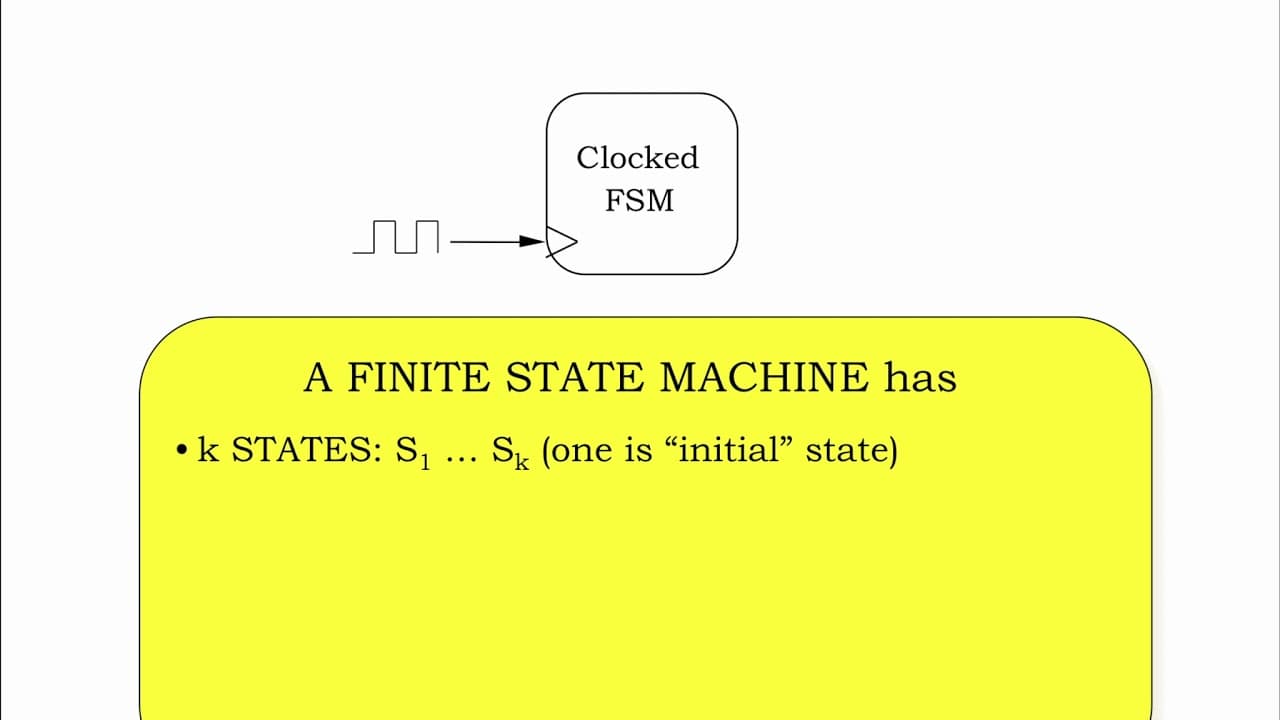
Finite state machines (FSMs) are used to describe the behavior of sequential systems. FSMs have a clock input, fixed number of states, inputs, and outputs. Designing an FSM involves choosing the number of states and input/output encoding.
Read in Other Languages (beta)
Share This Summary 📚
Summarize YouTube Videos and Get Video Transcripts with 1-Click
Try YouTube Summary with ChatGPT & Claude or YouTube Transcript Generator
Explore More Summaries from MIT OpenCourseWare 📚


Summarize YouTube Videos and Get Video Transcripts with 1-Click
Try YouTube Summary with ChatGPT & Claude or YouTube Transcript Generator