When Do Single-Vertex Crease Patterns Fold Flat?
TL;DR
A single-vertex crease pattern folds flat when the sum of the odd angles equals the sum of the even angles, also known as Kawasaki's condition. At least one fold is necessary for folding a circle onto a line, assuming the pattern originated from a flat sheet of paper. Understanding these principles is essential for assessing flat foldability in geometry.
Transcript
PROFESSOR: Today, we are talking about the local behavior of a crease pattern. So you take some crease pattern for some flat folding-- we're thinking about flat foldability. This is a foldability question. I give you a crease pattern like this. I want to know, does it fold flat, like this one does. And we're studying what happens locally right arou... Read More
Key Insights
- 🍹 The sum of the odd angles in a crease pattern must be equal to the sum of the even angles for it to fold flat.
- 🙏 Folding a circle onto a line requires at least one fold and assumes that the crease pattern came from a flat piece of paper.
Install to Summarize YouTube Videos and Get Transcripts
Explore YouTube Video Summarizer or Get YouTube Transcript Extractor
Questions & Answers
Q: Is a single-vertex crease pattern always flat foldable?
No. Sometimes these patterns fold flat and sometimes they do not. Whether a given single-vertex pattern folds flat depends on the sum of the odd angles being equal to the sum of the even angles.
Q: What is a single-vertex crease pattern?
It is a disk-shaped or small region around a single vertex with n creases emanating from it. The pattern is defined by a sequence of angles, theta 1 up to theta n, measured between consecutive creases in clockwise order.
Q: What condition makes a single-vertex crease pattern fold flat?
The pattern must satisfy Kawasaki's condition: the sum of the odd angles equals the sum of the even angles. When this balance holds, the vertex can fold flat.
Q: Why must you make at least one fold to fold a circle onto a line?
A flat folding of a disk folds its boundary circle onto a portion of the circle, which you can then unroll onto a straight line. An unfolded full circle occupies the whole circle and cannot be unrolled, so at least one fold is needed to collapse it into a portion that unrolls onto a line.
Q: What does it mean that the crease pattern came from flat paper?
It means the sum of the angles around the vertex is 360 degrees, exactly as in a flat sheet of paper. This assumption is used when reasoning about a flat crease pattern one vertex at a time.
Q: What is a convex cone in single-vertex crease patterns?
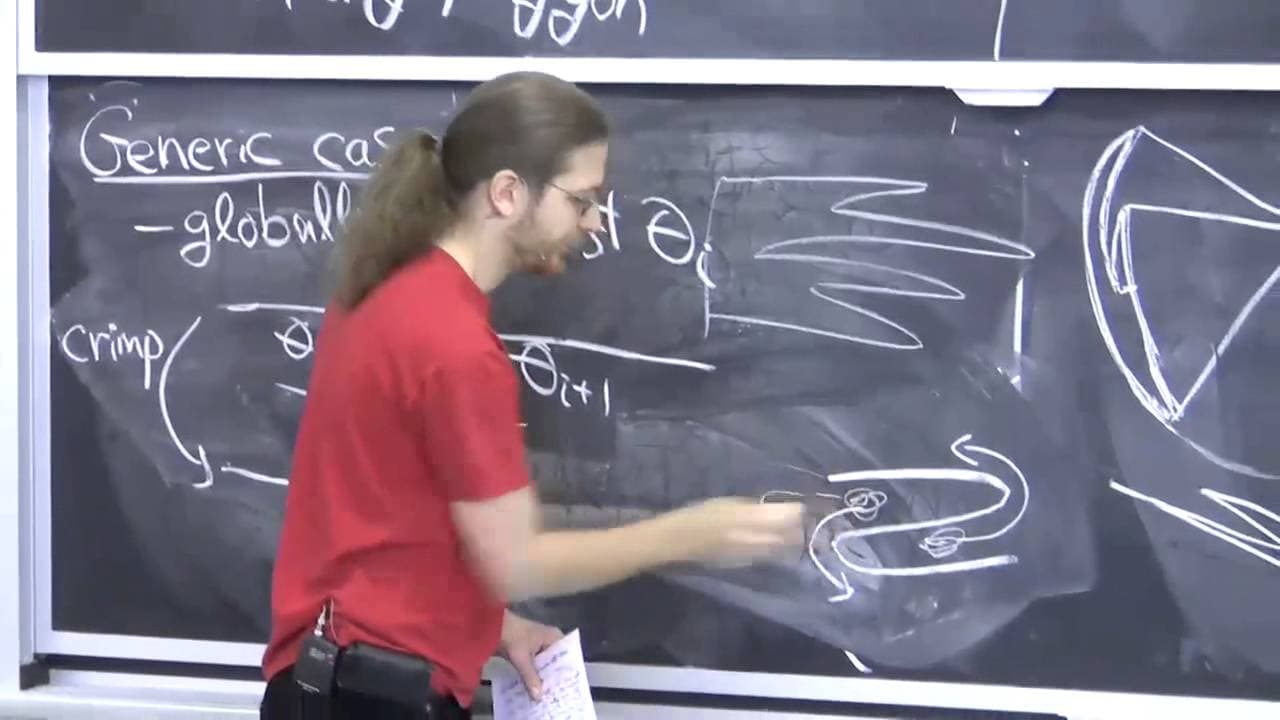
A convex cone relaxes the flat-paper constraint so the angles sum to 360 degrees or less. For example, folding a crimp on two bottom creases can leave two angles of 135 degrees each, for a total of 270 degrees, which is less than 360.
Q: What are vertices and faces in a crease pattern?
Vertices are the corners where all the edges (creases) come together. Faces are the regions, such as triangles, that the creases divide the paper into.
Q: How does single-vertex flat folding relate to folding a circle onto a line?
A flat folding of the disk maps its boundary circle onto a circle, and unrolling that gives a folding of the circle onto a line. This is a step up from folding one-dimensional line segments onto a line, using the same mindset but with different topology, so some earlier one-dimensional results do not carry over.
Summary & Key Takeaways
-
Crease patterns consist of vertices (corners) and faces (regions divided by creases).
-
Single vertex crease patterns can fold flat if the sum of the odd angles is equal to the sum of the even angles.
-
Folding a circle onto a line requires at least one fold and assumes that the crease pattern came from a flat piece of paper.
Read in Other Languages (beta)
Share This Summary 📚
Summarize YouTube Videos and Get Video Transcripts with 1-Click
Try YouTube Summary with ChatGPT & Claude or YouTube Transcript Generator
Explore More Summaries from MIT OpenCourseWare 📚


Summarize YouTube Videos and Get Video Transcripts with 1-Click
Try YouTube Summary with ChatGPT & Claude or YouTube Transcript Generator