Demonstrations of Deep Learning
TL;DR
Deep learning tools and data are becoming more accessible and user-friendly.
Transcript
demonstrations of deep learning inspire our creativity and help us understand where we're really at with deep learning such as the strengths and weaknesses of these systems traditionally sharing deep learning systems at large scale required serious software engineering skills but there's a very exciting trend in overcoming bottlenecks to deployment... Read More
Key Insights
- 👤 The trend towards enhanced user-friendliness in deploying deep learning models is reshaping the landscape of AI applications.
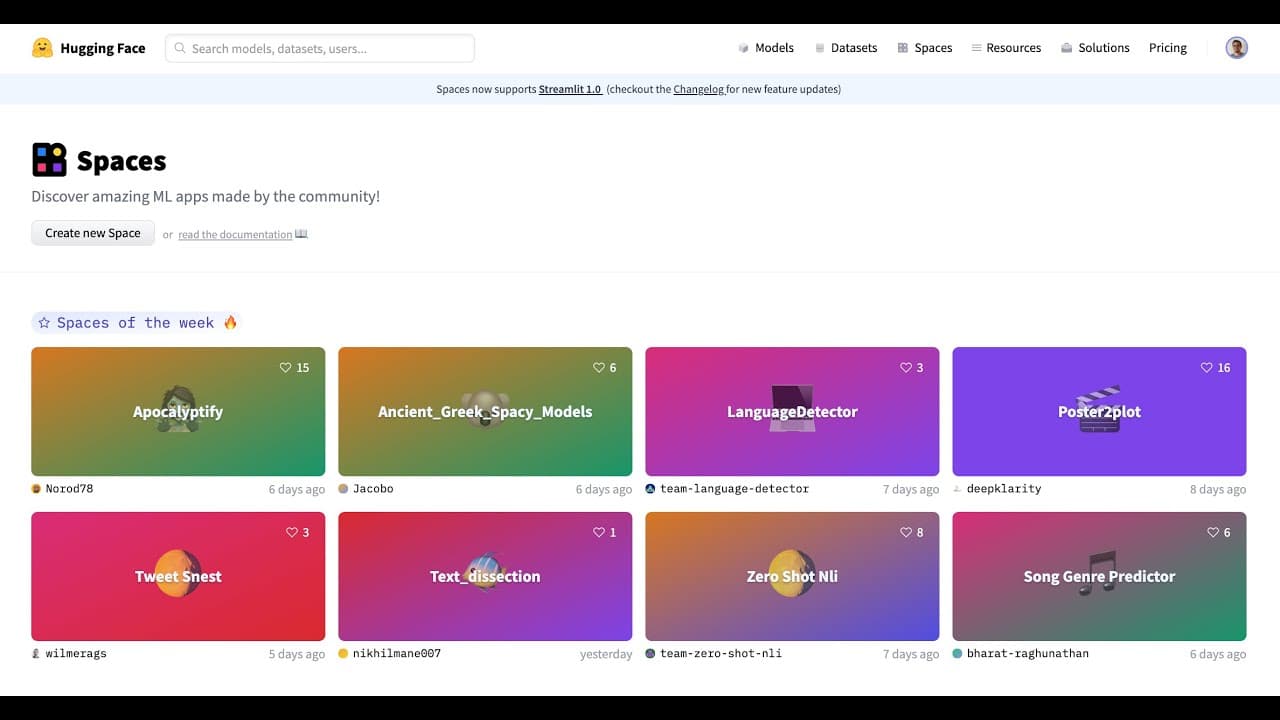
- 👻 Hugging Face Spaces exemplify the shift towards easily shareable models, allowing users to interact with various applications effortlessly.
- 👨🔬 Online repositories like Kaggle are crucial in providing datasets, fostering an inclusive environment for innovation in deep learning research.
- 👋 The Papers with Code platform serves as a bridge between academic research and practical implementations, highlighting the best performing models.
- 😒 Weaviate’s use of vector embeddings represents a significant advancement in search technologies, allowing for sophisticated querying and data retrieval.
- 👨💻 The development of tools that require minimal coding knowledge, like Gradio and Streamlit, democratizes AI by making it accessible to a broader audience.
- 🤗 Increasing collaboration through open-access data sharing is reshaping how deep learning projects are developed and implemented in real-world scenarios.
Install to Summarize YouTube Videos and Get Transcripts
Explore YouTube Video Summarizer or Get YouTube Transcript Extractor
Questions & Answers
Q: What are Hugging Face Spaces and how do they enhance deep learning model sharing?
Hugging Face Spaces provide an innovative platform where users can easily upload and share deep learning models. By utilizing frameworks like Streamlit and Gradio, it allows for instant web demos of these models, eliminating the need for users to download model weights and create their own applications. This significantly improves model accessibility and interactivity.
Q: Why is dataset accessibility important in deep learning development?
Accessible datasets are critical as they empower developers, researchers, and students to experiment and build deep learning models. Platforms like Kaggle and UCI Machine Learning Repository provide a variety of datasets, enabling users to learn and innovate without struggling to find data. This accessibility fosters creativity and accelerates advancements in machine learning research.
Q: How does the Weaviate search engine utilize deep learning?
Weaviate employs deep learning to transform objects into continuous vector embeddings, enabling efficient nearest neighbor searches. By using algorithms that calculate distances between these embeddings, it retrieves relevant information quickly. Moreover, it supports semantic search through knowledge graphs, enhancing search capabilities through advanced data structuring.
Q: What role do platforms like Papers with Code play in the deep learning community?
Platforms like Papers with Code are instrumental in organizing and indexing deep learning research outputs. They provide a curated collection of datasets used in publications, along with benchmark performance tracking for new models. This helps developers stay updated on state-of-the-art results and facilitates better model training and comparisons.
Summary & Key Takeaways
-
The content discusses the growing accessibility of deep learning tools, showcasing platforms like Hugging Face Spaces, which allow easy sharing and interaction with deep learning models through web applications.
-
It highlights the trend of enhancing data accessibility through repositories like Kaggle and Papers with Code, making it easier for developers to find and utilize relevant datasets and methodologies.
-
The content concludes by introducing Weaviate, a vector search engine that leverages deep learning embeddings to facilitate powerful search functionalities, enabling users to explore vast data efficiently.
Read in Other Languages (beta)
Share This Summary 📚
Summarize YouTube Videos and Get Video Transcripts with 1-Click
Try YouTube Summary with ChatGPT & Claude or YouTube Transcript Generator
Explore More Summaries from Connor Shorten 📚
Summarize YouTube Videos and Get Video Transcripts with 1-Click
Try YouTube Summary with ChatGPT & Claude or YouTube Transcript Generator