20.2.2 Wires
TL;DR
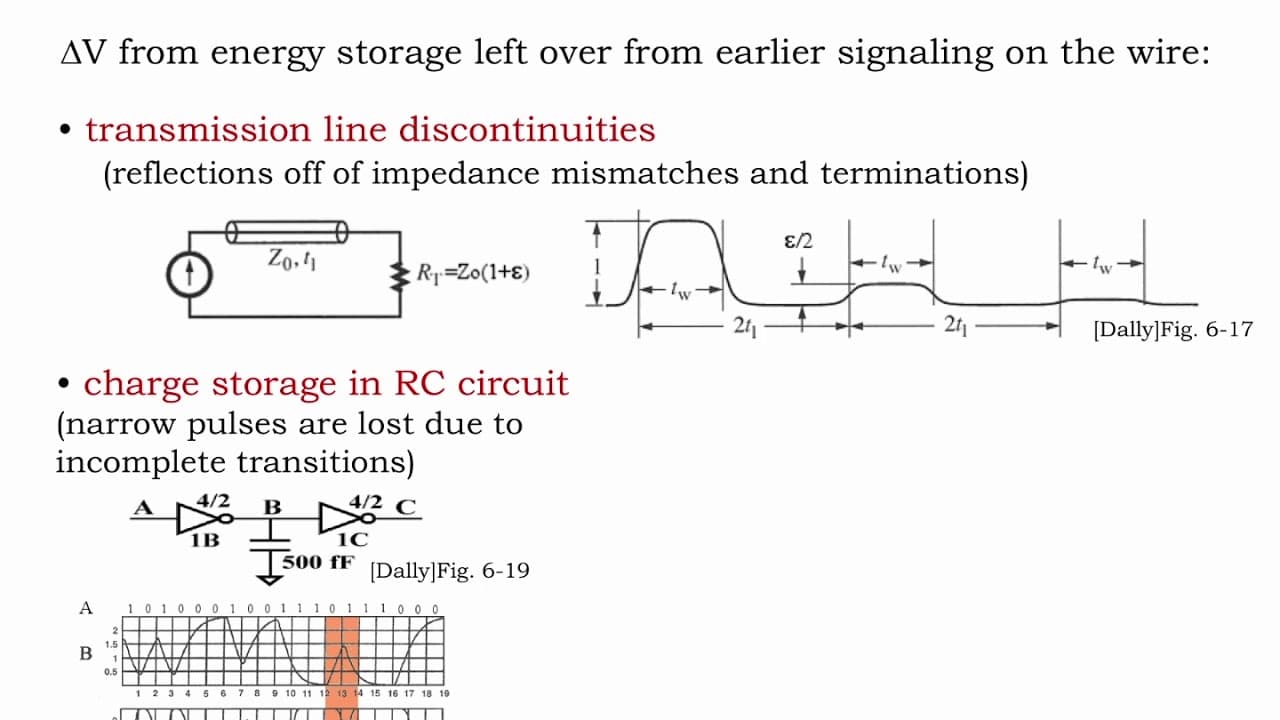
Signal wires are not just simple logic circuits; they are transmission lines that require careful design to minimize energy storage effects and ensure optimal performance.
Transcript
So, how hard can it be to build a communication channel? Aren't they just logic circuits with a long wire that runs from one component to another? A circuit theorist would tell you that wires in a schematic diagram are intended to represent the equipotential nodes of the circuit, which are used to connect component terminals. In this simple model, ... Read More
Key Insights
- 🫥 Signal wires are not simply logic circuits; they are transmission lines with various parameters like resistance, inductance, capacitance, and conductance.
- 🚄 The distance between components becomes crucial for accurate prediction of circuit performance, especially in high-speed signaling.
- 📡 Termination of signal wires with matching resistance helps prevent echoes and reflections, ensuring reliable transmission.
- 📡 Energy storage effects, impedance discontinuities, and insufficient time for signals to settle can degrade circuit performance and require careful engineering of signal wires.
- 🐎 Circuit optimization often involves identifying heavily-loaded wires and redesigning them to improve their speed.
Install to Summarize YouTube Videos and Get Transcripts
Explore YouTube Video Summarizer or Get YouTube Transcript Extractor
Questions & Answers
Q: How do wires in circuit diagrams differ from real-world wires?
In circuit diagrams, wires represent equipotential nodes for component connections, while real-world wires act as transmission lines with resistance, inductance, capacitance, and conductance.
Q: Why is the distance between components important for high-speed signaling?
As circuit speeds increase, distances between components become critical due to the finite propagation time of voltage changes along wires. Accurate prediction of circuit performance requires accounting for this distance.
Q: How can echoes and reflections in signal wires be prevented?
Echoes and reflections can be prevented by terminating the wire with a resistance to ground that matches the characteristic impedance of the transmission line. Termination at both ends may be needed for bidirectional signals.
Q: What are the consequences of poor engineering of signal wires?
Poorly designed signal wires can lead to energy storage effects, causing corruption of current transmissions. Reflections from impedance discontinuities and insufficient time for signals to reach valid logic levels are common problems.
Summary & Key Takeaways
-
Signal wires in circuit diagrams represent equipotential nodes that connect components, but in reality, they are transmission lines that have resistance, inductance, capacitance, and conductance.
-
For high-speed signaling, wires must be treated as transmission lines with finite propagation time, and the distance between components becomes critical for accurate performance prediction.
-
Proper termination of wires with matching resistance to ground is necessary to prevent echoes and reflections, which can corrupt signal transmissions.
Read in Other Languages (beta)
Share This Summary 📚
Summarize YouTube Videos and Get Video Transcripts with 1-Click
Try YouTube Summary with ChatGPT & Claude or YouTube Transcript Generator
Explore More Summaries from MIT OpenCourseWare 📚


Summarize YouTube Videos and Get Video Transcripts with 1-Click
Try YouTube Summary with ChatGPT & Claude or YouTube Transcript Generator