20. Cell Signaling 1 – Overview
TL;DR
Protein signaling involves specific signals binding to receptors on the cell surface, triggering a response inside the cell.
Transcript
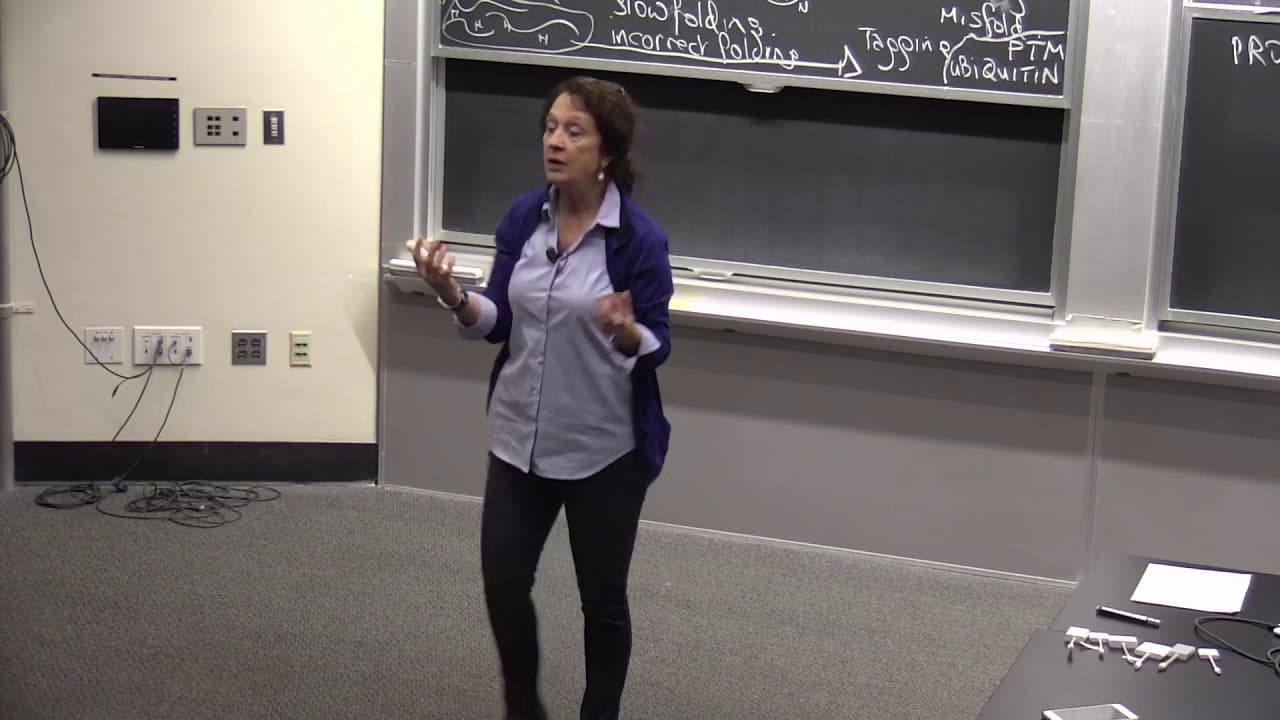
BARBARA IMPERIALI: Now, I want to talk today about one small thing before we move on to signaling, because it really kind of completes the work that we talked about with respect to trafficking. So I popped this question up last time, and it seemed like there weren't quite enough sort of people leaping to give me an answer. But let's just take a loo... Read More
Key Insights
- 📡 Protein signaling involves specific signals binding to receptors on the cell surface, triggering a response inside the cell.
- 💨 Signals can be small molecules, proteins, or carbohydrates, and they can act in different ways depending on their origin and location.
- 🧑🤝🧑 The most common types of receptors involved in protein signaling are G protein-coupled receptors (GPCRs) and receptor tyrosine kinases.
- 📡 GPCRs have a 7 transmembrane helix structure and can activate intracellular signaling pathways.
- 🥺 Receptor tyrosine kinases are dimeric proteins that are activated by ligands, leading to intracellular signaling.
- 🧡 Protein signaling is involved in a wide range of cellular processes, including cell division, metabolism, and gene regulation.
Install to Summarize YouTube Videos and Get Transcripts
Explore YouTube Video Summarizer or Get YouTube Transcript Extractor
Questions & Answers
Q: What is protein signaling?
Protein signaling is a process in which specific signals bind to receptors on the cell surface, triggering a response inside the cell.
Q: What are the different types of signals?
Signals can be small molecules, proteins, or carbohydrates, and they can be autocrine (self-signaling), paracrine (nearby cells), endocrine (from a distance), or juxtacrine (cells in contact).
Q: What are the most common types of receptors involved in protein signaling?
The most common types of receptors are G protein-coupled receptors (GPCRs) and receptor tyrosine kinases, which are found on the cell surface.
Q: How do GPCRs work?
GPCRs have a 7 transmembrane helix structure and are activated when a signal molecule binds to the receptor on the cell surface. This triggers a signaling cascade inside the cell.
Q: What is the role of receptor tyrosine kinases?
Receptor tyrosine kinases are dimeric proteins that are activated by ligands. When the ligand binds to the receptor, it causes dimerization and initiates intracellular signaling.
Summary & Key Takeaways
-
Protein signaling involves the specific binding of signals to receptors on the cell surface, which triggers a response inside the cell.
-
Signals can take different forms such as small molecules, proteins, and carbohydrates, and they can be autocrine, paracrine, endocrine, or juxtacrine.
-
Receptors can be intracellular or cell surface receptors, with the most common types being G protein-coupled receptors (GPCRs) and receptor tyrosine kinases.
Read in Other Languages (beta)
Share This Summary 📚
Summarize YouTube Videos and Get Video Transcripts with 1-Click
Try YouTube Summary with ChatGPT & Claude or YouTube Transcript Generator
Explore More Summaries from MIT OpenCourseWare 📚


Summarize YouTube Videos and Get Video Transcripts with 1-Click
Try YouTube Summary with ChatGPT & Claude or YouTube Transcript Generator