Dubnium - Periodic Table of Videos
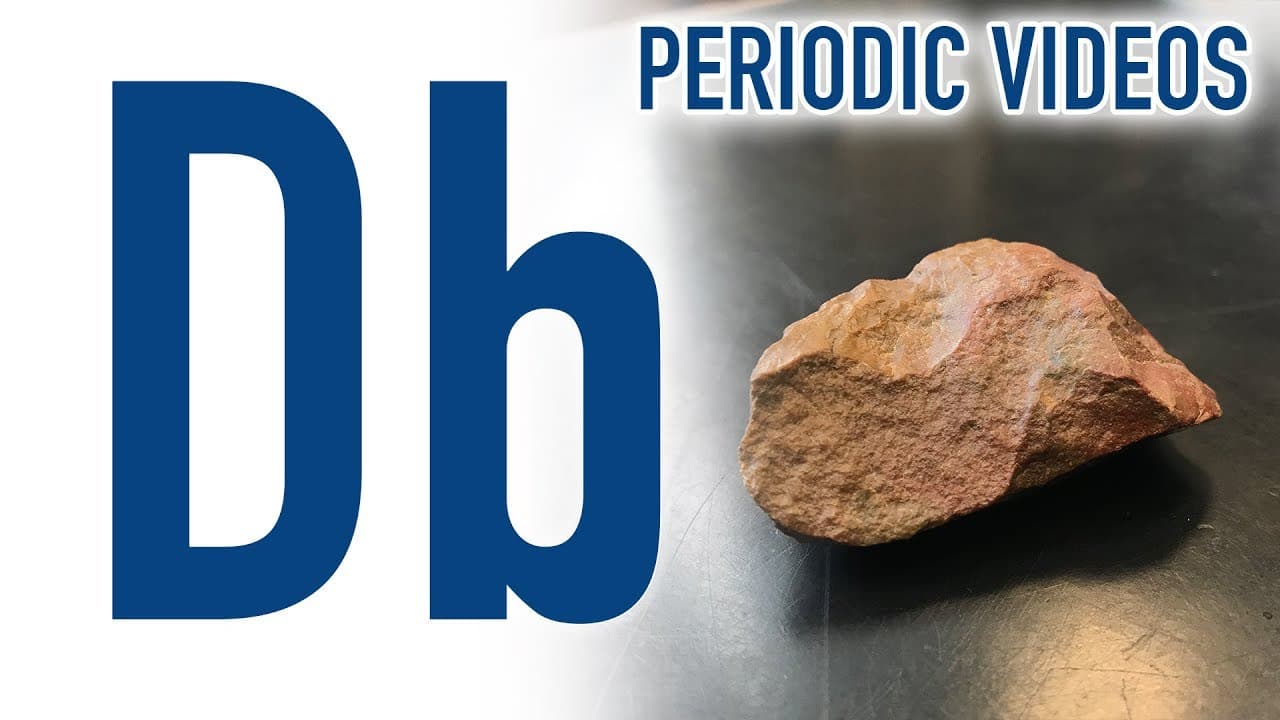
TL;DR
Dubnium is element 105, a synthetic, short-lived super-heavy element made by fusing neon, atomic number 10, with americium, atomic number 95. Dubna and Berkeley teams synthesized it at roughly the same time, prompting a long priority and naming dispute. Experiments on only a few atoms found chemistry resembling niobium and tantalum, showing why Dubnium remains important to understanding whether periodic trends persist in very heavy elements. Read on for how it is made, detected, and studied.
Transcript
Element 105, Dubnium,... ...was the shortest video we made, at 45 seconds. I know very little about Dubnium. I'm not sure anybody knows much about it. And I realized there was a lot more to say about it than we did the first time. And in particular,... ...I have a really nice sample,... ...which is relevant,... ...which I'll tell you about in a ... Read More
Key Insights
- 😤 Dubnium's synthesis required collaboration between different research teams and resolved conflicts over priority.
- ❣️ The chemistry of Dubnium provides valuable information about the periodic properties of super-heavy elements.
- ❓ The synthesis and study of Dubnium demonstrate the importance of collaboration and a friendly scientific approach.
- 🫀 Only a small amount of Dubnium atoms have been synthesized due to the challenges of creating stable isotopes.
Install to Summarize YouTube Videos and Get Transcripts
Explore YouTube Video Summarizer or Get YouTube Transcript Extractor
Questions & Answers
Q: What is Dubnium?
Dubnium is element 105 and belongs to the super-heavy region of the periodic table. It can only be made synthetically, and its atoms are produced one at a time and survive from seconds to a few hours.
Q: How is Dubnium synthesized?
Dubnium can be synthesized by accelerating a light neon atom into a heavier americium atom so that they fuse. Neon has atomic number 10 and americium has atomic number 95, which add up to Dubnium’s atomic number of 105.
Q: How are Dubnium atoms detected?
Researchers detect Dubnium through its radioactive decay rather than by analyzing a large sample. They measure emitted gamma rays and follow the decay of daughter compounds, using predicted gamma-ray energies and known radioactive elements to work backward.
Q: Why are stable isotopes of Dubnium difficult to produce?
A more stable Dubnium atom would require the combined nucleus to contain as many neutrons as possible. The available synthesis options do not provide a large excess of neutrons, so researchers did not produce any very stable isotopes.
Q: Who discovered Dubnium?
Teams in Dubna, Russia, and Berkeley, America, discovered Dubnium at more or less the same time. An independent committee examined evidence from the competing teams after their priority dispute could not be resolved directly.
Q: Why was element 105 named Dubnium?
The name followed a friendly agreement to honor Dubna, home of Russia’s Joint Institute for Nuclear Research and its accelerators. The transcript also notes that Berkeley already had three associated element names, Californium, Americium, and Berkelium, while Seaborgium was named around the same period.
Q: What did experiments reveal about Dubnium’s chemistry?
Dubnium sits immediately below tantalum, so researchers expected similar chemistry. Experiments using only a few atoms suggested it may be slightly more like niobium, the element immediately above tantalum in the same group.
Q: Why is Dubnium important to the periodic table?
In very heavy atoms, relativistic effects from fast-moving electrons could potentially disrupt expected periodic properties. Dubnium still shows the properties of its group, indicating that at element 105 the periodic trends behave reasonably as expected.
Summary & Key Takeaways
-
Dubnium is a super-heavy element in the periodic table that can only be synthesized through a process of fusing light atoms into heavier ones.
-
The discovery of Dubnium was a result of a collaborative effort between research teams in Dubna, Russia, and Berkeley, USA, with a debate over priority.
-
Despite the limited amount of Dubnium atoms synthesized, experiments have revealed its chemistry, which aligns with its group in the periodic table.
Read in Other Languages (beta)
Share This Summary 📚
Summarize YouTube Videos and Get Video Transcripts with 1-Click
Try YouTube Summary with ChatGPT & Claude or YouTube Transcript Generator
Explore More Summaries from Periodic Videos 📚



Summarize YouTube Videos and Get Video Transcripts with 1-Click
Try YouTube Summary with ChatGPT & Claude or YouTube Transcript Generator