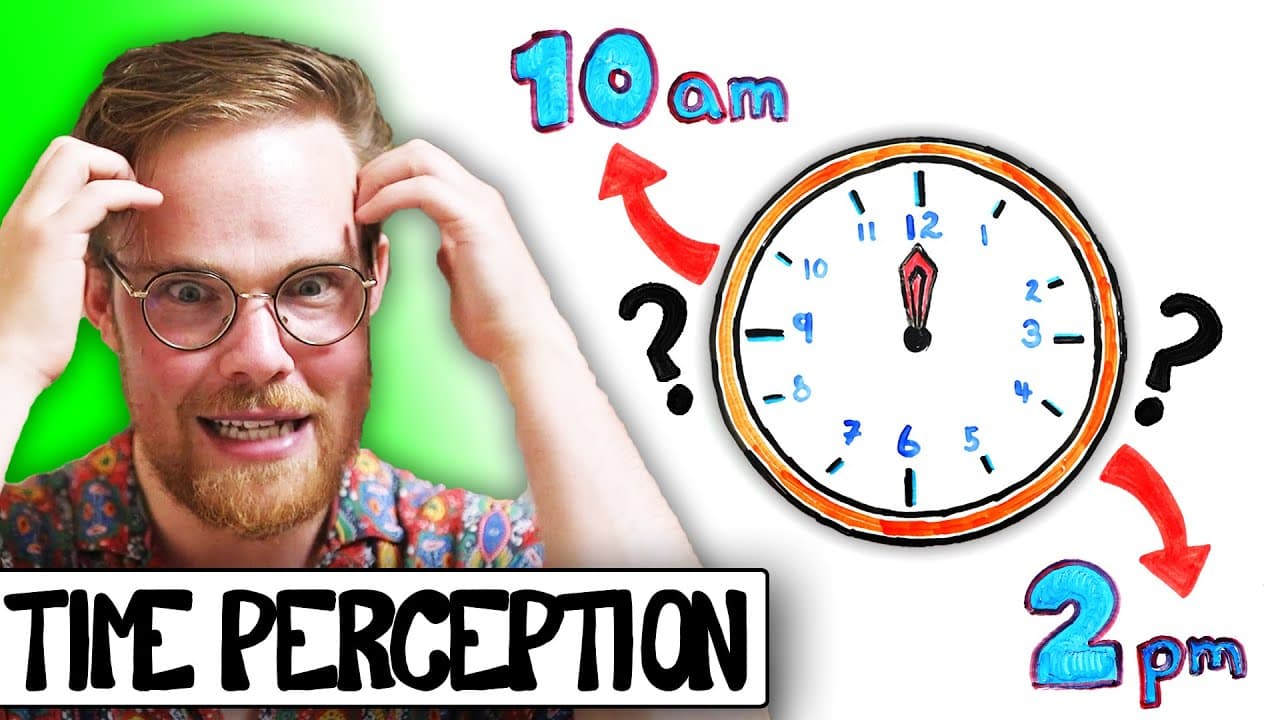
Which of these TWO ways do you perceive time?
TL;DR
People perceive time either as themselves moving forward through time (ego-moving perspective) or as time moving forward through them (time-moving perspective).
Transcript
- You may not know this, but there are actually only two ways that us English-speaking humans perceive time. So I'm gonna ask you a question right now so you can find out which one you are. If I tell you that Wednesday's noon meeting has been moved forward by two hours, do you now think that it's at 2:00 p.m. or at 10:00 a.m.? If you think the meet... Read More
Key Insights
- ⌛ English-speaking humans perceive time in two ways: ego-moving or time-moving perspectives.
- ⌛ Different languages have different ways of referencing time, which may influence the perception of time.
- ⌛ Perception of time can vary depending on individuals' personality traits and recent physical movements.
Install to Summarize YouTube Videos and Get Transcripts
Explore YouTube Video Summarizer or Get YouTube Transcript Extractor
Questions & Answers
Q: How do ego-moving and time-moving perspectives of time differ?
In the ego-moving perspective, individuals see themselves as moving forward through time, while in the time-moving perspective, individuals see themselves as static, with time moving forward through them.
Q: Why is there a split in perception when referring to events like the Wednesday noon meeting?
The split in perception is due to the English language and its reliance on metaphorical expressions. Different individuals interpret these expressions differently, leading to the split in perception.
Q: Do other languages have similar perception issues with time?
Some languages have more direct ways of referencing time, eliminating the perception issues observed in English. For example, the Aymara language perceives the past as in front and the future as behind.
Q: Are there personality differences associated with ego-moving and time-moving perspectives?
Studies have found that individuals with ego-moving perspectives tend to have a greater sense of personal agency, while those with time-moving perspectives are more fatalistic and believe events are predetermined.
Summary & Key Takeaways
-
English-speaking humans perceive time in two ways: ego-moving perspective (seeing themselves moving forward through time) or time-moving perspective (seeing themselves as static and time moving forward through them).
-
The perception of time in English is called fictive motion and is a metaphorical movement of an object through space.
-
Different languages perceive time differently, and some languages have more direct ways of referencing time.
Read in Other Languages (beta)
Share This Summary 📚
Summarize YouTube Videos and Get Video Transcripts with 1-Click
Try YouTube Summary with ChatGPT & Claude or YouTube Transcript Generator
Explore More Summaries from AsapSCIENCE 📚




Summarize YouTube Videos and Get Video Transcripts with 1-Click
Try YouTube Summary with ChatGPT & Claude or YouTube Transcript Generator