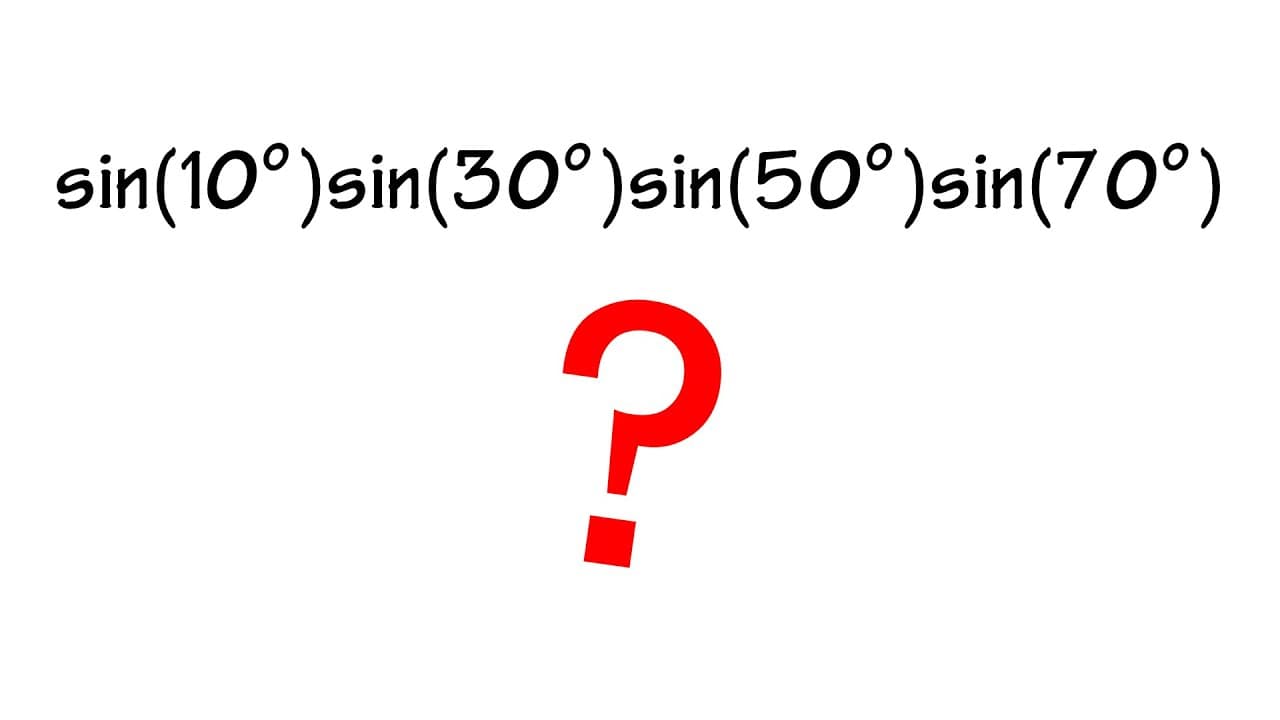
sin(10°)sin(30°)sin(50°)sin(70°) = ? No calculator!
TL;DR
Learn how to calculate the sine of multiple angles without using a calculator.
Transcript
okay let's do some math for fun here we're going to calculate sine of 10 degrees times sine of 30 degrees times sine of 50 degrees times sine of 70 degrees and yes we are using degrees and also if you are like you can put up sine of 90 degrees but that's just equal to 1 so it doesn't really matter right but anyway you should pause the vide... Read More
Key Insights
- 👨💼 Trigonometric identities, specifically the sine and cosine functions, can be used to simplify calculations involving sine of multiple angles.
- 👨💼 By rewriting sine in terms of cosine and utilizing the double angle identity, the equation can be simplified further.
- 👨💼 Supplementary angles, such as 20 degrees and 160 degrees, have the same sine values due to the nature of the sine function.
- 🥺 Applying trigonometric identities allows for the cancellation of common terms in the equation, leading to a simpler calculation.
- 👨💼 In this specific example, the calculation of sine of four angles (10, 30, 50, and 70 degrees) results in the value of 1/16.
- 👨💼 The approach shown in the video is a manual method to calculate sine without relying on a calculator.
- ❓ Trigonometry has various identities and relationships that can be utilized to solve complex problems.
Install to Summarize YouTube Videos and Get Transcripts
Explore YouTube Video Summarizer or Get YouTube Transcript Extractor
Questions & Answers
Q: How can you calculate the sine of multiple angles without a calculator?
To calculate the sine of multiple angles, you can use trigonometric identities, such as the sine and cosine functions, to simplify the equations. By manipulating the equations and canceling out common terms, the calculations become easier.
Q: What is the relationship between sine and cosine functions?
The sine and cosine functions are related through trigonometric identities. For example, sine theta can be rewritten as cosine of complementary angle (90 degrees - theta). This relationship allows us to express sine in terms of cosine, making it easier to calculate without a calculator.
Q: How do you simplify the equation for calculating sine?
By applying trigonometric identities, such as the double angle identity, you can simplify the equation for calculating sine. The video demonstrates how to rewrite the sine of an angle as the sine of the double angle divided by two times the sine of the original angle.
Q: Why does the sin(20 degrees) equal sin(160 degrees)?
Sin(20 degrees) equals sin(160 degrees) because these angles are supplementary angles, meaning they add up to 180 degrees. When the angles add up to 180 degrees, the sine values are the same. This is a trigonometric identity that allows us to simplify calculations.
Summary & Key Takeaways
-
This video demonstrates a method to calculate the sine of angles without a calculator.
-
The video explains the use of trigonometric identities, specifically the sine and cosine functions.
-
By applying these identities and simplifying the equations, the video shows how to find the sine of multiple angles.
Read in Other Languages (beta)
Share This Summary 📚
Summarize YouTube Videos and Get Video Transcripts with 1-Click
Try YouTube Summary with ChatGPT & Claude or YouTube Transcript Generator
Explore More Summaries from blackpenredpen 📚

Summarize YouTube Videos and Get Video Transcripts with 1-Click
Try YouTube Summary with ChatGPT & Claude or YouTube Transcript Generator