Limit comparison test vs direct comparison test, calculus 2 tuturial
TL;DR
The video explains how to use both the limit comparison test and the direct comparison test to determine if a series converges.
Transcript
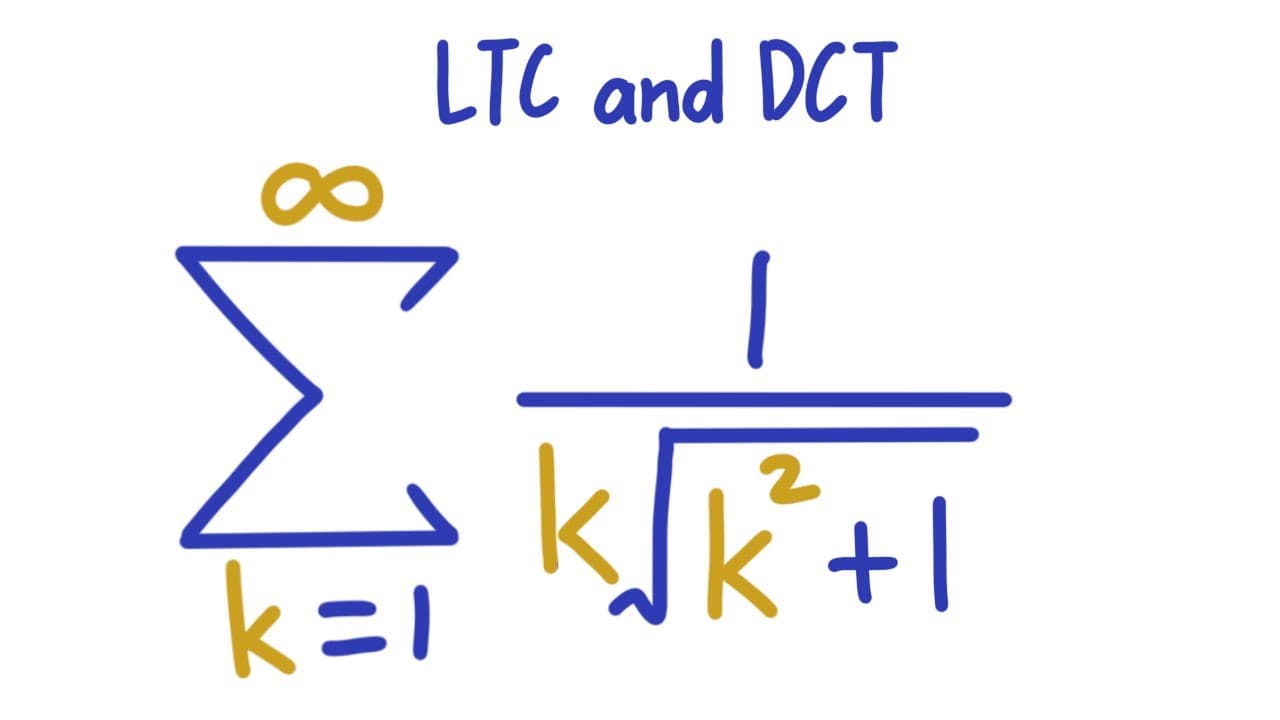
converge or diverge Sigma when K goes from 1 to infinity 1 over K times square root of K square plus 1 as we can see if we know this plus 1 then we know that this square root of K square gives us a K and this K multiplied with that K we get K square on the denominator and we know Sigma 1 over K squared converges so we have something that we know th... Read More
Key Insights
- 😒 The video explains how to use the limit comparison test to show the convergence of a series.
- 😒 It also demonstrates the use of the direct comparison test for determining the convergence of a series.
- ⛔ The limit comparison test involves dividing the given series by a known convergent series and taking the limit.
- 🏆 The direct comparison test compares the given series to a known convergent or divergent series to draw conclusions about its convergence.
- 🤩 The key factor in both tests is the comparison to a known series that has a known convergence or divergence.
- 🏆 The tests rely on algebraic manipulations and the properties of limits to determine convergence or divergence.
- 🍉 The video emphasizes the importance of considering the positivity of terms in the inequality comparisons.
Install to Summarize YouTube Videos and Get Transcripts
Explore YouTube Video Summarizer or Get YouTube Transcript Extractor
Questions & Answers
Q: What is the purpose of the limit comparison test?
The limit comparison test is used to determine if a given series converges by comparing it with a known convergent series. It involves taking the limit as the terms of the series approach infinity.
Q: How do you apply the limit comparison test?
To apply the limit comparison test, you divide the given series by a known convergent series and take the limit as the terms approach infinity. If the resulting limit is a finite nonzero value, then the given series also converges.
Q: What is the direct comparison test used for?
The direct comparison test is another method to determine the convergence of a series. It involves comparing the given series to a known convergent series or a known divergent series.
Q: How do you use the direct comparison test?
To use the direct comparison test, you find a known series that is either greater than or less than the given series. If the known series converges, then the given series must also converge. If the known series diverges, then the given series must also diverge.
Summary & Key Takeaways
-
The video discusses how to use the limit comparison test to determine the convergence of a series.
-
It also explains how to use the direct comparison test to show the convergence of a series.
-
Both tests involve comparing the given series to a known convergent series.
Read in Other Languages (beta)
Share This Summary 📚
Summarize YouTube Videos and Get Video Transcripts with 1-Click
Try YouTube Summary with ChatGPT & Claude or YouTube Transcript Generator
Explore More Summaries from blackpenredpen 📚
Summarize YouTube Videos and Get Video Transcripts with 1-Click
Try YouTube Summary with ChatGPT & Claude or YouTube Transcript Generator