MOS circuits | Layers | VLSI | Lec-46
TL;DR
The video explains different layers used in circuit design and their specific applications.
Transcript
hi everyone in this video you are going to learn about choice of layers what are the different layers we have and why we are choosing that particular layer only because why we are using that particular layer for only that particular operation suppose what are the different layers you come across in the stick diagrams and layout diagrams metal one m... Read More
Key Insights
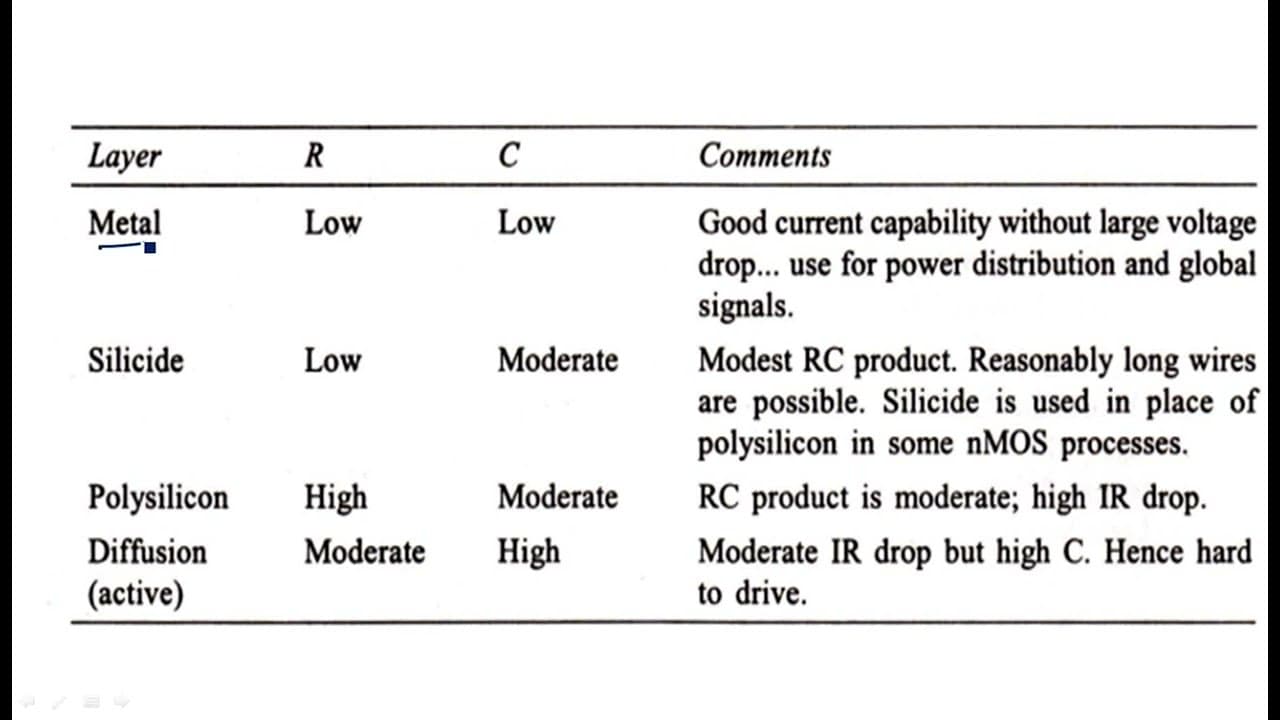
- 🛟 Different layers in circuit design serve unique functions, dictated by their electrical properties, including resistance and capacitance.
- 🤘 Metal layers are favored for power supply interconnections due to their excellent electrical characteristics and reliability.
- ✋ Polysilicon must be used cautiously; its higher resistance and capacitance limit its application to gate creation in transistors.
- ➕ P-plus and N-plus diffusion layers are specialized for transistor fabrication, exhibiting high capacitance that restricts their usage elsewhere.
- 🍻 The propagation delay linked to layer resistance and capacitance can substantially impact circuit performance.
- 😘 Silicide can substitute polysilicon in some processes, combining lower resistance with moderate capacitance.
- ⚡ Layer choice must be strategic to ensure optimal performance and efficiency in design, with consequences for voltage stability and signal integrity.
Install to Summarize YouTube Videos and Get Transcripts
Explore YouTube Video Summarizer or Get YouTube Transcript Extractor
Questions & Answers
Q: What is the primary function of metal layers in circuit design?
Metal layers are primarily used for power supply connections, offering low resistance and capacitance which ensures minimal voltage drop across long distances. They serve as global signal carriers, facilitating the distribution of power supply rails like VDD and VSS throughout the circuit effectively.
Q: Why is polysilicon limited to specific applications in circuit design?
Polysilicon is restricted in use due to its moderate resistance and capacitance. It is mainly utilized for gate terminals in transistors, and extending its use for long interconnections causes increased propagation delay. Therefore, it is not suitable for long distances in circuit pathways.
Q: What distinguishes P-plus and N-plus diffusion layers from other layers?
P-plus and N-plus diffusion layers are specifically employed in creating transistors and are not used for interconnections. They have high resistance and capacitance values, which limits their utility outside of forming transistor structures, making them less viable for other circuit functions.
Q: How do resistance and capacitance affect layer selection in circuit design?
Both resistance and capacitance significantly influence layer selection. Layers with low resistance and capacitance, like metal, are preferred for power distribution. In contrast, layers like polysilicon and diffusion have high resistance and capacitance, making them unsuitable for long-distance connections.
Summary & Key Takeaways
-
The video discusses various layers used in circuit design, including metal, polysilicon, P-plus, and N-plus diffusion layers, explaining each layer's role.
-
It emphasizes the significance of resistance and capacitance in selecting layers for specific operations, highlighting that metal layers are preferred for power supply due to low resistance.
-
Limitations of various layers are described, noting that while metals are suitable for interconnections, polysilicon and diffusion layers are restricted to specific applications due to higher capacitance and resistance.
Read in Other Languages (beta)
Share This Summary 📚
Summarize YouTube Videos and Get Video Transcripts with 1-Click
Try YouTube Summary with ChatGPT & Claude or YouTube Transcript Generator