TX GOVT 2306-Test 1 Review
TL;DR
Comprehensive review for Texas Government Test 1.
Transcript
all right let's go ahead and begin your test one review remember your test one uh opens up on Monday and you'll have the entire week to complete it until midnight on Friday night or 11:59 p.m. on Friday night uh the the test member is 50 multiple choice questions you have two hours to complete it uh your answers will be Ram your tes... Read More
Key Insights
- The test consists of 50 multiple-choice questions, is open book, and students have two hours to complete it.
- Political science is defined as the study of government, focusing on empirical and normative approaches.
- Different forms of government include autocracy, anarchy, tyranny, authoritarianism, totalitarianism, aristocracy, oligarchy, and democracy.
- Political culture and ideology influence government function; political efficacy is crucial for public influence.
- Texas history is marked by immigration and cultural clashes, impacting its political landscape.
- The Texas Constitution outlines government principles and citizen rights, emphasizing limited government and popular sovereignty.
- Federalism involves a balance of power between state and federal governments, with significant court cases shaping its application.
- Local governments are vital to federalism despite not being mentioned in the U.S. Constitution.
Install to Summarize YouTube Videos and Get Transcripts
Explore YouTube Video Summarizer or Get YouTube Transcript Extractor
Questions & Answers
Q: What is the structure of the Texas Government Test 1?
The Texas Government Test 1 consists of 50 multiple-choice questions. Students have two hours to complete the test, and it is open book. The questions and answers are randomized to reduce the possibility of cheating. It is recommended that students prepare in advance despite the open-book format to manage time effectively during the test.
Q: How does the lecture define political science?
Political science is defined as the study of government, focusing on the political decisions and behaviors of society. It is categorized under behavioral sciences, which include psychology, sociology, and cultural anthropology. The lecture distinguishes between empirical political science, which relies on data and statistics, and normative political science, which addresses philosophical questions about justice and virtue to form policy approaches.
Q: What are the different forms of government discussed in the lecture?
The lecture discusses various forms of government, including autocracy (one ruler), anarchy (no ruler), tyranny (absolute power by one ruler), authoritarianism (government restrained by social institutions), totalitarianism (elimination of challengers by one ruler), aristocracy (leaders chosen by birth), oligarchy (small group of rulers), and democracy (rule by citizens, either directly or through representatives). Each form has distinct characteristics and implications for governance.
Q: How does political culture influence government function?
Political culture, defined as broadly shared values, beliefs, and attitudes about government function, significantly influences government operations. Political efficacy, the public's belief in their ability to influence government, drives participation and shapes government policies. High political efficacy leads to more public engagement and informed citizens, ultimately impacting political knowledge and the direction of government actions.
Q: What role does Texas history play in its political landscape?
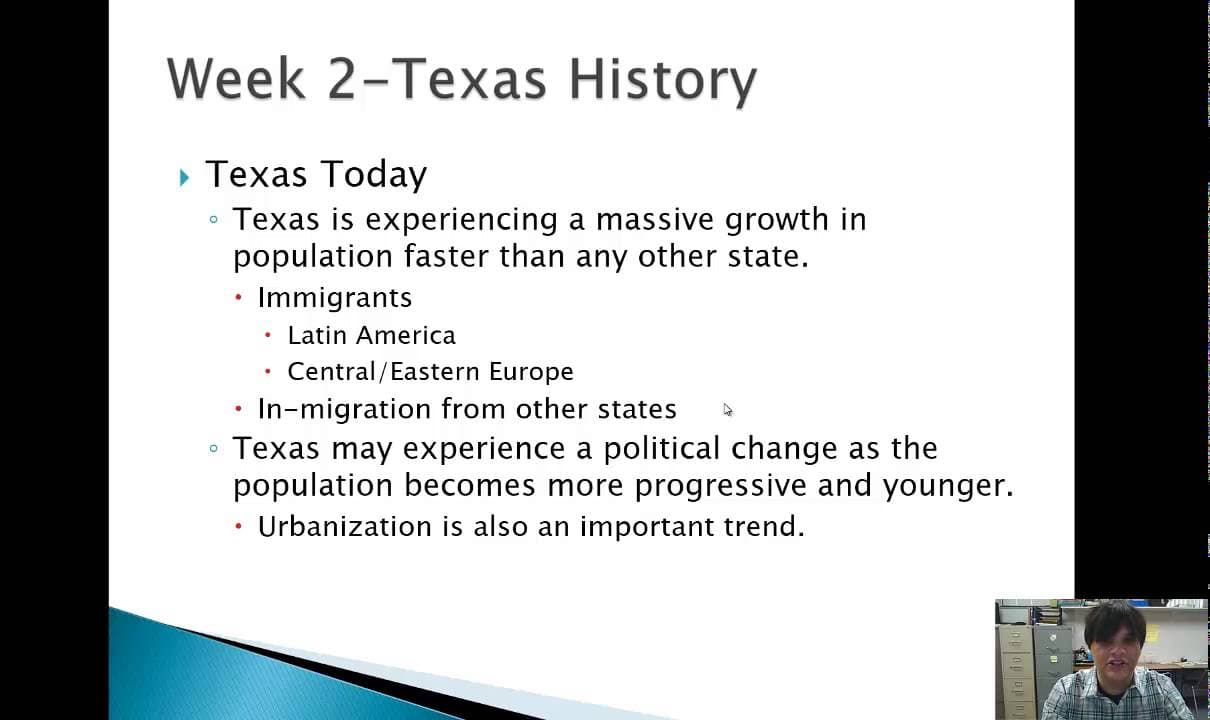
Texas history is characterized by continuous immigration and cultural clashes, shaping its political landscape. The state has experienced various eras marked by different groups, such as Native Americans, Spanish, French, and Americans, each contributing to Texas's cultural and political development. These historical dynamics influence Texas's current political environment, including its potential shift towards becoming a swing state due to demographic changes and urbanization.
Q: What are the key features of the Texas Constitution?
The Texas Constitution outlines the principles, authorities, and rights established by the government. It emphasizes limited government, popular sovereignty, and the separation of powers. The Texas Bill of Rights, similar to the U.S. Bill of Rights but more detailed, is placed in Article 1, reflecting Texans' distrust of big government. The Constitution is highly detailed and wordy, posing challenges for average citizens to fully understand it.
Q: How does federalism impact state and federal power distribution?
Federalism involves a balance of power between state and federal governments, with each level having distinct powers. The federal government has expressed powers, such as taxing and spending, while states retain powers not delegated to the national government, as outlined in the 10th Amendment. Important court cases, like McCulloch v. Maryland and U.S. v. Lopez, have shaped federalism by defining the scope of federal and state powers.
Q: What is the significance of local governments in the federal system?
Local governments, though not mentioned in the U.S. Constitution, are vital to the federal system. They serve as the foundation for state governments, which in turn support the federal structure. Local governments handle various functions, such as education and local law enforcement, and play a crucial role in implementing state and federal policies. Their existence and operation are essential for maintaining the balance and effectiveness of the federal system.
Summary & Key Takeaways
-
The lecture reviews key concepts for the Texas Government Test 1, including political science definitions, forms of government, and political ideology. It emphasizes understanding empirical and normative approaches, political culture, and efficacy.
-
Texas history and its constitution play a significant role in shaping the state's political landscape. The lecture covers historical immigration trends, cultural clashes, and the evolution of Texas's political structure and values.
-
Federalism and its impact on state and federal power distribution are discussed, along with important court cases. The lecture highlights the role of local governments and the trend of devolution, where power is returned to the states.
Read in Other Languages (beta)
Share This Summary 📚
Summarize YouTube Videos and Get Video Transcripts with 1-Click
Try YouTube Summary with ChatGPT & Claude or YouTube Transcript Generator