What Are the Differences Between BFS and DFS in Graph Traversal?
TL;DR
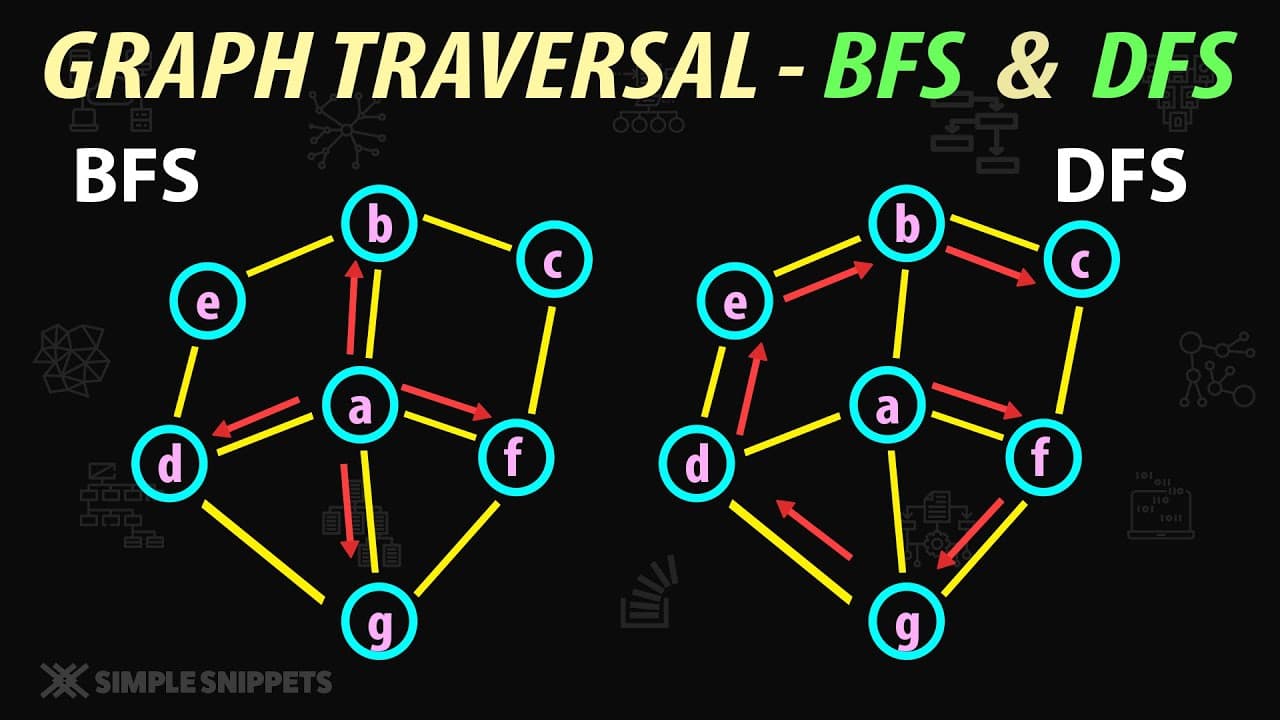
Breadth First Search (BFS) visits all neighboring vertices of a selected node using a queue, while Depth First Search (DFS) explores one neighboring vertex at a time and backtracks when necessary, using a stack. BFS processes nodes layer by layer, whereas DFS dives deep into one branch before moving to others, leading to different traversal outcomes.
Transcript
hey what's going on guys tanmay here for simple snippets and welcome back to another video tutorial on data structures and algorithms and let's continue with a graph topic we've covered quite a lot of details about graph data structure in case if you're new on this channel or in case if you've missed the previous videos check out the link in the vi... Read More
Key Insights
- 📚 Graph traversal is an important aspect of working with graph data structures, as it allows for visiting, updating, and adding/changing nodes.
- 🌍 Graph traversal can be classified into two methodologies: breadth first search (BFS) and depth first search (DFS).
- 📝 In BFS, one node is selected and all of its adjacent nodes are visited, then the process is repeated for each of the adjacent nodes.
- 📊 BFS uses a queue data structure to keep track of the nodes that need to be visited.
- 🔎 In DFS, one node is selected and it moves to one of its adjacent nodes. This process continues recursively until the neighboring nodes have all been visited.
- 📚 DFS uses a stack data structure to keep track of the nodes that need to be visited.
- 🔄 BFS and DFS provide different ways of traversing a graph, with BFS visiting nodes in a breadth-wise manner and DFS visiting nodes in a depth-wise manner.
- 💡 The order in which BFS and DFS are performed affects the output, as different paths and sequences of visiting nodes can be chosen.
Install to Summarize YouTube Videos and Get Transcripts
Explore YouTube Video Summarizer or Get YouTube Transcript Extractor
Questions & Answers
Q: What are the two different methods of graph traversal explained in the video?
The video explains breadth first search (BFS) and depth first search (DFS) as two different methods of graph traversal.
Q: What data structure is used for BFS traversal?
BFS traversal uses a queue data structure.
Q: What data structure is used for DFS traversal?
DFS traversal uses a stack data structure.
Q: What is the difference between BFS and DFS?
In BFS, all neighboring vertices of a selected node are visited first before moving on, while in DFS, one neighboring vertex is visited before moving on to the next.
Summary & Key Takeaways
-
The video tutorial explains the concepts of graph traversal using breadth first search (BFS) and depth first search (DFS).
-
BFS involves visiting each neighboring vertex of a selected node before moving on to the next unvisited neighbor.
-
DFS involves visiting one neighboring vertex before moving on to the next, and backtracking when all neighbors have been visited.
Read in Other Languages (beta)
Share This Summary 📚
Summarize YouTube Videos and Get Video Transcripts with 1-Click
Try YouTube Summary with ChatGPT & Claude or YouTube Transcript Generator
Explore More Summaries from Simple Snippets 📚

Summarize YouTube Videos and Get Video Transcripts with 1-Click
Try YouTube Summary with ChatGPT & Claude or YouTube Transcript Generator