Steady State Error | Examples | CS | Control Systems | Lec-32
TL;DR
This content explains how to calculate steady state error in a unity feedback system.
Transcript
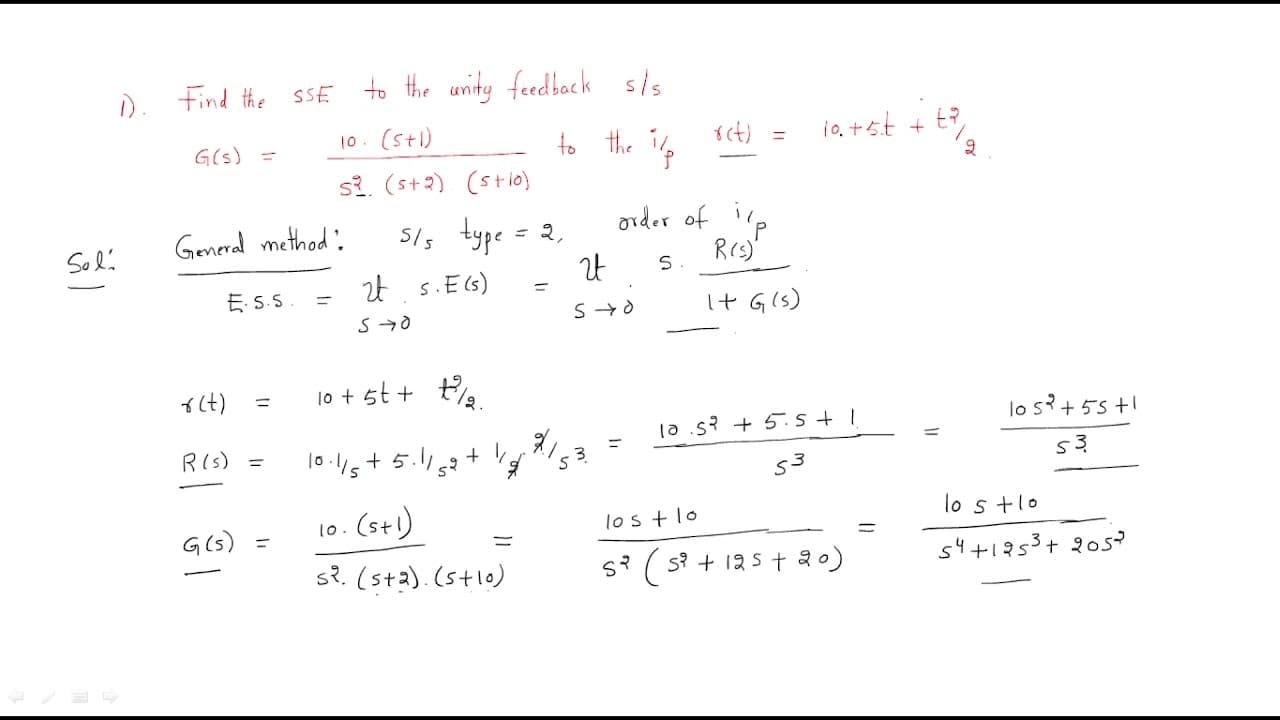
hello everyone we will discuss a problem regarding steady state error here the problem is find the steady state error to the unity feedback system the system gfs equal 10 into s plus 1 s square into s plus 2 s plus 10 to the input r of t 10 plus phi t plus t square by 2 this is the input and he is asking to find out the study state header so we hav... Read More
Key Insights
- ⌛ Steady state error is a critical measure of control system performance, emphasizing the system’s ability to reach desired outputs over time.
- ⌛ The general method, while accurate, can be complex and time-consuming, highlighting the importance of efficiency in engineering applications.
- ❓ The shortcut method provides a more accessible route to finding steady state error, demonstrating the value of systematic problem breakdown.
- 🧑🏭 System type is a significant factor in determining steady state error, serving as a guideline for expected performance with various inputs.
- ⚾ Different input components yield differing steady state errors based on their orders and the control system's type.
- 👻 Laplace transforms facilitate the examination of systems in control theory, allowing for easier manipulation of system equations.
- 🪡 Understanding both methods gives engineers options depending on the complexity of the problem and the need for quick results.
Install to Summarize YouTube Videos and Get Transcripts
Explore YouTube Video Summarizer or Get YouTube Transcript Extractor
Questions & Answers
Q: What is steady state error and why is it important?
Steady state error is the difference between the desired output and the actual output of a control system as time approaches infinity. It's crucial because it provides insights into system performance, indicating how well a system can track inputs and reach desired states.
Q: What are the two main methods presented for calculating steady state error?
The two methods are the general method, which involves detailed calculations using Laplace transforms, and the shortcut method, which simplifies the process by breaking down the input signal and applying a straightforward formula.
Q: How does the input signal affect the steady state error in the given problem?
The input signal consists of three components: a constant, a linear, and a quadratic term. The steady state error is influenced by the type of system (type 2 in this case) and the order of the input signal components, leading to varying errors based on these properties.
Q: Why is the second method preferred over the first method?
The second method is preferred due to its logical structure and ease of understanding, as it allows for quicker calculations without intricate algebra. This method effectively identifies errors for each component of the input separately, making it practical for rapid analysis.
Q: What role does the system type play in calculating steady state error?
The system type indicates the number of integrators in the forward path of the control system, which directly affects the steady state error. In this example, a type 2 system leads to zero error for constant and linear input, while showing a calculable error for the quadratic input.
Q: What is the formula used to determine the acceleration constant in the second method?
The acceleration constant formula is given by the limit as s tends to zero of s squared multiplied by the transfer function g(s). This helps in quantifying how the system responds to acceleration inputs.
Q: What was the final steady state error value calculated in both methods?
The final steady state error value calculated through both methods is two, demonstrating consistency in the results despite the differing approaches used to reach the conclusion.
Q: How are Laplace transforms utilized in the context of the steady state error problem?
Laplace transforms are employed to convert time-domain signals into the frequency domain, which simplifies the analysis and calculation of system responses, including the steady state error, through algebraic manipulation instead of differential equations.
Summary & Key Takeaways
-
The content outlines two methods for calculating steady state error in a unity feedback system, emphasizing their differences in complexity and logic.
-
The first method involves intricate calculations using Laplace transforms and limits to find the steady state error, resulting in a value of two.
-
The second method is more straightforward, breaking the input into smaller parts to simplify the calculations, ultimately leading to the same steady state error value of two.
Read in Other Languages (beta)
Share This Summary 📚
Summarize YouTube Videos and Get Video Transcripts with 1-Click
Try YouTube Summary with ChatGPT & Claude or YouTube Transcript Generator