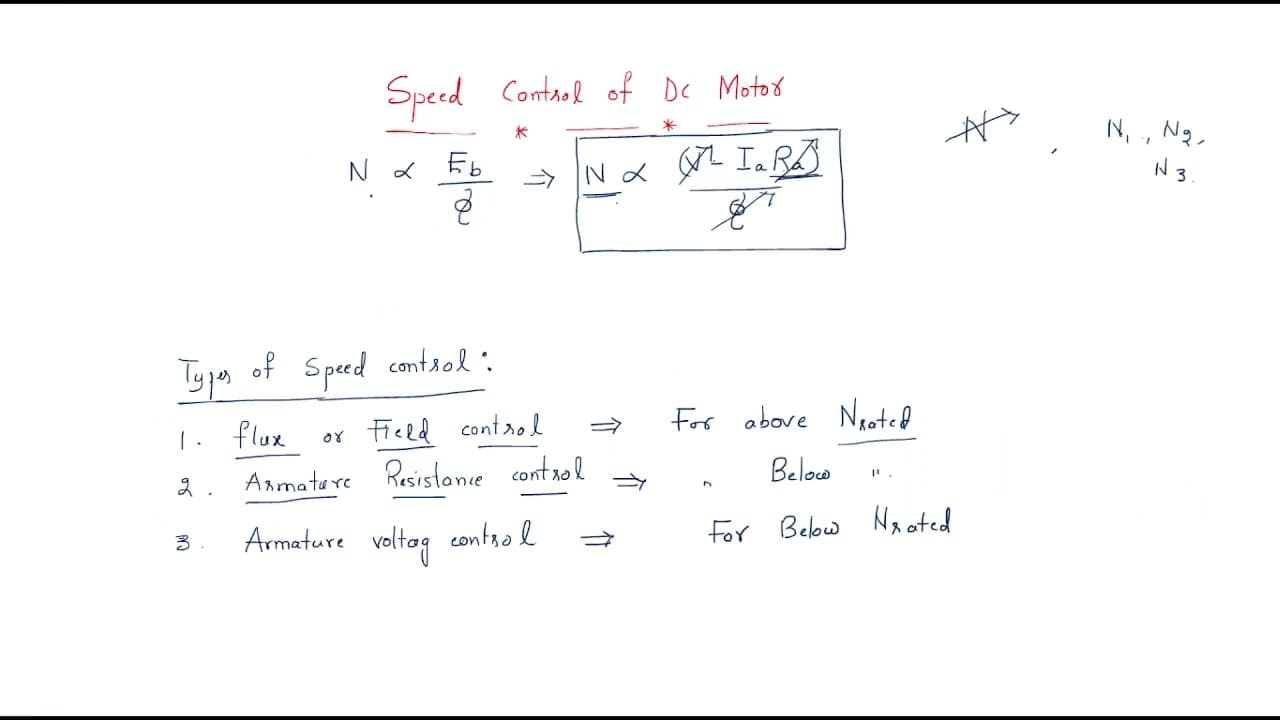
Speed Control Of DC Motor | Flux or field control - 1| DC machines | Lec-57
TL;DR
This session covers various methods for controlling the speed of DC motors, emphasizing their applications and limitations.
Transcript
hello everyone in this session we will discuss the next topic is speed control of dc motor speed control of dc motor okay the speed control is very very important part speed control because for any motor we have so many application by varying the speed so different different applications have different different speeds and we have some methods to c... Read More
Key Insights
- 🐎 Speed control of DC motors is essential for various applications requiring specific operational speeds.
- ☠️ Flux control is advantageous for speeds above rated, but comes with limitations to maintain efficiency.
- 🥺 Armature resistance control serves best for speeds below rated values, often leading to energy losses.
- 🐎 Armature voltage control provides flexible speed regulation for lower speed applications.
- 🚄 Core saturation poses significant challenges to maintaining motor performance at high speeds.
- 🧑🦼 Reducing flux in a DC motor decreases torque, impacting overall motor effectiveness.
- 🐎 Power output can remain consistent during speed adjustments if torque and speed adjustments are balanced.
Install to Summarize YouTube Videos and Get Transcripts
Explore YouTube Video Summarizer or Get YouTube Transcript Extractor
Questions & Answers
Q: What are the primary methods for speed control of DC motors discussed in the session?
The session emphasizes three main methods for controlling the speed of DC motors: flux or field control, armature resistance control, and armature voltage control. Each method serves specific applications and operates effectively within designated speed ranges, helping to tailor motor performance to various operational demands.
Q: Why is flux control primarily effective only above rated speeds?
Flux control is most effective above rated speeds because speed is inversely proportional to the flux. When the flux increases, core saturation occurs, limiting further flux variations. As a result, maintaining a reduced flux allows for speed increases while managing losses and temperature rises effectively within operational limits.
Q: What limitations accompany the use of flux control for speed adjustment in DC motors?
Limitations of flux control include saturation effects at higher speeds, leading to increased hysteresis and eddy current losses, which elevate temperature and reduce efficiency. Additionally, flux cannot be controlled below a certain level due to armature reaction, which affects overall motor performance and commutation quality.
Q: How does armature resistance control affect speed below rated values?
Armature resistance control allows for the manipulation of speed below rated values by increasing resistance in the armature circuit. This method causes a drop in armature voltage and subsequently reduces speed, but it is less efficient than other methods due to increased power losses associated with resistance.
Q: What happens to torque as the flux in the motor decreases?
As the flux decreases, the torque also diminishes since torque is directly proportional to the product of flux and armature current. This reduction in torque can hinder the motor's performance, especially at low flux levels, where sufficient torque is necessary for operation.
Q: Can power output remain constant when adjusting motor speed through flux control?
Yes, under the flux control method, the DC motor operates as a constant power, variable torque drive. As speed increases, while torque decreases, these two factors compensate for each other, allowing power output to remain relatively consistent across varying speeds.
Q: What is a significant consequence of operating a motor at dangerously high speeds due to low flux?
Operating a motor at dangerously high speeds due to low flux leads to excessive centrifugal forces that the rotor may not withstand, risking mechanical failure. This poses safety hazards and potential damage to the motor from excessive wear or catastrophic failure.
Q: How does armature voltage control function to adjust motor speed?
Armature voltage control adjusts the speed of a DC motor by varying the voltage applied to the armature winding. Increasing armature voltage allows the motor to operate at higher speeds, while decreasing it brings down the speed. This method is particularly suited for operations below rated speeds, enhancing versatility in motor applications.
Summary & Key Takeaways
-
Speed control of DC motors is vital for applications requiring variable speeds, and several methods exist to manage these speeds effectively.
-
The discussion includes flux or field control, armature resistance control, and armature voltage control, each suitable for different speed ranges and applications.
-
Limitations of these methods include saturation effects, increased losses, and challenges in maintaining efficiency, particularly above rated speeds.
Read in Other Languages (beta)
Share This Summary 📚
Summarize YouTube Videos and Get Video Transcripts with 1-Click
Try YouTube Summary with ChatGPT & Claude or YouTube Transcript Generator