Dynamic CMOS logic | Four phase clock | PDC | Lec-117
TL;DR
Learn about dynamic semos logic, its circuit structure, and clock input effects.
Transcript
hi everyone in this video you going to learn about the dynamic semos logic Dynamic seos logic is the second type of different types of logic realizations of the seos logic function whereas in the previous video I have explained about the pseudo inmos logic where half PM transistor and half NM transistors have been constructed that means p transisto... Read More
Key Insights
- ⏲️ Dynamic semos logic utilizes both pmos and nmos transistors for efficient logic realization, integrating clock inputs for timing control.
- ⌛ Comparatively, dynamic logic systems offer advantages over static setups by enabling time-dependent operations and improved performance under specific conditions.
- 👻 The circuit’s operation is heavily reliant on the interaction of on and off states, allowing the logic output to be directly controlled by clock signals.
- 🔠 Charge sharing during clock periods can be problematic if inputs change too frequently, necessitating careful timing and input management.
- 🥺 Cascading single-phase structures risks data integrity due to potential delays, which can lead to erroneous outputs.
- ⏰ Implementing a four-phase clock system provides more robust timing and improved circuit performance by reducing overlap issues.
- 🐎 Transmission gates can serve as effective buffers in dynamic logic circuits, enhancing signal integrity and transmission speed.
Install to Summarize YouTube Videos and Get Transcripts
Explore YouTube Video Summarizer or Get YouTube Transcript Extractor
Questions & Answers
Q: What is dynamic semos logic and how does it differ from pseudo inmos logic?
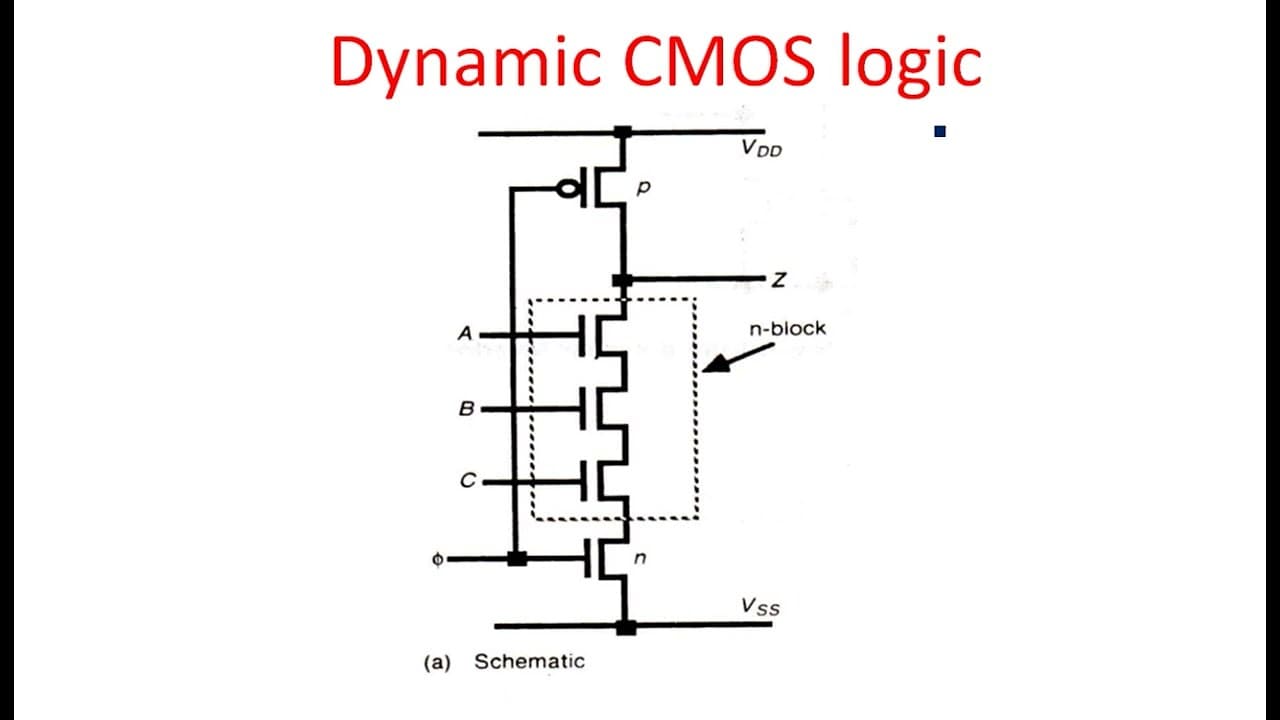
Dynamic semos logic is a type of logic realization using a combination of pmos and nmos transistors to create specific logic functions. It differs from pseudo inmos logic, which uses a half PM and half NM transistor setup. In dynamic semos logic, the common clock input plays a crucial role in changing states and facilitating operations, emphasizing the dynamic aspect of the logic over static setups.
Q: How does the three-input nand gate function using dynamic seos logic?
The three-input nand gate using dynamic seos logic consists of three pmos transistors connected in parallel and three nmos transistors arranged in series. This configuration allows for specific logic realization based on the input conditions, driven by the clock signal, ensuring the correct output is produced according to the given logic conditions.
Q: What role does the clock signal play in dynamic semos logic?
The clock signal in dynamic semos logic governs the operation of the transistors, switching them between on and off states. This timing is essential, as it allows for the evaluation of logic states during specific periods, preventing issues like charge sharing and ensuring that the output remains stable and accurate during operations.
Q: What are the challenges associated with single-phase dynamic logic structures?
Single-phase dynamic logic structures may face circuit delays, which can lead to incorrect input timings at the next circuit stage. This delay can result in unwanted changes in outputs due to cascading signals, making single-phase structures less reliable compared to multi-phase systems like a four-phase clock setup, which mitigates these issues.
Q: How does a four-phase clock improve dynamic logic circuit performance?
A four-phase clock improves dynamic logic circuit performance by ensuring that each clock phase is distinct and non-overlapping. This design reduces the chances of incorrect outputs caused by circuit delays, allowing the circuit to handle changes in input states more effectively, resulting in stronger logic outputs and improved overall reliability.
Q: What modifications can be applied to further enhance dynamic semos logic circuits?
To enhance dynamic semos logic circuits, a transmission gate can be included at the output. This modification helps buffer the connections, improving signal strength by converting weak outputs into strong ones, and minimizing delays caused by circuit interconnects, leading to faster and more reliable signal propagation.
Summary & Key Takeaways
-
The video introduces dynamic semos logic, comparing it to pseudo inmos logic, highlighting how pmos and nmos transistors work together in this phenomenon.
-
A focus is placed on the three-input nand gate implementation using dynamic seos logic, emphasizing the roles of each transistor in pull-up and pull-down networks.
-
The discussion extends to the importance of clock signals, particularly how a four-phase clock helps reduce charge sharing issues and improves circuit reliability.
Read in Other Languages (beta)
Share This Summary 📚
Summarize YouTube Videos and Get Video Transcripts with 1-Click
Try YouTube Summary with ChatGPT & Claude or YouTube Transcript Generator