Data Modeling - Complex Data Types and Cumulation - Day 1 Lecture - DataExpert.io Free Boot Camp

TL;DR
Introduction to complex data types and their application in data modeling.
Transcript
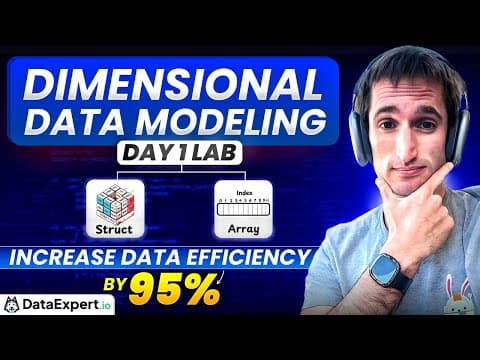
welcome to dimensional data modeling day one this is the very first lecture of the entire boot camp in this lecture we're going to be talking about complex data types like struct and array you can think of array as a list in a column and you can think of struct as almost like a table within a table so these two concepts are very important w... Read More
Key Insights
- Complex data types like structs and arrays help in creating compact data sets but come with usability challenges.
- Understanding the user of your data model is crucial for effective data modeling, as different users have different needs.
- Dimensions in data modeling can be identifiers or attributes, with attributes being either fixed or slowly changing.
- Data models can be categorized as OLTP for transactions, OLAP for analytics, and master data for a middle ground.
- Cumulative table design helps retain historical data and aids in transition analysis but has drawbacks like complex backfilling.
- The compactness-usability tradeoff in data modeling affects how data is stored and accessed, impacting performance and usability.
- Run-length encoding is an effective compression technique for reducing data size, especially in temporal data.
- Handling temporal dimensions requires careful consideration of data structures to maintain efficiency and avoid unnecessary data expansion.
Install to Summarize YouTube Videos and Get Transcripts
Explore YouTube Video Summarizer or Get YouTube Transcript Extractor
Questions & Answers
Q: What are complex data types and why are they important in data modeling?
Complex data types, such as structs and arrays, are used in data modeling to create more compact data sets. Structs can be thought of as tables within tables, and arrays as lists within columns. These data types help in reducing the size of data sets significantly, as demonstrated by the example of compressing Airbnb's listing data by over 95%. However, they come with usability challenges as they are harder to query and work with.
Q: How does understanding the data customer impact data modeling?
Understanding the data customer is crucial in data modeling because different users have different needs and expectations from the data. For example, data analysts and scientists require data that is easy to work with, typically in flat structures with simple data types. On the other hand, data engineers might work with nested types like structs and arrays. Machine learning models require flat and primitive types, while customers usually need data presented in charts or visual forms. Recognizing these needs ensures the data model is effective and user-friendly.
Q: What are the types of dimensions in data modeling?
In data modeling, dimensions can be categorized as identifiers or attributes. Identifier dimensions uniquely identify an entity, such as a user ID or social security number. Attributes are additional information about an entity and can be either fixed or slowly changing. Fixed attributes, like a birthday, do not change over time, while slowly changing attributes, like favorite food, can change over time. Understanding these dimensions helps in accurately modeling and analyzing data.
Q: What is the difference between OLTP and OLAP data models?
OLTP (Online Transaction Processing) and OLAP (Online Analytical Processing) are two types of data models with different purposes. OLTP is used for transaction processing, focusing on minimizing data duplication and optimizing for quick access to individual records, often in normalized forms. OLAP, on the other hand, is used for analytical processing, focusing on facilitating fast queries over large datasets, often at the expense of data duplication. OLAP models are typically denormalized to reduce the need for joins and to improve query performance.
Q: What is cumulative table design and what are its benefits?
Cumulative table design is a data modeling approach that retains historical data by merging today's data with yesterday's data through full outer joins. This design allows for comprehensive historical analysis and transition analysis, such as identifying user activity patterns over time. It provides a scalable solution for querying historical data without needing complex group by operations. However, it has drawbacks, such as the inability to backfill in parallel and the need to manage PII effectively.
Q: What is the compactness versus usability tradeoff in data modeling?
The compactness versus usability tradeoff in data modeling refers to the balance between minimizing data size and ensuring ease of use. Most compact tables use compression techniques and complex data types to reduce size, making them suitable for online systems with high user loads. In contrast, most usable tables are straightforward, with simple data types, making them ideal for analytical tasks. The middle ground involves using complex data types like structs and arrays, which are suitable for master data that other data engineers might consume.
Q: How does run-length encoding work in data compression?
Run-length encoding is a data compression technique that reduces the size of data by eliminating duplicate values in a sequence. It stores the value once along with the count of its occurrences, thus minimizing storage requirements. This technique is particularly effective when dealing with temporal data that has repetitive patterns, as it can significantly reduce the data size without losing information. Run-length encoding is commonly used in conjunction with file formats like Parquet to optimize storage in big data environments.
Q: What challenges arise when handling temporal dimensions in data modeling?
Handling temporal dimensions in data modeling involves challenges related to data expansion and sorting. Temporal dimensions, such as those involving time-based data like calendars, can lead to massive data sets if not managed properly. Using complex data types like arrays and structs can help maintain efficiency by keeping related data together, reducing the need for joins that can disrupt data sorting and compression. Properly managing these dimensions is crucial to avoid unnecessary data expansion and to ensure efficient data processing and storage.
Summary & Key Takeaways
-
The lecture introduces complex data types such as structs and arrays, explaining their importance in making data sets more compact. It highlights the challenges in querying and usability these data types bring.
-
Different types of dimensions in data modeling are discussed, including identifier dimensions and attributes, which can be fixed or slowly changing. The importance of understanding the user of the data model is emphasized.
-
The lecture covers OLTP and OLAP data models, explaining their differences and the role of master data as a middle ground. It also discusses cumulative table design for historical data retention and the compactness-usability tradeoff.
Read in Other Languages (beta)
Share This Summary 📚
Summarize YouTube Videos and Get Video Transcripts with 1-Click
Try YouTube Summary with ChatGPT & Claude or YouTube Transcript Generator
Explore More Summaries from Data with Zach 📚




Summarize YouTube Videos and Get Video Transcripts with 1-Click
Try YouTube Summary with ChatGPT & Claude or YouTube Transcript Generator