Definite Integration Based on Property No 4 Problem No 3 - Definite Integration - Diploma Maths II
TL;DR
This video explains how to solve a definite integral problem by determining if the function is odd or even.
Transcript
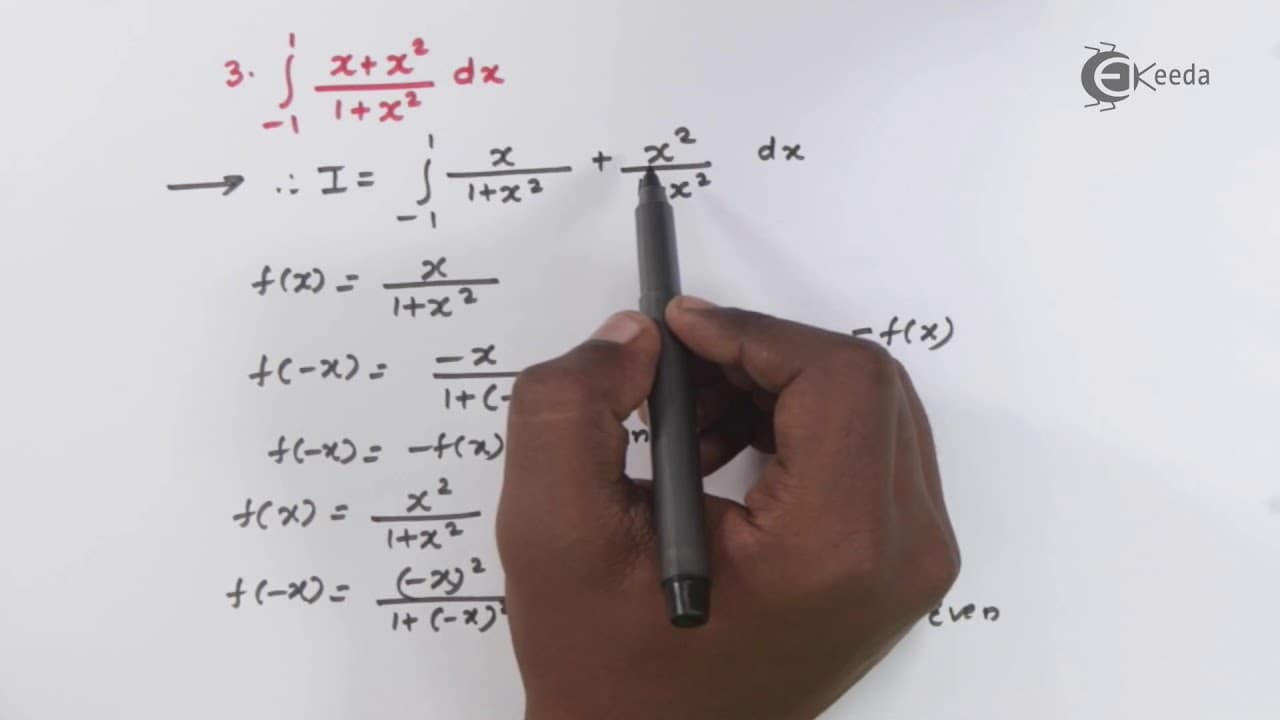
click the Bell icon to get latest videos from equator hello friends in this video we are going to continue one more problem which is based on property number 4 of definite integral so let us start with problem number 3 integral minus 1 to 1 X plus X square upon 1 plus X square DX here you can see the limits are given in the form of minus a to plus ... Read More
Key Insights
- 🦕 The video explains the process of determining if a function is odd or even and how it affects the definite integral value.
- 🥳 By separating the function into odd and even parts, the integration becomes simpler and more manageable.
- 👻 Adjusting the numerator and denominator allows for the separation of integrals and simplification.
- ⛔ The importance of considering the limits and symmetry of the function in definite integrals is highlighted.
- ❓ The solution provided showcases the step-by-step process of solving the given definite integral problem.
- 🅰️ This type of problem often involves algebraic manipulation and substitution to simplify the integrals.
- 🦕 Understanding the properties of odd and even functions helps in solving similar types of definite integral problems.
Install to Summarize YouTube Videos and Get Transcripts
Explore YouTube Video Summarizer or Get YouTube Transcript Extractor
Questions & Answers
Q: How do you determine if a function is odd or even?
To determine if a function is odd or even, you substitute -x for x in the given function. If the function remains unchanged (except for a possible negative sign), it is even. If the function changes sign (including the negative sign), it is odd.
Q: What happens when the function is odd and the limits are in the form of -a to a?
If the function is odd and the limits are in the form of -a to a, the integral value will be zero. This is because the positive and negative areas cancel each other out when the limits are symmetric.
Q: How do you simplify the even function after splitting the limits?
After splitting the limits for the even function, you can adjust the numerator by adding 1 to both parts of the fraction and balance it out by subtracting 1. This allows you to separate the numerator and denominator into two separate integrals.
Q: What is the final answer to the given definite integral problem?
The final answer to the given definite integral problem is 4 - π/2.
Summary & Key Takeaways
-
The video introduces a problem that involves finding the value of a definite integral with given limits.
-
The function is split into two parts: an odd function and an even function. The odd function has an integral value of zero, while the even function is further evaluated.
-
The even function is simplified by adjusting the numerator and denominator, resulting in two separate integrals.
-
The integrals are solved individually, and the final answer is obtained by combining the results.
Read in Other Languages (beta)
Share This Summary 📚
Summarize YouTube Videos and Get Video Transcripts with 1-Click
Try YouTube Summary with ChatGPT & Claude or YouTube Transcript Generator
Explore More Summaries from Ekeeda 📚






Summarize YouTube Videos and Get Video Transcripts with 1-Click
Try YouTube Summary with ChatGPT & Claude or YouTube Transcript Generator