Clipping circuits | Single ended | Part-1/2 | PDC | Pulse Digital Circuits | Lec-26
TL;DR
This video explains various single-ended clipping circuits and their functions.
Transcript
hi everyone in this video I want to give you the overall brief idea of some more single ended clipping circuits in the previous video we have seen shunt type Clippers series type Clippers and how the operation of shunt type acids type with respect to transfer functions also we have seen okay so now this video is especially for several circuits whic... Read More
Key Insights
- 📡 Shunt type clippers are used to remove specific portions of input signals by connecting diodes in parallel with the output.
- 🙊 The orientation of diodes determines whether positive or negative signal peaks are clipped from the waveform.
- 👻 Reference voltages can modify circuit behavior significantly, allowing selective clipping above or below a certain threshold.
- 📋 Sinusoidal waveforms provide a clear basis for analyzing and demonstrating clipping circuits' functionality.
- 📡 The diode's on and off states are critical in shaping the output waveform, affecting signal integrity and processing.
- ⚡ Shunt type clippers can operate without reference voltages, simplifying some designs yet limiting control.
- 🎨 The potential for multiple configurations means greater adaptability in circuit design, catering to varied electronic applications.
Install to Summarize YouTube Videos and Get Transcripts
Explore YouTube Video Summarizer or Get YouTube Transcript Extractor
Questions & Answers
Q: What are the main types of clipping circuits discussed in the video?
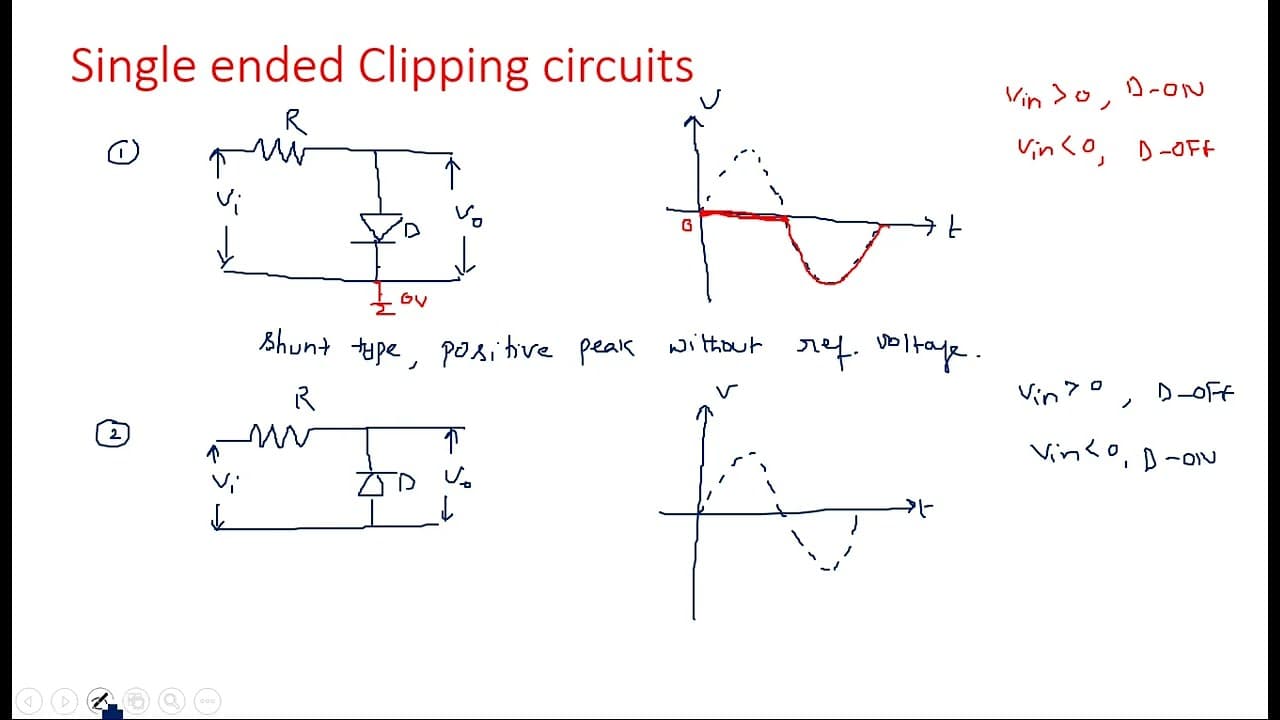
The video primarily covers shunt type and series type clipping circuits. Shunt type circuits are designed with diodes connected in parallel with the output, effectively clipping certain portions of the input signal. Series type circuits, on the other hand, have diodes placed in series, influencing the output based on input conditions.
Q: How does the diode's orientation affect the clipping operation?
The orientation of the diode is crucial in determining which peaks of the waveform are clipped. When a diode is forward-biased in a shunt configuration, it allows certain input segments to short circuit, resulting in zero output for positive peaks. Conversely, when reversed, it clips negative peaks from the waveform, affecting the resulting output signal.
Q: Can you explain the role of the reference voltage in clipping circuits?
Reference voltage plays a significant role in determining which parts of the input signal are preserved or discarded. By setting a reference voltage, designers can dictate whether only the positive or negative portions of a waveform are clipped, allowing for greater control over signal processing and output characteristics in various electronic applications.
Q: What is the significance of the sinusoidal input waveform in the examples?
The sinusoidal waveform serves as a standard input in the examples due to its predictable characteristics, making it easier to visualize and measure the effects of clipping. The sinusoidal nature illustrates how different configurations of clipping circuits respond to variations in voltage, impacting both the shape and amplitude of the output waveform.
Q: How does the output waveform change when the diode operates in an on versus off state?
When the diode is in an on state, the output waveform effectively short circuits to zero, removing the corresponding input peaks, while in an off state, the output waveform mirrors the input, preserving its shape. The switching between these states directly determines which peaks of the input are clipped and which are passed through.
Q: What is an example of a shunt type clipper without reference voltage?
An example of a shunt type clipper without reference voltage is a simple circuit with a resistor and a diode where the diode is connected in parallel to the output. In this configuration, positive peaks are clipped, while the negative peaks are passed, resulting in a specific output waveform characterized by the absence of positive voltage excursions.
Q: How do multiple configurations of clipping circuits enhance flexibility in design?
Multiple configurations allow designers to tailor the clipping behavior to specific signal conditions and requirements. By manipulating the positioning of resistors and diodes, along with the potential application of reference voltages, engineers gain a broader range of control over signal processing, enabling customized solutions for various electronic applications.
Summary & Key Takeaways
-
The video discusses multiple configurations of single-ended clipping circuits, including shunt and series types, focusing on diode behavior and output waveform generation.
-
Each clipping configuration utilizes a combination of resistors and diodes to selectively remove either positive or negative peaks from an input sinusoidal waveform.
-
The impact of reference voltages is explored, detailing how they influence clipping behavior in various circuit setups, such as negative reference voltage implementations.
Read in Other Languages (beta)
Share This Summary 📚
Summarize YouTube Videos and Get Video Transcripts with 1-Click
Try YouTube Summary with ChatGPT & Claude or YouTube Transcript Generator