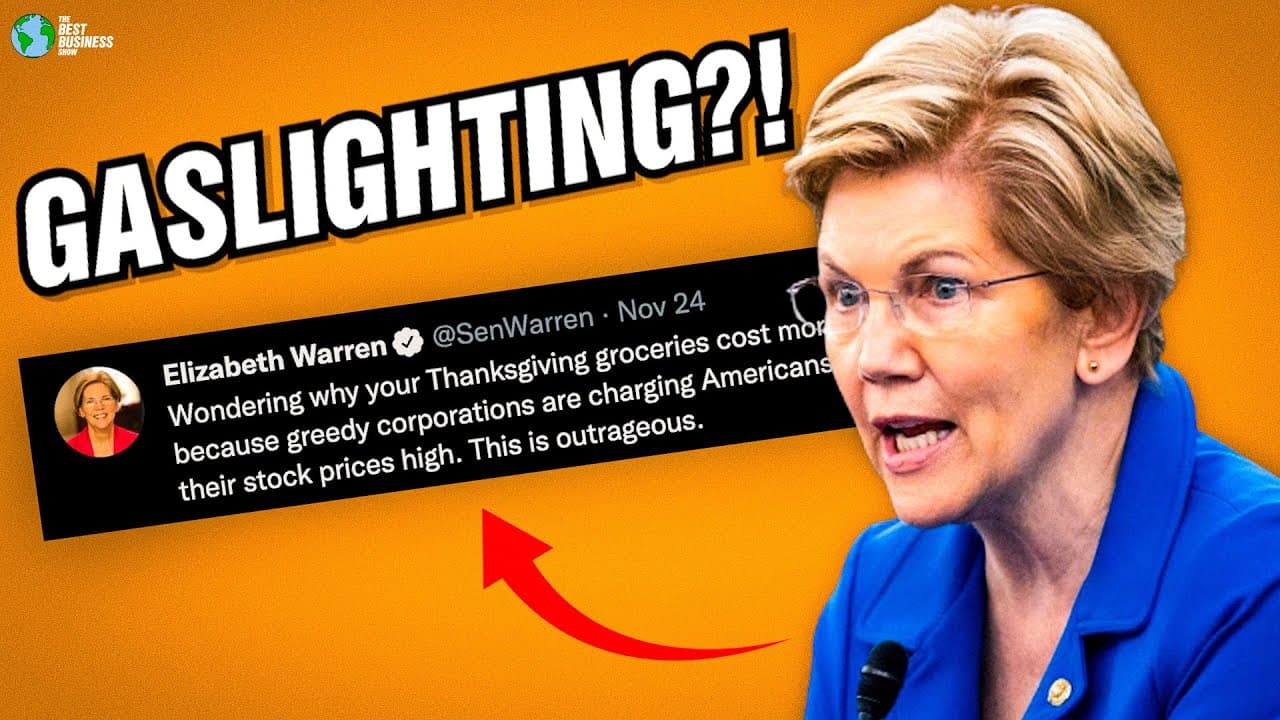
Are Politicians Misleading on Food Prices?
TL;DR
Rising food prices result from economic factors like inflation and increased labor costs, not just corporate greed as claimed by politicians like Elizabeth Warren. The prevailing economic climate, fueled by government policies and supply chain disruptions, requires a nuanced understanding beyond the oversimplified narratives offered by leaders.
Transcript
politicians are gaslighting americans that's what's happening right now we have two tweets over the weekend from a politician who absolutely is saying there's no way she believes this stuff zero chance that she believes the first tweet we have is that we elizabeth warren tweeted and said americans are paying record high prices for their thanksgivin... Read More
Key Insights
- 😋 Elizabeth Warren's accusation of corporate greed oversimplifies the multifaceted issues driving inflation and rising food prices.
- 🧑🏭 Economic factors, including increased labor costs and disrupted supply chains, are responsible for price adjustments rather than corporate malice.
- ✊ The unprecedented monetary stimulus has significantly impacted the economy, contributing to inflation and purchasing power erosion.
- 😃 The concept of "big poultry" raises questions about the accuracy of corporate responsibility narratives in the political discourse.
- 🇨🇷 There is a notable disconnect between political rhetoric and economic realities, particularly concerning cost increases across industries.
- 🤨 Small businesses, like larger corporations, face immense pressure to raise prices to cope with rising costs and labor shortages.
- 🧑🏭 Trust in politicians is diminishing, as many demonstrate a tendency to misrepresent facts for political gain rather than address underlying economic challenges.
Install to Summarize YouTube Videos and Get Transcripts
Explore YouTube Video Summarizer or Get YouTube Transcript Extractor
Questions & Answers
Q: What specific accusations did Elizabeth Warren make against poultry companies?
Elizabeth Warren accused poultry companies of abusing their market power by charging excessively high prices for Thanksgiving turkeys while simultaneously distributing large profits to shareholders and executives. This statement sparked debate about the reality of pricing mechanisms in the context of broader economic challenges.
Q: How do rising costs impact corporations and their pricing strategies?
Rising costs driven by increased labor expenses, material costs, and supply chain disruptions force corporations to raise their prices to maintain profit margins. This necessitates adjusting pricing strategies to protect profitability without being labeled as greedy, as they respond to market pressures.
Q: What role does government monetary policy play in current inflation rates?
The government's recent monetary policy, which involved significant stimulus measures and increased liquidity, has led to inflation by flooding the market with cash. This policy affects purchasing power and consumption patterns, contributing to upward pricing trends across various sectors, including food and labor.
Q: How do critics articulate the differences between corporate pricing and price gouging?
Critics argue that while businesses have to adjust prices due to increased operational expenses, price gouging implies unethical practices in setting prices to exploit consumers. They contend that higher costs are often a necessary response to economic realities rather than an indication of avarice or malfeasance.
Q: Why is it problematic to blame corporations for rising consumer prices, according to the content?
Blaming corporations overlooks the complex economic landscape dictated by inflation, increased labor costs, and disrupted supply chains. Such narratives often simplify the problem and distract from understanding how various factors, including government policy, drive inflation and affect pricing.
Q: What are the implications of rising wages for small businesses in today’s economy?
Rising wages, though generally beneficial for workers, have compelled small businesses to increase their prices to remain viable. This dynamic highlights the challenges small enterprises face in sustaining profitability amidst rising operational costs and heightened competition for labor.
Q: How do the commentators view Elizabeth Warren's statements on corporate greed?
The commentators express skepticism about Warren's claims, suggesting they are politically motivated rather than grounded in economic reality. They believe she is catering to her political base, diverting attention from systemic issues that contributed to inflation and corporate responses.
Q: What advice do the commentators provide regarding political narratives and trust in politicians?
They advise maintaining a critical perspective toward political narratives from both parties, emphasizing the need for individuals to examine issues independently and understand the complexity of economic matters rather than accepting simplified or biased representations.
Summary & Key Takeaways
-
The politicians, particularly Elizabeth Warren, are accused of misrepresenting the reasons for rising food prices, attributing them to corporate greed instead of inflation and increased costs.
-
The discussion highlights the complexities of the current economic climate, including high inflation rates, labor cost increases, and disrupted supply chains, which are affecting both large corporations and small businesses alike.
-
The commentary argues that government policies, including extensive monetary stimulus, have contributed to the inflationary landscape, urging citizens to critically evaluate political narratives surrounding corporate practices and pricing strategies.
Read in Other Languages (beta)
Share This Summary 📚
Summarize YouTube Videos and Get Video Transcripts with 1-Click
Try YouTube Summary with ChatGPT & Claude or YouTube Transcript Generator
Explore More Summaries from Anthony Pompliano 📚

Summarize YouTube Videos and Get Video Transcripts with 1-Click
Try YouTube Summary with ChatGPT & Claude or YouTube Transcript Generator