4.4.7 R4. Regression Trees - Video 6: The CP Parameter
TL;DR
The complexity parameter (cp) penalizes the number of splits in a decision tree, helping to balance accuracy and generalization.
Transcript
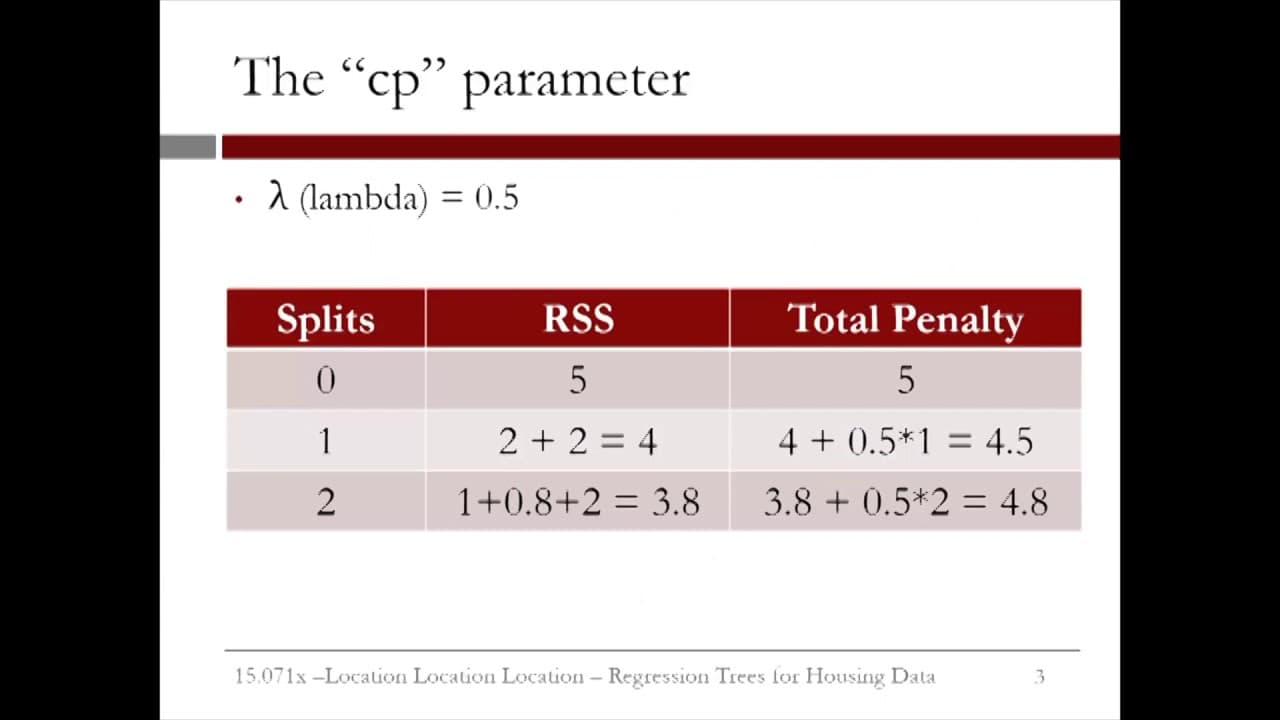
The cp parameter-- cp stands for complexity parameter. Recall that the first tree we made using latitude and longitude only had many splits, but we were able to trim it without losing much accuracy. The intuition we gain is, having too many splits is bad for generalization-- that is, performance on the test set-- so we should penalize the complexit... Read More
Key Insights
- 🌲 The complexity parameter (cp) balances the number of splits in a decision tree, aiming for a trade-off between accuracy and generalization.
- 🌲 The penalization of splits through lambda helps avoid overfitting by limiting the complexity of the tree.
- 🌥️ Small values of lambda encourage larger trees, while larger values discourage making additional splits.
- 💨 The complexity parameter (cp) is closely related to lambda, providing an easy way to adjust the size of the tree without directly interpreting lambda.
Install to Summarize YouTube Videos and Get Transcripts
Explore YouTube Video Summarizer or Get YouTube Transcript Extractor
Questions & Answers
Q: What does the complexity parameter (cp) stand for in decision trees?
The complexity parameter (cp) in decision trees stands for the penalty for having too many splits, allowing for a balance between accuracy and generalization.
Q: What is the goal when building a decision tree with the complexity parameter?
The goal when building a decision tree with the complexity parameter is to minimize the residual sum of squares (RSS) at each leaf, while penalizing the number of splits.
Q: How does lambda affect the decision tree's splits?
Lambda affects the decision tree's splits by determining the penalty for each additional split. A large value of lambda discourages making many splits, while a small or 0 value allows for more splits.
Q: How is the complexity parameter (cp) related to lambda?
The complexity parameter (cp) is closely related to lambda. It is calculated as cp=lambda/RSS(no splits) and serves as a way to encourage large trees (small cp) or small trees (large cp) without needing to directly interpret lambda.
Summary & Key Takeaways
-
The complexity parameter (cp) is used to penalize the number of splits in a decision tree, balancing accuracy and generalization.
-
The goal when building a decision tree is to minimize the residual sum of squares (RSS) at each leaf, plus lambda times the number of splits (S).
-
Choosing a small or 0 value for lambda will make many splits until it no longer decreases the error, while a large value of lambda discourages making many splits.
Read in Other Languages (beta)
Share This Summary 📚
Summarize YouTube Videos and Get Video Transcripts with 1-Click
Try YouTube Summary with ChatGPT & Claude or YouTube Transcript Generator
Explore More Summaries from MIT OpenCourseWare 📚



Summarize YouTube Videos and Get Video Transcripts with 1-Click
Try YouTube Summary with ChatGPT & Claude or YouTube Transcript Generator