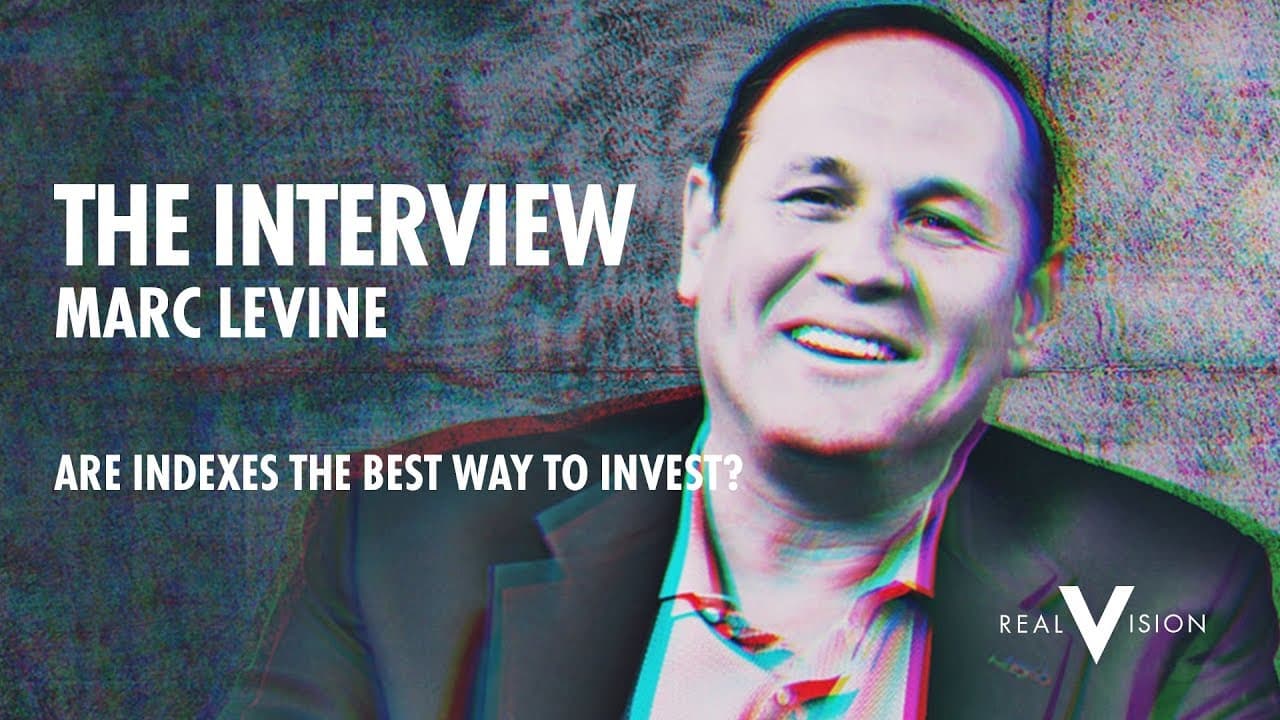
Are Indexes The Best Way To Invest? (w/ Marc Levine) | Interview | Real Vision™
TL;DR
The increasing popularity of passive investing has led to higher market correlation and a decline in active manager performance.
Transcript
the embedded correlation in equity markets is radically higher than it was ten years ago right which suggests that the volatility profile is different and if you think about that it makes sense right because if everybody's buying the S&P 500 you would expect and in the market is shifting increasingly passive towards those who are buying the S&P 500... Read More
Key Insights
- 😮 The rise of passive investing has led to a higher correlation among assets in equity markets.
- 😘 Passive strategies, particularly index investing, have gained popularity due to their low costs and ability to replicate market performance.
- ⌛ Active managers have struggled to outperform the market benchmarks, with the majority of them consistently underperforming over different time periods.
- 💓 Studies have shown that 93% of active managers fail to beat passive investments in terms of returns, making passive strategies a more reliable choice for investors.
- 🥺 The increased dominance of index funds and passive strategies has led to a decline in market volatility.
- 🥹 Active managers have a more individualistic stock selection approach and may have concentrated holdings in companies they believe have the best prospects.
- 😒 The use of data and studies by organizations like S&P further supports the superiority of passive investing over active management.
Install to Summarize YouTube Videos and Get Transcripts
Explore YouTube Video Summarizer or Get YouTube Transcript Extractor
Questions & Answers
Q: Why has the correlation in equity markets increased compared to ten years ago?
The correlation in equity markets has increased due to the growing popularity of passive investing, as more investors buy index funds like the S&P 500, causing the correlation among assets to rise.
Q: What is the difference between passive investing and active investing?
Passive investing involves investing in index funds or ETFs, which aim to replicate the performance of a specific market index. Active investing, on the other hand, involves individual stock selection and attempts to outperform the market through active management.
Q: Can active managers still generate higher returns compared to passive strategies?
Studies have shown that a significant majority of active managers underperform their benchmarks over various time periods. Therefore, passive strategies have proven to provide better returns for investors, leading to the popularity of index investing.
Q: Why do passive investors prefer index funds over active management?
Passive investors prefer index funds because they offer low costs, eliminate manager risk, and provide exposure to a diversified portfolio of stocks. This approach has consistently outperformed most active managers, making it an attractive option for many investors.
Summary & Key Takeaways
-
Equity market correlation has significantly increased in the past decade due to the rise of passive investing and the dominance of index funds.
-
Passive strategies, such as investing in popular index funds like the S&P 500, have created higher correlations among assets and increased market volatility.
-
Active managers, who have a more individualistic approach to stock selection, are struggling to outperform the market benchmarks due to the rise of passive investing.
Read in Other Languages (beta)
Share This Summary 📚
Summarize YouTube Videos and Get Video Transcripts with 1-Click
Try YouTube Summary with ChatGPT & Claude or YouTube Transcript Generator
Explore More Summaries from Real Vision 📚


Summarize YouTube Videos and Get Video Transcripts with 1-Click
Try YouTube Summary with ChatGPT & Claude or YouTube Transcript Generator