What Are the Key Properties of Determinants?
TL;DR
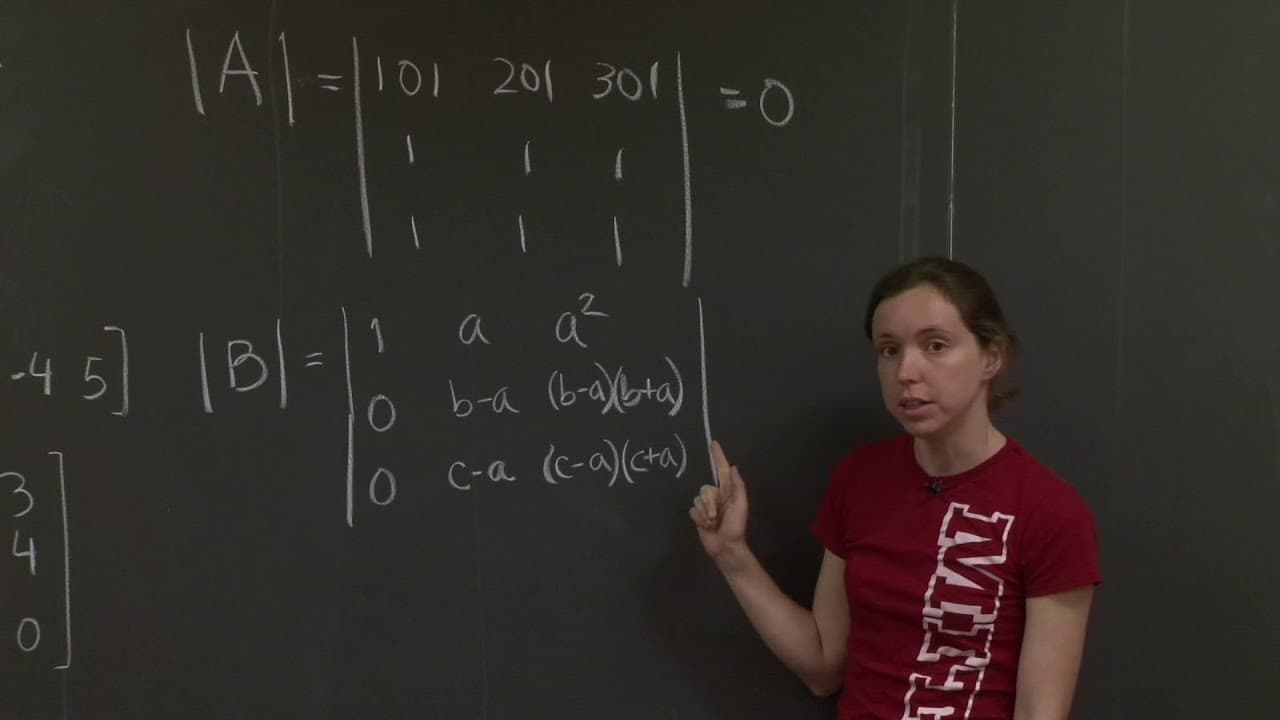
The key properties of determinants include that the determinant of the identity matrix is always 1, switching two rows changes the sign of the determinant, and it is a linear function of each row separately. Additionally, determinants can be calculated using these properties, leading to specific formulas for types of matrices, such as the Vandermonde determinant and considerations for skew-symmetric matrices.
Transcript
ANA RITA PIRES: Hi. Welcome back to recitation. In lecture, you've been learning about the properties of determinants. To remember, there were three main properties, and then seven more that fall out of those three. I'll tell you what these three were. The first one was the determinant of the identity matrix is always equal to 1. If you switch two ... Read More
Key Insights
- 🚨 Additionally, seven more properties emerge from the three main properties of determinants.
- 🤨 Elimination steps, except for permuting rows, do not change the determinant of a matrix.
- 💌 The Vandermonde determinant follows a pattern with differences of the letters present in the matrix.
- 🤨 A product of a column vector and a row vector results in a singular matrix with a determinant of 0.
Install to Summarize YouTube Videos and Get Transcripts
Explore YouTube Video Summarizer or Get YouTube Transcript Extractor
Questions & Answers
Q: What are the three main properties of determinants?
The three main properties of determinants are: (1) the determinant of the identity matrix is always 1, (2) switching two rows changes the determinant's sign, and (3) the determinant is a linear function of each row separately.
Q: How do you find the determinant of a Vandermonde matrix?
To find the determinant of a Vandermonde matrix, you can apply elimination steps and factor out common terms. The resulting determinant follows a specific pattern, even for larger Vandermonde matrices.
Q: Why is the determinant of matrix C equal to 0?
Matrix C is a product of two matrices, resulting in a rank one matrix with linearly dependent rows. As a result, the determinant of C is always 0.
Q: Are all skew-symmetric matrices guaranteed to have a determinant of 0?
Not necessarily. While the skew-symmetric matrix D in the example has a determinant of 0, the determinant of a skew-symmetric matrix can be any number, depending on the specific values of the matrix. The determinant being 0 in this case was due to the specific factors present in the matrix.
Summary & Key Takeaways
-
The content discusses the three main properties of determinants: the determinant of the identity matrix is always 1, switching two rows changes the determinant's sign, and the determinant is a linear function of each row separately.
-
The content provides examples of finding determinants using these properties for four different matrices: A, B (Vandermonde matrix), C (product of two matrices), and D (skew-symmetric matrix).
-
The content concludes with additional insights such as the Vandermonde determinant formula and the connection between skew-symmetric matrices and determinants.
Read in Other Languages (beta)
Share This Summary 📚
Summarize YouTube Videos and Get Video Transcripts with 1-Click
Try YouTube Summary with ChatGPT & Claude or YouTube Transcript Generator
Explore More Summaries from MIT OpenCourseWare 📚


Summarize YouTube Videos and Get Video Transcripts with 1-Click
Try YouTube Summary with ChatGPT & Claude or YouTube Transcript Generator