NEET Physics Dual Nature of Radiation and Matter : Multiple Choice Previous Years Questions MCQs 4
TL;DR
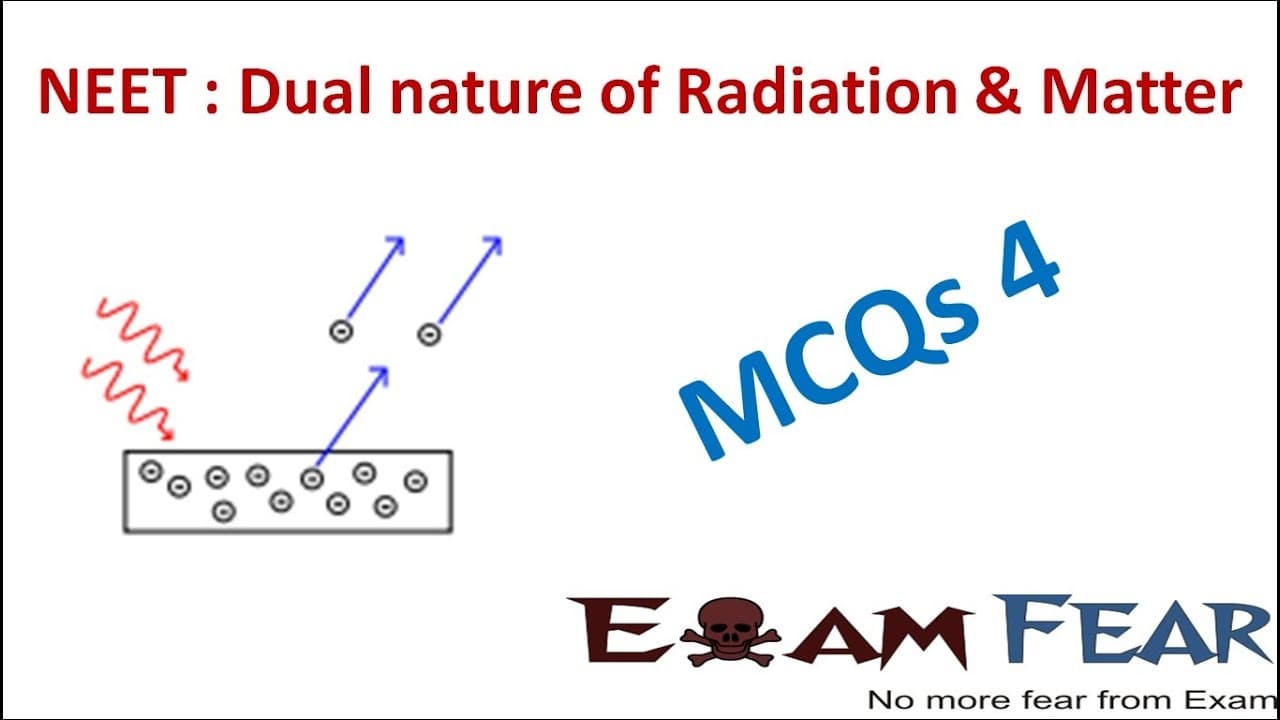
Calculate the energy of incident radiation and determine which metals will emit photoelectrons based on their work functions.
Transcript
hello friends this video on neat dual nature of radiation and matter is brought to you by example.com no more fear from exam question number 11 the work functions for metals a b and c are respectively 1.92 electron volt 2 electron volt and 5 electron volt according to einstein's equation the metals which will emit photoelectrons for a radiation of ... Read More
Key Insights
- 😌 Work functions for metals A, B, and C are given as 1.92 eV, 2.0 eV, and 5.0 eV, respectively.
- 🫤 The energy of incident radiation is calculated using the formula E = hc/λ.
- ⚡ Converting the energy to electron volts, the value is approximately 3 eV.
- 💦 Photoelectric emission occurs when the energy of incident radiation is greater than the work function.
- 😃 Metals A and B will emit photoelectrons, while metal C will not.
- 🙂 The intensity of light decreases as the distance between the light source and the photoelectric cell increases.
- 🙂 The number of photoelectrons emitted is directly proportional to the intensity of light.
Install to Summarize YouTube Videos and Get Transcripts
Explore YouTube Video Summarizer or Get YouTube Transcript Extractor
Questions & Answers
Q: How do you calculate the energy of incident radiation?
The energy of incident radiation can be calculated using the formula E = hc/λ, where h is Planck's constant, c is the speed of light, and λ is the wavelength of the radiation.
Q: How do you convert the energy of incident radiation to electron volts?
To convert the energy from joules to electron volts, divide it by 1.6 x 10^-19.
Q: Which metals will emit photoelectrons in the given scenario?
Metals A and B will emit photoelectrons because the energy of the incident radiation is greater than their respective work functions. Metal C will not emit photoelectrons because the energy is less than its work function.
Q: How does the distance between the light source and the photoelectric cell affect the number of photoelectrons emitted?
As the distance between the light source and the cell increases, the intensity of the light decreases. The number of photoelectrons emitted is directly proportional to the intensity of light, so reducing the distance by half will increase the number of photoelectrons emitted four times.
Summary & Key Takeaways
-
The video discusses the concept of photoelectric emissions and work functions for three different metals.
-
It explains how to calculate the energy of incident radiation and convert it to electron volts.
-
It shows how to determine which metals will emit photoelectrons based on their work functions and the energy of the incident radiation.
Read in Other Languages (beta)
Share This Summary 📚
Summarize YouTube Videos and Get Video Transcripts with 1-Click
Try YouTube Summary with ChatGPT & Claude or YouTube Transcript Generator
Explore More Summaries from LearnoHub - Class 11, 12 📚



Summarize YouTube Videos and Get Video Transcripts with 1-Click
Try YouTube Summary with ChatGPT & Claude or YouTube Transcript Generator