Mindbending Explanation Of Tantra According To The Vedas - Hinduism Expert Om Dhumatkar
TL;DR
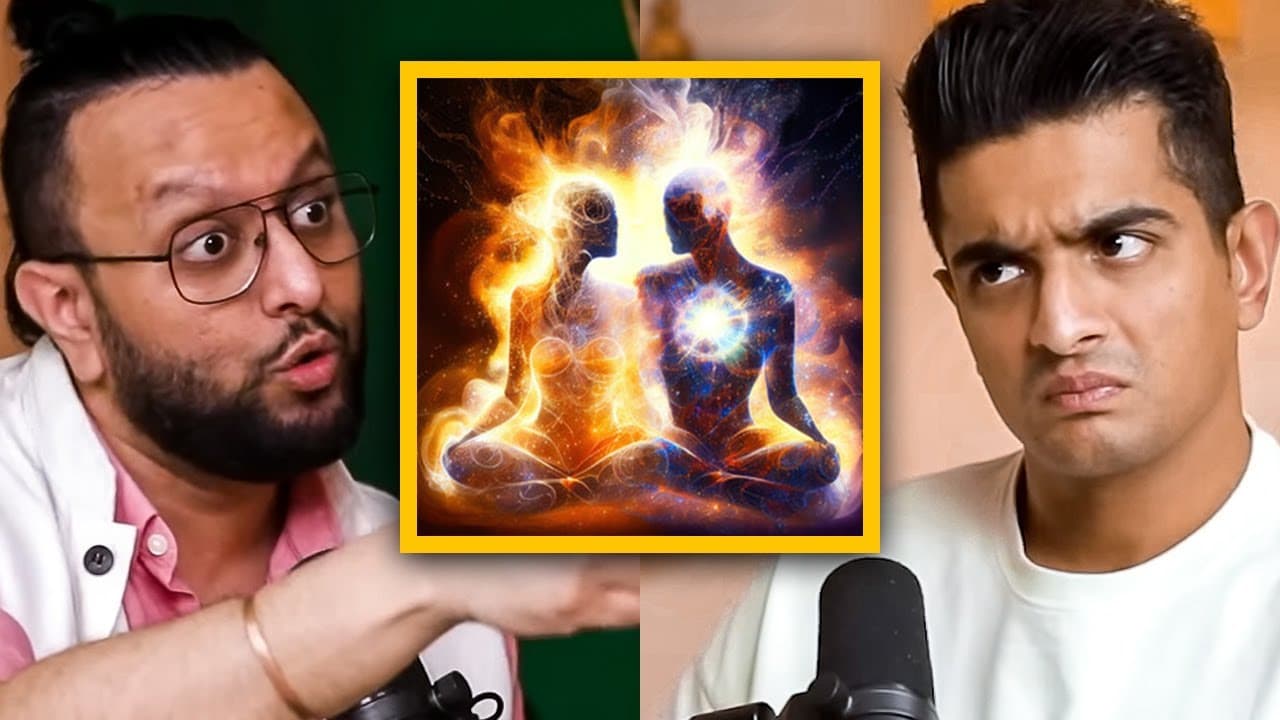
Discusses the diverse paths of Hinduism, emphasizing Tantra's significance and implications.
Transcript
happiness through Curiosity on Dr eclipse that rajashi nandi on the show who's become like a fan favorite okay now because of the Tantra podcast what a guy incredible yeah uh if any of the audience members have not checked out those episodes my God you should go check it out give me a whole different aspect on Hinduism it was very Tantra Centric ok... Read More
Key Insights
- ❓ Hinduism is a vast religion with multiple paths, including Tantra, Vedic rituals, and modern practices.
- 🫵 Tantra is often viewed as the quickest route to achieving liberation, but its effectiveness is subjective to individual experiences.
- 🕴️ The evolution of Hinduism heavily involves adaptations of ancient practices to suit contemporary spiritual needs and societal changes.
- ❓ Different spiritual paths in Hinduism can complement each other, as exemplified by Krishna's teachings in the Bhagavad Gita.
- 🅰️ Body types and personal conditioning significantly influence one's spiritual practice choice and effectiveness.
- 🛕 Temples and modern worship practices connect back to ancient traditions but have also diversified over time.
- ❓ Misconceptions about Tantra often focus on its sexual elements while neglecting its broader spiritual and philosophical dimensions.
Install to Summarize YouTube Videos and Get Transcripts
Explore YouTube Video Summarizer or Get YouTube Transcript Extractor
Questions & Answers
Q: What is the relationship between Tantra and liberation in Hinduism?
Tantra is considered a potent spiritual path within Hinduism that aims at liberation or Nirvana. It emphasizes transcending one's ego and achieving enlightenment through specific practices and rituals. Unlike other paths, Tantra integrates physicality with spirituality, making discipline an essential component. Its complexity and potential for danger also call for careful practitioners who seek deeper knowledge of their subconscious and consciousness.
Q: How does the understanding of different body types relate to spiritual practices in Hinduism?
The discussion of body types—ectomorph, mesomorph, and endomorph—illustrates that individuals have varying tendencies that require personalized approaches to spiritual growth. Similar to physical training, the spiritual path one might find most effective can differ, indicating that practices like Gyan, Karma, or Tantra may vary in efficacy based on one's inherent nature and mental conditioning.
Q: Why is the historical perspective important when discussing Hinduism today?
Understanding the historical evolution of Hinduism is crucial as it provides insight into how ancient practices have transformed and adapted over time. Encounters such as the dialogue between Arjuna and Krishna in the Bhagavad Gita highlight the philosophical underpinnings that shaped modern practices and beliefs. This historical context reveals the continuity and change within the religion, informing current practices.
Q: Can Tantra be associated solely with sexual practices?
While Tantra has been sensationalized to focus on sexual aspects, its essence encompasses much more. Tantra is fundamentally about transcending the physical realm and utilizing physicality to achieve spiritual growth. The sexual practices are merely a fraction of a broader discipline that encompasses profound philosophical and spiritual techniques for enlightenment.
Q: How do modern practices differ from ancient Hindu rituals?
Modern Hindu practices, such as temple worship and prayers to murtis, have evolved from ancient rituals that were prominently Vedic or Tantric. The Kali Santarana Upanishad suggests that in Kali Yuga, simpler practices, like mantra chanting, are more effective for spiritual progress. This reflects a shift in how ancient rituals are adapted to fit contemporary spirituality while retaining essential philosophical foundations.
Summary & Key Takeaways
-
The content explores the evolution of Hinduism, highlighting differing practices, including Tantric and Vedic traditions, and their historical contexts.
-
It posits that Tantra may be the fastest path to spiritual growth and enlightenment, though its effectiveness varies based on individual conditioning and mindsets.
-
The discussion also clarifies that while modern practices may have roots in ancient traditions, interpretations and methods have evolved to suit contemporary spiritual needs.
Read in Other Languages (beta)
Share This Summary 📚
Summarize YouTube Videos and Get Video Transcripts with 1-Click
Try YouTube Summary with ChatGPT & Claude or YouTube Transcript Generator
Explore More Summaries from TRS Clips 📚



Summarize YouTube Videos and Get Video Transcripts with 1-Click
Try YouTube Summary with ChatGPT & Claude or YouTube Transcript Generator