What Is CW Radar and How Does It Measure Velocity?
TL;DR
Continuous Wave (CW) radar measures the velocity of moving objects using the Doppler frequency shift, rather than providing range information. Unlike pulse radar, which measures distances, CW radar relies on a simpler setup with a continuous wave transmitter and receiver, making it ideal for applications where monitoring speed is essential but measuring distance is unnecessary.
Transcript
hi everyone in this video I am going to introduce about the CW radar which is nothing but continuous Wave Rider CW radar stands for continuous View radar I already told you when I was discussing about pulse radar there are several types of radar systems available each and every reli system is named based on the type of the waveform it emits type of... Read More
Key Insights
- 🐎 CW radar is specifically useful for targeting applications where object speed monitoring is essential but distance measurement is not required.
- 💄 The simplicity of CW radar hardware makes it an attractive option in industries that demand reliable velocity assessments with minimized complexity.
- 🖐️ Doppler frequency plays a crucial role in determining the speed of moving objects in CW radar applications, highlighting the importance of frequency analysis.
- 🕴️ The operational efficiency of CW radar is suited for environments requiring quick and continuous monitoring of moving targets, such as traffic control or naval tracking systems.
- 🎯 With CW radar, practitioners must account for potential issues with stationary targets, as their presence can result in zero output signals, complicating data interpretation.
- 👻 The technology’s unique properties allow for applications in law enforcement and military settings, where velocity measurement is critical for tracking.
- 💗 Understanding how both CW and pulse radar function can enhance capabilities in various technological fields and improve operational strategies.
Install to Summarize YouTube Videos and Get Transcripts
Explore YouTube Video Summarizer or Get YouTube Transcript Extractor
Questions & Answers
Q: What is the primary function of CW radar?
The primary function of Continuous Wave Radar (CW radar) is to determine the velocity of moving targets. Unlike other radar systems that can measure distance, CW radar exclusively focuses on monitoring how quickly an object is moving towards or away from the radar source, which is critical in numerous applications, including aviation and vehicular tracking.
Q: How does CW radar determine the velocity of a target?
CW radar determines the velocity of a target by analyzing the Doppler frequency shift. When a target moves, the frequency of the radar waves reflects a change based on the target's velocity. Using the established relation between Doppler frequency and velocity, represented as FD = 2 vR / λ, radar operators can compute the relative velocity of the moving object accurately.
Q: Why can't CW radar measure range?
CW radar cannot measure the range to a target because it emits a continuous wave instead of pulses. Since it lacks the time delay information that pulses provide, it is unable to assess how far an object is located, limiting its functionality in applications where distance measurement is necessary.
Q: What are the key components of the CW radar system?
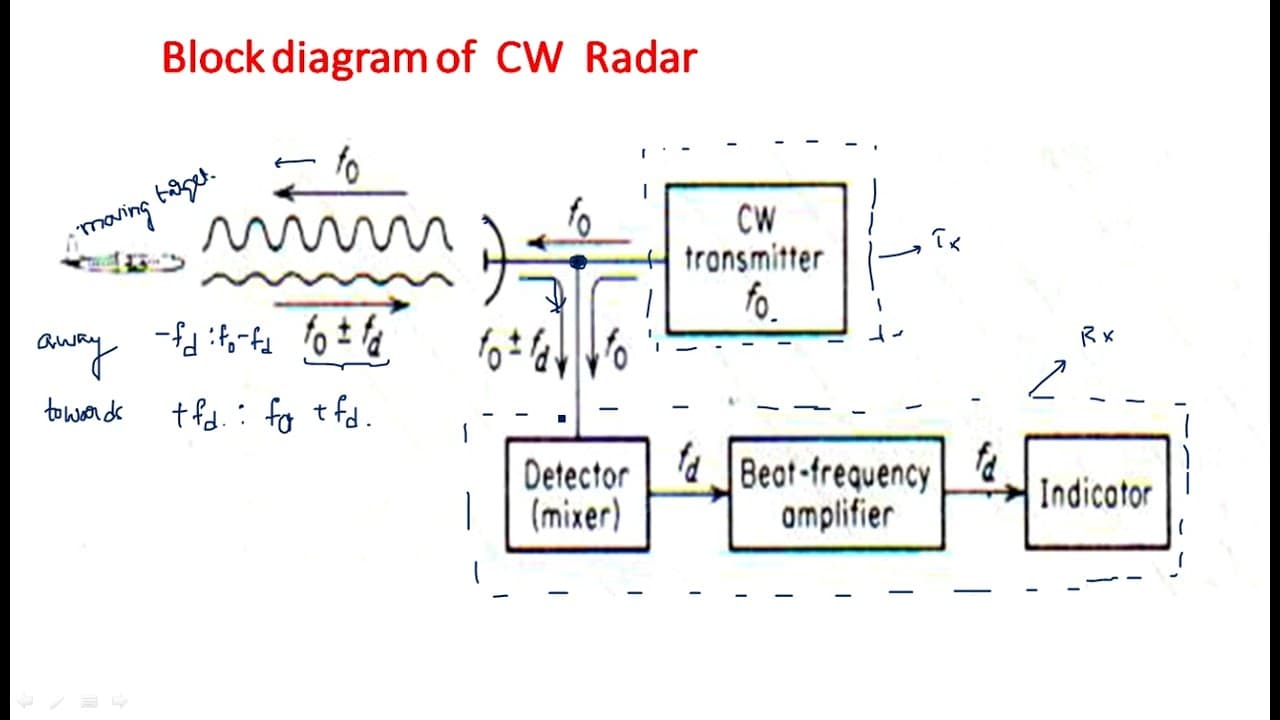
The key components of a CW radar system include a continuous wave transmitter, a receiver, and an antenna. The transmitter generates a continuous wave signal that is sent out into the air, while the receiver captures the reflected waves to analyze them for frequency changes caused by moving targets.
Q: How does the block diagram of CW radar compare to pulse radar?
The block diagram of CW radar is less complex than that of pulse radar. CW radar requires only a continuous wave generator and amplifier for transmission, while pulse radar necessitates additional components for modulation and complexity inherent in pulse waveform transmission.
Q: What happens to the CW radar output when detecting stationary targets?
When CW radar detects a stationary target, the output frequency reflects no change, resulting in a Doppler frequency shift of zero. This means that the radar will effectively indicate no velocity, as stationary objects do not generate the frequency shift required for measurement, leading to a simple output signal.
Q: Can CW radar detect multiple targets simultaneously?
CW radar can face challenges in simultaneously detecting multiple targets because it focuses on measuring the frequency shift of the closest (or moving) target. The continuous nature of the wave can complicate distinguishing between multiple signals, especially within crowded environments.
Summary & Key Takeaways
-
Continuous Wave Radar (CW radar) is designed to detect the velocity of moving objects using a continuous wave, unlike pulse radar, which measures range.
-
The calculation of relative velocity in CW radar relies on the Doppler frequency shift rather than direct velocity calculations, making it unique among radar systems.
-
The CW radar system is less complex than pulse radar, requiring only a continuous wave generator, receiver, and antenna for effective operation.
Read in Other Languages (beta)
Share This Summary 📚
Summarize YouTube Videos and Get Video Transcripts with 1-Click
Try YouTube Summary with ChatGPT & Claude or YouTube Transcript Generator