What Are Steering Behaviors and How to Implement Seeking?
TL;DR
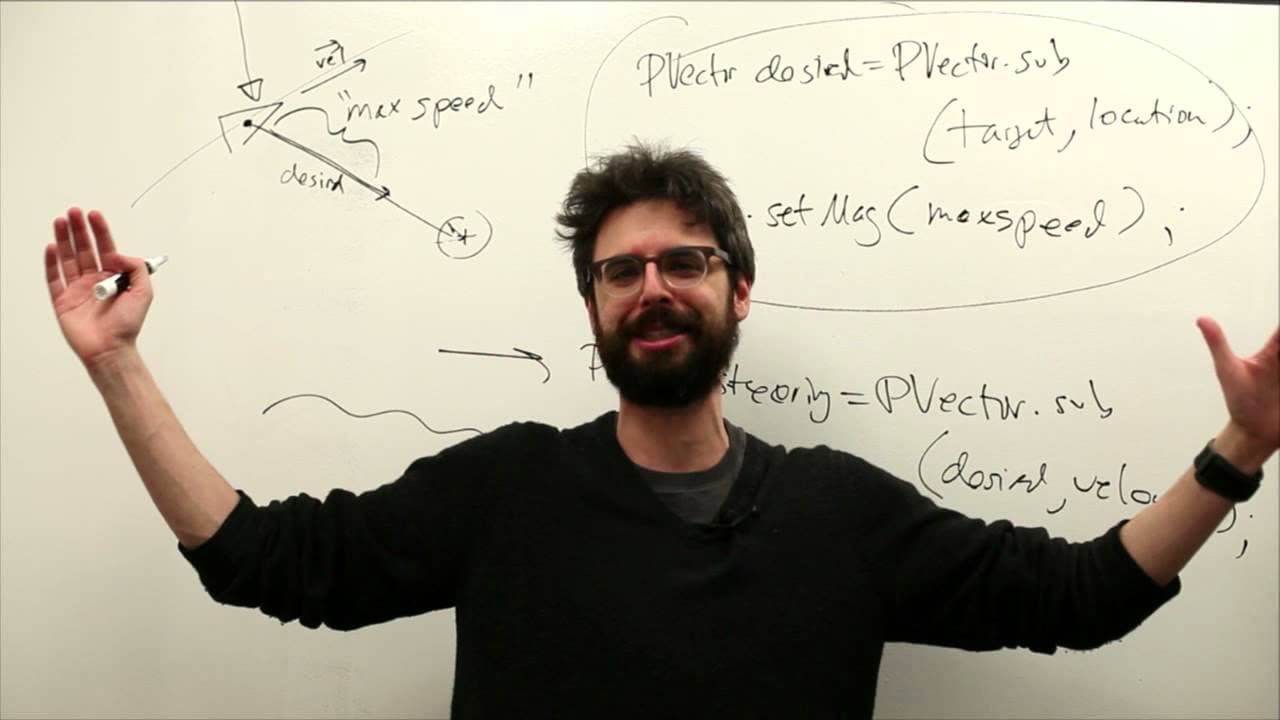
Steering behaviors are techniques that allow autonomous agents to navigate towards targets. To implement seeking behavior, calculate the desired velocity vector from the agent's position to the target, adjusting it based on maximum speed and maximum force parameters. This allows the agent to move realistically and efficiently towards its goal.
Transcript
I forgot what I was going to say hi um steering behaviors this video is going to we're going to walk through our first we're going to make out an autonomous agent it's going to have a steering Behavior moded off of the work of Craig Reynolds and it's going to be very exciting so let's take a look we're going to start with a basic scenario let's say... Read More
Key Insights
- ❓ Steering behaviors enable autonomous agents to exhibit lifelike and realistic movements.
- 🧘 The seeking behavior involves calculating the desired velocity based on the agent's current location and the target's position.
- 🐎 Parameters like maximum speed and maximum force greatly influence the behavior of the agent.
Install to Summarize YouTube Videos and Get Transcripts
Explore YouTube Video Summarizer or Get YouTube Transcript Extractor
Questions & Answers
Q: What is the purpose of implementing steering behaviors in autonomous agents?
Steering behaviors allow autonomous agents to navigate and interact with their environment in a lifelike and improvisational manner. It adds realism and variability to their movements.
Q: How is the desired velocity calculated in the seeking behavior?
The desired velocity is calculated by creating a vector that points from the agent's location to the target. Then, it is scaled to the maximum speed of the agent using the set magnitude function.
Q: What are the significance of the maximum speed and maximum force parameters?
The maximum speed parameter determines the top speed at which the agent can move, while the maximum force parameter controls how effectively the agent can turn. These parameters allow fine-tuning of the agent's behavior.
Q: How is the steering force calculated in the seeking behavior?
The steering force is calculated by subtracting the agent's velocity from the desired velocity. This resulting vector represents the force needed to steer the agent towards the target.
Summary & Key Takeaways
-
The video explains how to create an autonomous agent that exhibits seeking behavior towards a target in a basic scenario.
-
It demonstrates the calculation of the desired velocity for the agent to reach the target as fast as possible.
-
The video emphasizes the importance of parameters like maximum speed and maximum force in controlling the behavior of the agent.
Read in Other Languages (beta)
Share This Summary 📚
Summarize YouTube Videos and Get Video Transcripts with 1-Click
Try YouTube Summary with ChatGPT & Claude or YouTube Transcript Generator
Explore More Summaries from The Coding Train 📚




Summarize YouTube Videos and Get Video Transcripts with 1-Click
Try YouTube Summary with ChatGPT & Claude or YouTube Transcript Generator