Buckyball: Tiny Carbon Soccer Balls
TL;DR
Scientists discovered a new form of carbon, buckminsterfullerene or buckyballs, in 1985. It has unique properties and potential applications in various fields, including medicine.
Transcript
We tend to talk a lot about carbon on this show, because it’s difficult to avoid when you’re talking about science, or the Earth, or eating, or breathing, or existing in the universe. Carbon is a big deal - it’s all around us. We are carbon-based lifeforms so you’d think we’d have been familiar with all the different forms, or allotropes, of carbon... Read More
Key Insights
- 🤙 Carbon is a versatile element, and in 1985, scientists discovered a new form called buckminsterfullerene or buckyballs.
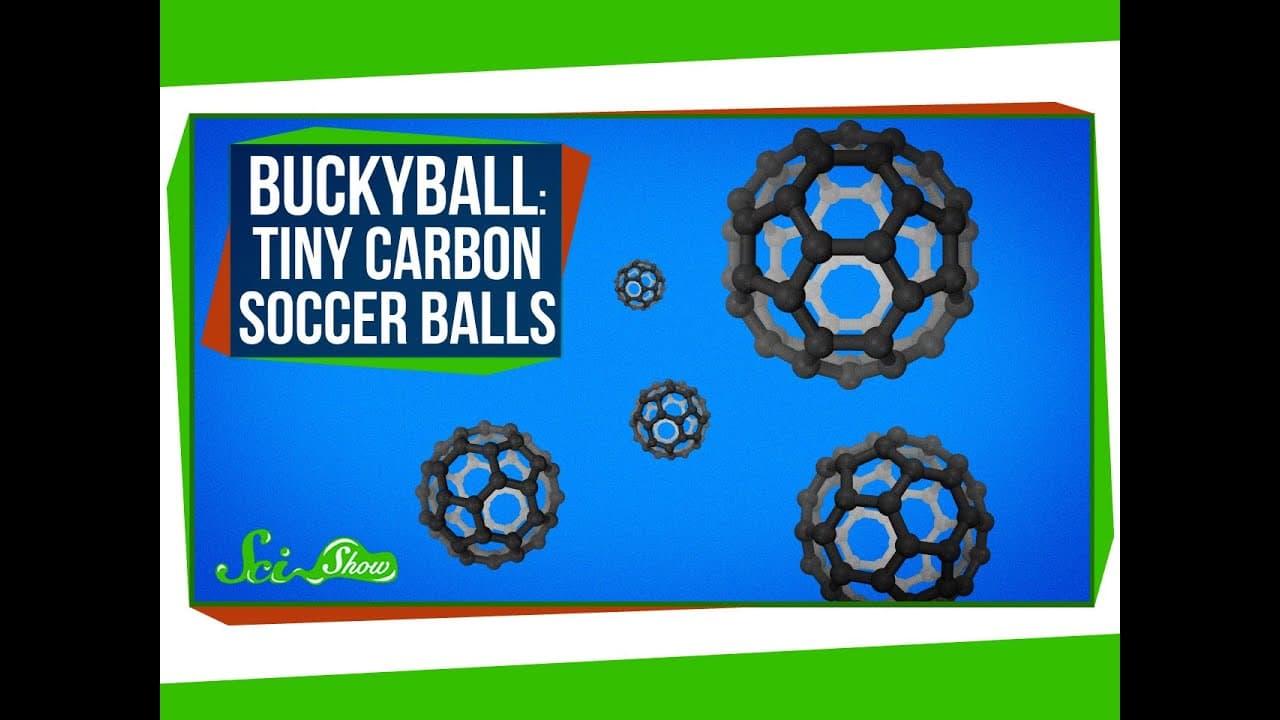
- ⚽ Buckyballs have 60 carbon atoms arranged in a spherical cage-like structure, resembling a soccer ball.
- ✋ They have unique properties such as high electrical conductivity, flexibility, and the ability to become incredibly hard under pressure.
- ⛈️ Buckyballs occur naturally on Earth, including in soot and areas struck by lightning.
- 😶🌫️ They are also found in space, with clouds of buckyballs being common interstellar phenomena.
- 🚚 Buckyballs have potential applications in medicine, including targeted drug delivery and tumor destruction.
- 😷 Current research focuses on utilizing buckyballs in individual cells for medical purposes.
Install to Summarize YouTube Videos and Get Transcripts
Explore YouTube Video Summarizer or Get YouTube Transcript Extractor
Questions & Answers
Q: How did scientists discover buckyballs?
Scientists Harold Kroto and Richard Smalley used a powerful laser to break carbon-carbon bonds in graphite, leading to the formation of buckyballs alongside long carbon chains.
Q: What makes buckyballs unique?
Buckyballs are extremely stable carbon molecules with 60 carbon atoms arranged in a spherical cage. Their unique structure and electron configuration give them flexibility, high electrical conductivity, and the ability to become incredibly hard under pressure.
Q: Where can buckyballs be found?
Buckyballs can be found in soot from candles, areas struck by lightning, and in space. Solid C60, a type of buckyball, has been discovered around stars 6,500 light years away from Earth.
Q: How can buckyballs be used in medicine?
Recent research suggests that buckyballs can be used to deliver medication or destroy tumors. When combined with nitrous oxide, buckyballs can create controlled explosions, leading to potential applications in targeted therapy.
Summary & Key Takeaways
-
In 1985, scientists discovered buckminsterfullerene, a new form of carbon shaped like a soccer ball.
-
Buckminsterfullerene, or buckyballs, have unique properties and can be found in nature and space.
-
Recent research suggests that buckyballs could be used in medicine, such as delivering medication or destroying tumors.
Read in Other Languages (beta)
Share This Summary 📚
Summarize YouTube Videos and Get Video Transcripts with 1-Click
Try YouTube Summary with ChatGPT & Claude or YouTube Transcript Generator
Explore More Summaries from SciShow 📚

Summarize YouTube Videos and Get Video Transcripts with 1-Click
Try YouTube Summary with ChatGPT & Claude or YouTube Transcript Generator