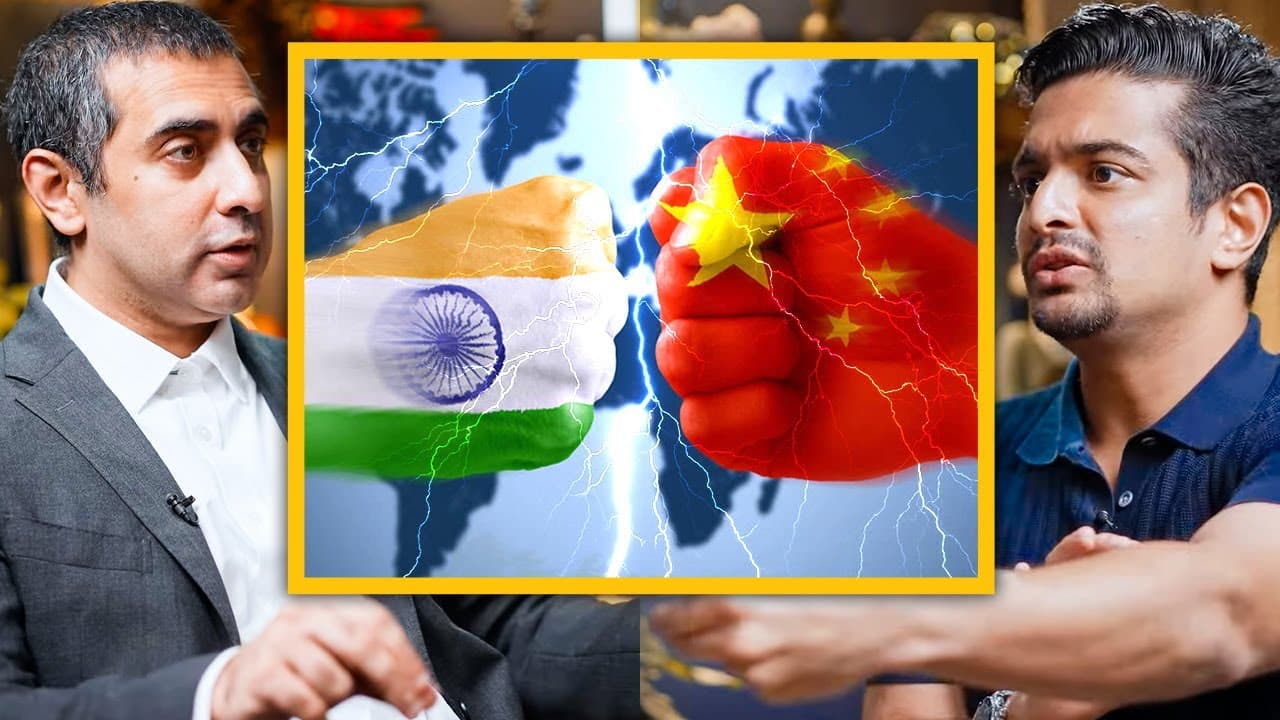
India Must Not Fight China - Balaji S Breaks Down India Vs China War Possibility
TL;DR
India and China are under pressure, but war is unlikely.
Transcript
binge watch and learn on PRS Clips we had a lot of people come on the show uh Indian guys Indian geopolitical commentators who suggest that we're on the brink of a war with China and so is America uh I'd actually like to just have this as the last section of today's conversation sure sure uh have you thought about the possibility of a hot war or do... Read More
Key Insights
- 😀 India faces external pressures from superpowers but demonstrates resilience in avoiding war.
- 🧘 Modi's diplomatic efforts position India favorably within complex global alliances.
- 🫱 Economic theories regarding the impact of war often misinterpret the relationship between destruction and growth.
- 🚨 Many countries continue to grapple with outdated definitions of democracy, which may inhibit understanding of emerging models like India’s.
- ✊ The geopolitical landscape relies heavily on the ability of nations to navigate conflicts through soft power and diplomacy rather than military action.
- 🌍 Public perception often simplifies complex geopolitical issues into binary outcomes, missing the nuances of international relations.
- 🌍 As economic shifts occur globally, alternative models of democracy may gain traction, reflecting a multipolar world.
Install to Summarize YouTube Videos and Get Transcripts
Explore YouTube Video Summarizer or Get YouTube Transcript Extractor
Questions & Answers
Q: What are the current geopolitical concerns between India and China?
The key concerns revolve around border disputes and military presence, which have historically led to tensions. However, both countries appear to be managing these disputes cautiously to avoid escalation into a larger conflict, which is seen as strategically smart given both nations are nuclear powers.
Q: How does Modi's leadership contribute to India's role on the world stage?
Modi has successfully facilitated diplomatic discussions, particularly during the G20, garnering participation from multiple nations on issues like Ukraine. His popularity and political legitimacy position him as a significant leader, capable of engaging with both Western and Eastern powers effectively.
Q: Why is India advised to avoid war?
Engaging in war can lead to significant suffering and economic instability, not just locally but globally. The narrative often misrepresents conflict as a means of economic boost, while in reality, it detracts from overall wealth and destroys resources that could be utilized for productive means.
Q: What is the "broken windows fallacy" as discussed in the content?
The broken windows fallacy illustrates the misconception that economic damage leads to economic stimulus. When a store window is broken, the money spent to repair it does not create new wealth—it instead reroutes funds from potentially more productive avenues, highlighting how war operates similarly by diverting resources.
Q: How can India maintain its position amidst global tensions?
India can enhance its geopolitical position through strategic diplomacy, maintaining a focus on non-conflict solutions, and reinforcing economic independence from external pressures, particularly from superpowers like the United States.
Q: What are the implications of modern democracy as compared to historical models?
The discussion touches upon the evolution of democracy, suggesting that Indian democracy may grow to become a leading example globally, particularly if crises in Western democracies arise. Emerging democracies can shape new ideals that reflect their unique cultural and economic contexts.
Summary & Key Takeaways
-
The discussion revolves around the potential for conflict between India and China, highlighting India's current ability to remain rational and avoid escalation despite external pressures.
-
Modi's leadership is positioned as significant in the global landscape, providing diplomatic ties and unity in discussions surrounding global conflicts like Ukraine.
-
The content critiques the misconception that war boosts economies, emphasizing instead that war leads to wealth destruction and a loss of freedom among citizens.
Read in Other Languages (beta)
Share This Summary 📚
Summarize YouTube Videos and Get Video Transcripts with 1-Click
Try YouTube Summary with ChatGPT & Claude or YouTube Transcript Generator
Explore More Summaries from TRS Clips 📚




Summarize YouTube Videos and Get Video Transcripts with 1-Click
Try YouTube Summary with ChatGPT & Claude or YouTube Transcript Generator