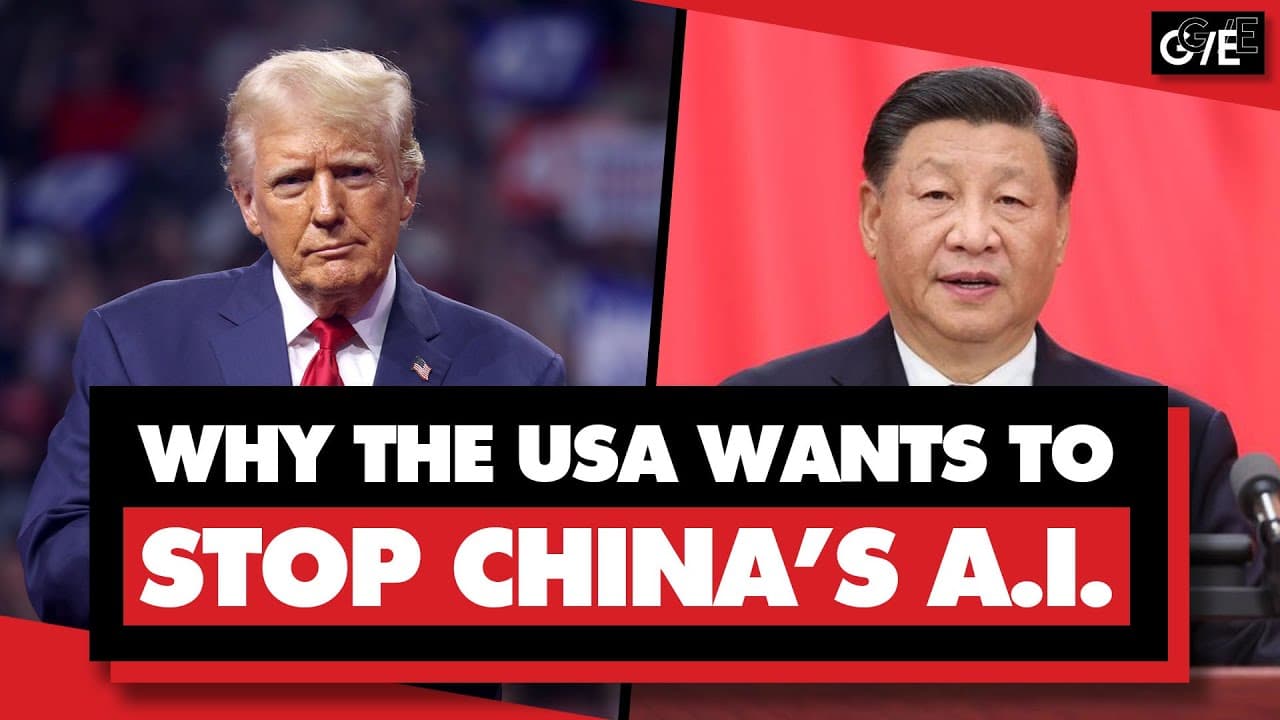
Tech CEOs admit they want AI monopoly: US plans to block China's competition & 'steal' engineers
TL;DR
US tech giants fear Chinese AI competition, aim for monopolies.
Transcript
if you're starting a company if you're the founder entrepreneur starting a company you always want to aim for Monopoly and um and that uh and you want to always avoid competition and so uh hence uh competition is for losers uh something we'll be talking about today the Chinese company deep seek has shaken up the global debat... Read More
Key Insights
- US tech companies, led by figures like Peter Thiel, openly admit to wanting monopolies and view competition as detrimental, especially in AI development.
- Chinese company DeepSeek has developed an advanced AI model that surpasses US models, challenging the assumed US dominance in AI technology.
- DeepSeek's AI model is groundbreaking due to its efficiency and cost-effectiveness, developed with significantly less computing power and cost compared to US models.
- The US government is actively working to restrict Chinese technological advances by imposing export restrictions on semiconductors and other critical technologies.
- There is a bipartisan effort in the US to curb Chinese innovation, with strategies including poaching Chinese engineers and banning Chinese apps.
- US tech companies accuse DeepSeek of intellectual property theft, despite their own history of using vast amounts of data without consent for AI training.
- Silicon Valley's push for monopolies is supported by government policies, reflecting a long-standing trend of corporate influence over US political decisions.
- China's approach to AI development involves state support and competition among firms, contrasting with the US model of corporate monopolies.
Install to Summarize YouTube Videos and Get Transcripts
Explore YouTube Video Summarizer or Get YouTube Transcript Extractor
Questions & Answers
Q: What is the significance of DeepSeek's AI model?
DeepSeek's AI model is significant because it challenges the US's assumed leadership in AI technology. Developed with minimal resources compared to US models, it demonstrates that advanced AI can be achieved more efficiently. Its open-source nature also democratizes access to cutting-edge AI technology, posing a direct challenge to US tech monopolies.
Q: How are US tech companies reacting to Chinese AI advancements?
US tech companies are reacting to Chinese AI advancements with concern and strategic actions to maintain their dominance. This includes lobbying for government intervention to restrict Chinese technology access, accusing Chinese companies of intellectual property theft, and advocating for policies that would limit competition. The goal is to preserve their monopolistic positions and prevent the rise of Chinese competitors.
Q: What role does the US government play in the AI competition with China?
The US government plays a crucial role in the AI competition with China by implementing policies designed to restrict China's access to critical technologies and talent. This includes export controls on semiconductors, efforts to ban Chinese apps, and discussions on attracting Chinese engineers to the US. These measures reflect a strategic effort to curb China's technological advancements and maintain US global leadership in AI.
Q: Why do US tech leaders advocate for monopolies?
US tech leaders advocate for monopolies because they believe it ensures sustained profits and market control. Figures like Peter Thiel argue that competition erodes profits and that monopolies allow companies to dominate markets and innovate without the pressure of competing firms. This perspective is deeply ingrained in Silicon Valley's business strategy and influences their approach to policy and innovation.
Q: What are the implications of US-China AI competition for global technology development?
The US-China AI competition has significant implications for global technology development. It could lead to a bifurcation of AI ecosystems, with different standards and technologies emerging in the US and China. The competition also accelerates innovation as both countries strive to outpace each other. However, it may also result in increased geopolitical tensions and protectionist policies that hinder international collaboration and technological progress.
Q: How does China's approach to AI development differ from the US?
China's approach to AI development differs from the US in that it involves significant state support and a focus on competition among domestic firms. The Chinese government provides incentives and infrastructure to foster innovation, allowing multiple companies to compete and drive down costs. This contrasts with the US model, which is dominated by a few large corporations seeking to establish monopolies and limit competition.
Q: What strategies are being discussed in the US Senate to counter Chinese AI advancements?
The US Senate is discussing several strategies to counter Chinese AI advancements, including imposing stricter export controls on semiconductors, attracting Chinese talent to the US, and banning Chinese apps. These measures aim to limit China's access to critical technologies and maintain US technological superiority. The discussions reflect a broader concern about China's growing influence in AI and its potential to challenge US dominance.
Q: How does the concept of monopolies relate to capitalism, according to Peter Thiel?
According to Peter Thiel, monopolies are an inherent aspect of capitalism as they enable companies to accumulate capital and sustain profits. He argues that competition erodes profits, and therefore, successful businesses should aim to establish monopolies. Thiel's view reflects a belief that capitalism naturally leads to the concentration of market power in the hands of a few dominant players, which he sees as essential for innovation and economic success.
Summary & Key Takeaways
-
US tech leaders, including Peter Thiel, advocate for monopolies and view competition as a threat, particularly from Chinese companies like DeepSeek. This reflects a broader strategy to maintain US dominance in AI.
-
DeepSeek's AI model has outperformed US counterparts, prompting fears among US tech giants and government efforts to restrict Chinese technological advancement through export controls and other measures.
-
The US government's response to Chinese AI competition involves a combination of policy measures aimed at limiting China's access to critical technologies and talent, highlighting a geopolitical struggle for technological supremacy.
Read in Other Languages (beta)
Share This Summary 📚
Summarize YouTube Videos and Get Video Transcripts with 1-Click
Try YouTube Summary with ChatGPT & Claude or YouTube Transcript Generator
Explore More Summaries from Geopolitical Economy Report 📚


Summarize YouTube Videos and Get Video Transcripts with 1-Click
Try YouTube Summary with ChatGPT & Claude or YouTube Transcript Generator