Commutation | Methods | Part-4/5 | DC machines | Lec-43
TL;DR
Delayed commutation in electrical systems causes issues due to reactance and cross magnetization effects.
Transcript
hello everyone we are discussing about the what are the reasons for delay combination generally we have three types three types of computations that is ideal computation and over computation and under computation or delayed computation generally the computation is delayed computation the reason is first is the reactance voltage second is the cross ... Read More
Key Insights
- 😵 Delayed commutation is primarily impacted by reactance and cross magnetization effects, which create inefficiencies.
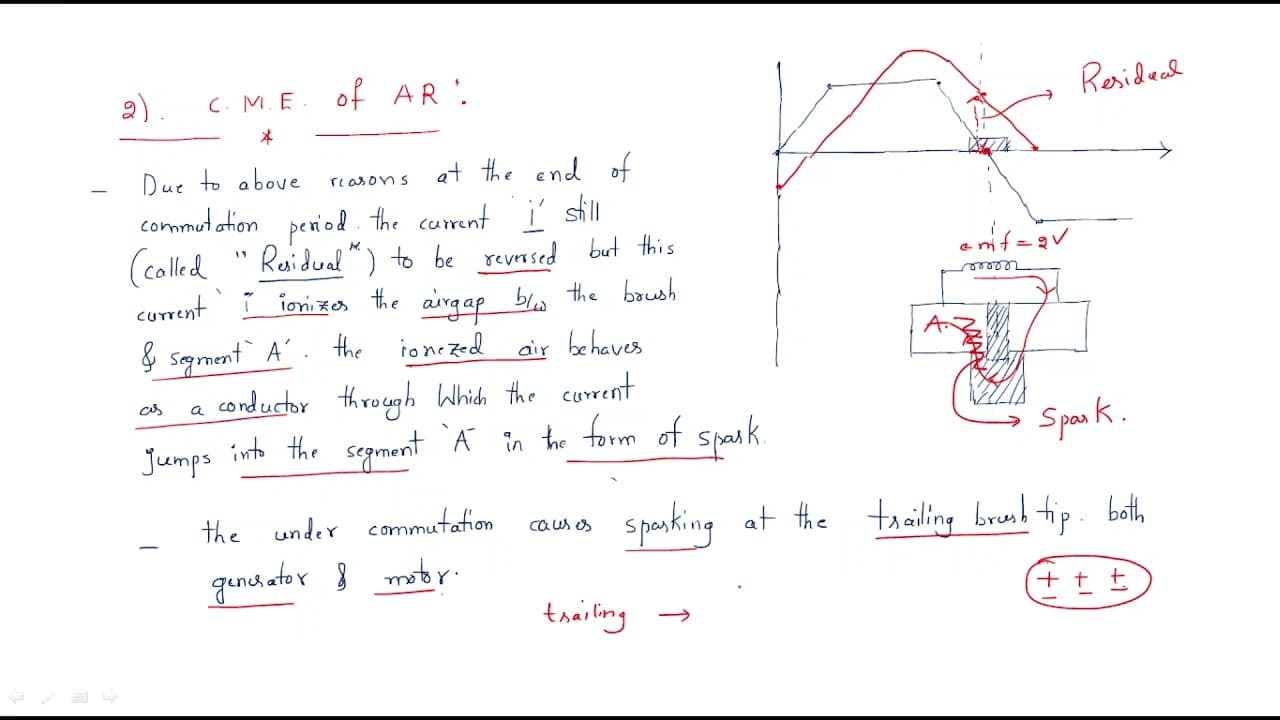
- 🥺 Residual currents can lead to sparking in brush segments, posing risks to the integrity of electrical systems.
- 🥺 Increasing brush resistance can significantly enhance the speed of current response during commutation, leading to improved performance.
- ⚡ Voltage drop across the brushes is a crucial factor; higher resistance leads to better management of induced EMF across the brushes.
- 🎰 Both delayed commutation and under computation can adversely affect the operation of DC machines, necessitating remedies.
- 🥺 The interaction between residual current and ionization can complicate the commutation process, leading to additional challenges.
- 🤩 Effective management of brush resistance is key to mitigating issues linked with delayed commutation in electrical systems.
Install to Summarize YouTube Videos and Get Transcripts
Explore YouTube Video Summarizer or Get YouTube Transcript Extractor
Questions & Answers
Q: What are the main reasons for delayed commutation in electrical systems?
Delayed commutation occurs mainly due to reactance voltage and the cross magnetizing effect of the armature reaction. Reactance voltage creates an opposing EMF when current tries to reverse, while the cross magnetization effect leads to residual currents that can generate unwanted sparking.
Q: How does reactance voltage affect the commutation process?
Reactance voltage opposes current reversal by creating an EMF that can hinder the flow of current when it is about to change direction. This opposing voltage must be addressed to ensure smooth commutation and prevent performance issues in electrical systems.
Q: What is the significance of residual current in delayed commutation?
Residual current, although often minimal, is important as it can result in unwanted sparking in the brush segments. This current can ionize the air gap, making it act like a conductor and leading to electrical discharges that can harm both generators and motors.
Q: What are the two methods to address delayed commutation?
The two methods are resistance computation and voltage EMF commutation. Resistance computation increases brush resistance to reduce the time constant, while voltage EMF commutation neutralizes opposing voltages to improve current flow efficiency and promote better commutation outcomes.
Summary & Key Takeaways
-
Delayed commutation refers to the delay in current flow in electrical systems primarily caused by reactance voltage and cross magnetizing effects, influencing performance negatively.
-
The residual current, although low or zero, can cause unwanted sparking due to ionization in the brush segments, impacting both generators and motors.
-
To mitigate delayed commutation, two primary methods are implemented: resistance computation and voltage EMF commutation, which help improve overall efficiency and performance.
Read in Other Languages (beta)
Share This Summary 📚
Summarize YouTube Videos and Get Video Transcripts with 1-Click
Try YouTube Summary with ChatGPT & Claude or YouTube Transcript Generator