Rectangular Waveguide | Calculation of cutoff wavelength | Microwave Engineering | Lec-17
TL;DR
The video explains the derivation of cutoff wavelength in rectangular waveguides.
Transcript
hi everyone in this video I am going to derive the expression for cutoff wavelength Lambda C in a rectangular waveguard so cut off wavelength cut off wavelength indicated by Lambda C so what do you mean by Lambda C cutoff C how can you define this cutoff wavelength is the wavelength of a wave that is traveling through a rectangular wave head which ... Read More
Key Insights
- ❓ Cutoff wavelength is crucial in determining the operational characteristics of a rectangular waveguide.
- 👋 The derivation involves fundamental electromagnetic wave equations, emphasizing the interrelationship between various parameters.
- 📡 Understanding gamma as a combination of attenuation and phase constants provides deeper insights into signal behavior in the waveguide.
- 🎅 The formula for Lambda C showcases its dependence on both geometrical and modal attributes of the waveguide.
- 👋 The video clarifies common misconceptions about frequency relationships and wave propagation limits.
- 🌍 Practical applications of cutoff wavelength include telecommunications and RF engineering, underlining its significance in real-world technical contexts.
- 🧑🎓 Familiarity with the derivation process enhances students' understanding of waveguide dynamics.
Install to Summarize YouTube Videos and Get Transcripts
Explore YouTube Video Summarizer or Get YouTube Transcript Extractor
Questions & Answers
Q: What is the cutoff wavelength (Lambda C) and why is it important?
The cutoff wavelength (Lambda C) is the maximum wavelength that can propagate through a rectangular waveguide. Waves with wavelengths longer than Lambda C cannot travel through the waveguide, which makes it essential for determining the operational limits of the waveguide and ensuring effective signal transmission.
Q: How is the cutoff frequency related to the propagation constant (gamma)?
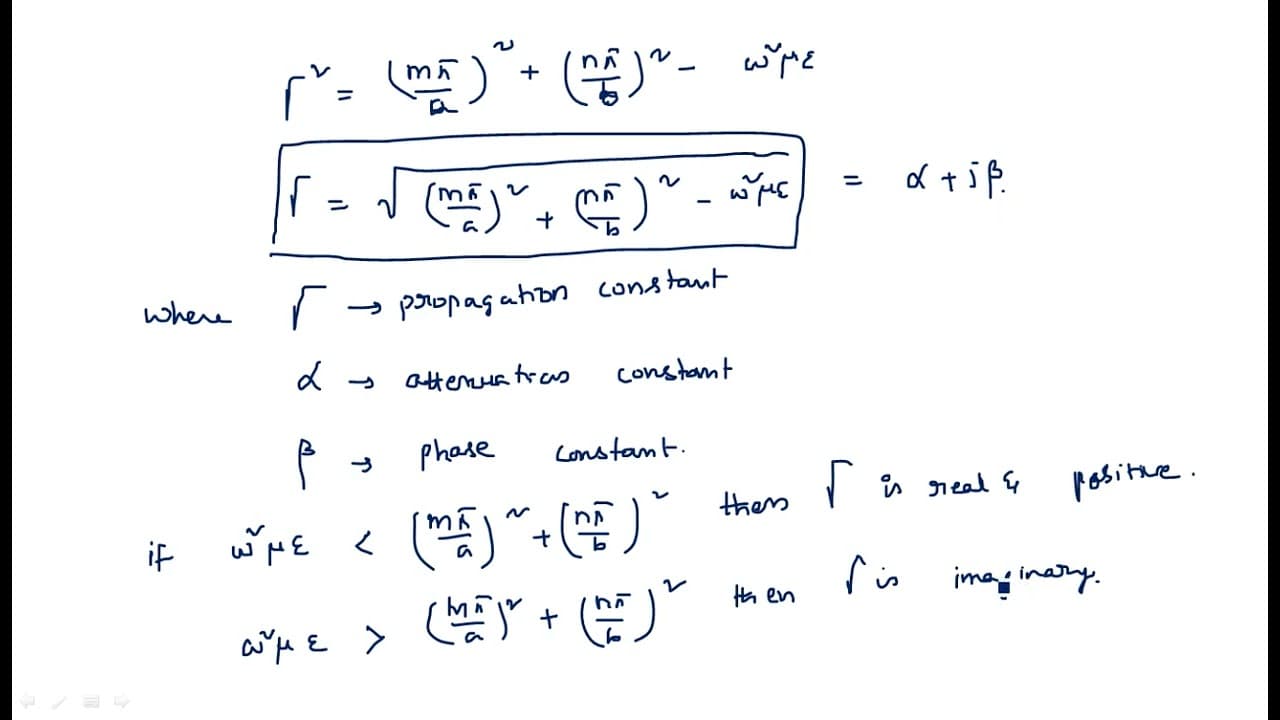
The cutoff frequency is established when the propagation constant gamma is equal to zero. This means that at this frequency, no wave can propagate through the waveguide, reflecting the critical threshold above which the waveguide cannot function effectively.
Q: Can you explain the relationship between frequency and the propagation conditions in waveguides?
As the frequency increases, the terms in the equations determining gamma and cutoff frequencies change. If the frequency is too high, it can cause gamma to become imaginary, indicating that signal propagation is not possible, hence highlighting the importance of understanding frequency in waveguide performance.
Q: What are the main parameters involved in calculating the cutoff wavelength?
The main parameters for calculating cutoff wavelength include the dimensions of the waveguide (a and b), mode numbers (m and n), and physical constants such as the permittivity and permeability of the medium. These values interplay in the derived formulas to establish the cutoff conditions.
Summary & Key Takeaways
-
The video discusses the concept of cutoff wavelength (Lambda C) in rectangular waveguides, defining it as the wavelength which allows wave propagation under specific conditions.
-
It proceeds with a detailed mathematical derivation, showing how gamma, the propagation constant, relates to cutoff frequency and the conditions under which waves can propagate through the guide.
-
The final formula for the cutoff wavelength is derived, allowing calculation based on parameters such as mode numbers, and dimensions of the waveguide.
Read in Other Languages (beta)
Share This Summary 📚
Summarize YouTube Videos and Get Video Transcripts with 1-Click
Try YouTube Summary with ChatGPT & Claude or YouTube Transcript Generator