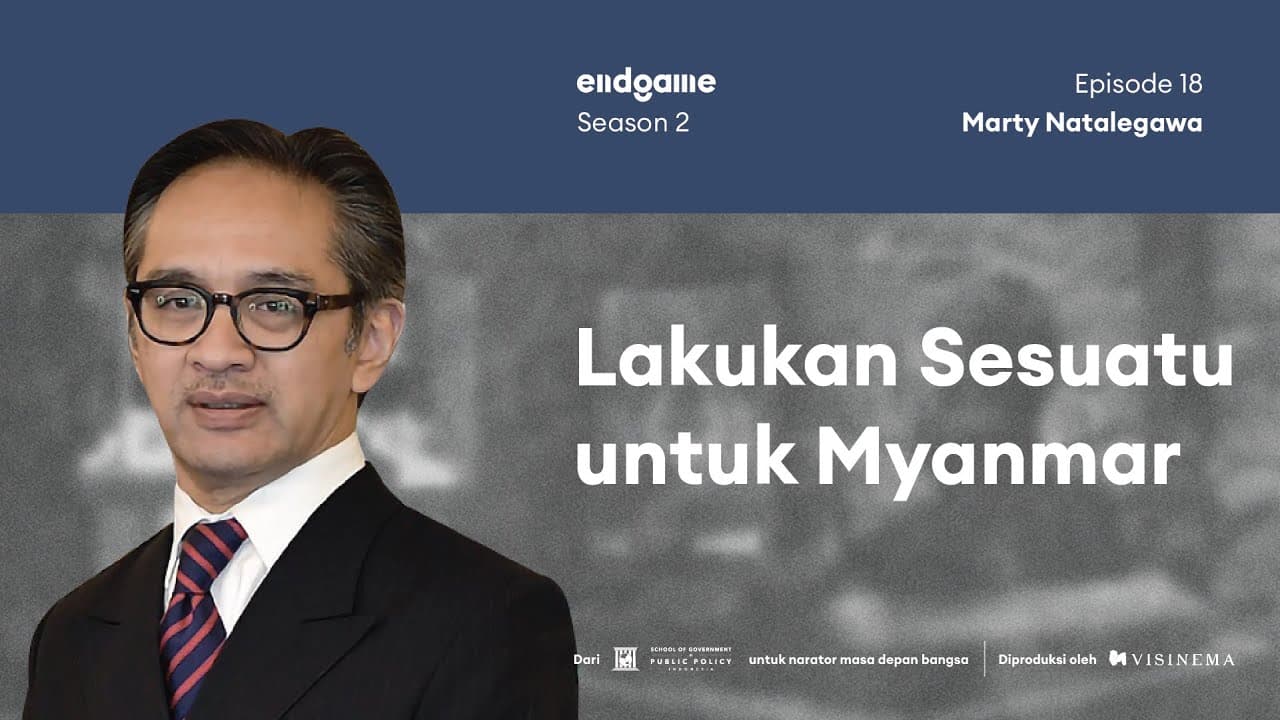
Does ASEAN Matter? Insights from Marty Natalegawa
TL;DR
ASEAN's relevance is questioned as it faces challenges like Myanmar's democratic regression and US-China rivalry. Marty Natalegawa emphasizes the need for proactive diplomacy and strategic trust among Southeast Asian nations. Without a clear direction, ASEAN risks becoming a mere ceremonial entity.
Transcript
They only dealt with the humanitarian dimension. The core issues; the problem in the governance and intolerance were ignored. Thus, we are where we are. So my point is, first and foremost, there must be clarion call to ASEAN, "You cannot go AWOL." [Voiceover: This is Endgame] GITA WIRJAWAN: Hi friends, today we are having Marty Natalegawa, the ... Read More
Key Insights
- ASEAN must not go AWOL; it needs to address core issues like governance and intolerance.
- Marty Natalegawa's book questions ASEAN's relevance, aiming to document past achievements and future challenges.
- ASEAN's transformation from trust deficit to strategic trust involved Indonesia's leadership in promoting diplomacy over hard power.
- The South China Sea conflict requires long-term, anticipatory approaches to avoid escalation.
- US-China rivalry impacts ASEAN's centrality; ASEAN needs a script to navigate geopolitical tensions.
- Democratization in Southeast Asia is a process, not an event, requiring persistence and resilience.
- ASEAN's role in Myanmar's crisis is crucial; engagement must respect democratic aspirations.
- Connectivity through technology doesn't guarantee better understanding; reading and writing are vital for informed perspectives.
Install to Summarize YouTube Videos and Get Transcripts
Explore YouTube Video Summarizer or Get YouTube Transcript Extractor
Questions & Answers
Q: How has ASEAN transformed from trust deficit to strategic trust?
ASEAN's transformation from trust deficit to strategic trust was facilitated by Indonesia's leadership in promoting diplomacy over hard power. Initiatives like the Bali Concord I and the Treaty of Amity and Cooperation emphasized negotiation and dialogue, helping ASEAN countries move from mutual suspicion to strategic trust. This process involved incremental steps such as expanding ASEAN membership and forming the ASEAN Community.
Q: What challenges does ASEAN face in maintaining its centrality amid US-China rivalry?
ASEAN faces challenges in maintaining its centrality due to the ongoing US-China rivalry. ASEAN must have a clear script and strategic direction to navigate these geopolitical tensions. The rivalry affects regional dynamics, and ASEAN needs to assert its role as a central force rather than merely an event organizer. ASEAN's proactive engagement and leadership are crucial to managing these challenges effectively.
Q: Why is ASEAN's role in Myanmar's crisis significant?
ASEAN's role in Myanmar's crisis is significant because it can influence the region's democratic trajectory. ASEAN must engage with Myanmar in a way that respects democratic aspirations and doesn't legitimize the junta's actions. ASEAN's involvement is crucial to promoting stability and ensuring that the region's democratic processes are not undermined. The organization must act decisively to address the situation and support Myanmar's democratic will.
Q: What insights does Marty Natalegawa offer on the South China Sea conflict?
Marty Natalegawa highlights the importance of a long-term, anticipatory approach to the South China Sea conflict. He emphasizes the need for a Code of Conduct to manage disputes and avoid escalation. ASEAN must maintain diplomatic efforts to ensure that conflicts do not spiral out of control. Indonesia's historical role in initiating dialogue and building consensus within ASEAN is crucial for managing the South China Sea issue.
Q: How does Marty Natalegawa view the relationship between democracy and economic progress?
Marty Natalegawa believes that democracy should lead to economic progress through accountable governance and equitable development. He argues that democratic principles, such as the regular expression of popular will and government accountability, can foster more sustainable economic growth. While acknowledging the challenges, he maintains that democracy offers the best framework for achieving long-term economic and social justice.
Q: What role does technology play in ASEAN's connectivity and understanding?
Technology enhances connectivity but does not guarantee better understanding or information. Marty Natalegawa points out that while digital connections provide access to vast information, they can also reinforce echo chambers and silo mentalities. He stresses the importance of reading and writing to challenge assumptions and promote informed perspectives. True connectivity requires going beyond digital interactions to foster deeper comprehension and tolerance.
Q: What are the key themes in Marty Natalegawa's book 'Does ASEAN Matter?'
Marty Natalegawa's book 'Does ASEAN Matter?' explores ASEAN's relevance in the current geopolitical landscape. It questions ASEAN's achievements and future challenges, emphasizing the need for strategic trust and proactive diplomacy. The book documents ASEAN's past successes and advocates for addressing governance issues, promoting regional stability, and ensuring that ASEAN remains a central force in Southeast Asia.
Q: How can ASEAN address the challenges posed by the South China Sea conflict?
ASEAN can address the South China Sea conflict by adopting a long-term, anticipatory approach and maintaining diplomatic efforts. Implementing a Code of Conduct to manage disputes and prevent escalation is crucial. ASEAN must ensure that conflicts do not spiral out of control and continue to engage in dialogue with all parties involved. Indonesia's historical role in initiating dialogue and building consensus within ASEAN is vital for managing the South China Sea issue.
Summary & Key Takeaways
-
Marty Natalegawa emphasizes the importance of ASEAN having a clear direction to remain relevant in geopolitical dynamics. He highlights Indonesia's role in transforming ASEAN from a trust deficit to strategic trust through diplomacy. The South China Sea issue and US-China rivalry pose challenges that require proactive ASEAN engagement.
-
ASEAN's relevance is questioned in Marty Natalegawa's book, 'Does ASEAN Matter?' He argues that ASEAN must address governance and intolerance issues, and not just focus on ceremonial aspects. The book documents ASEAN's past achievements and future challenges, advocating for a strategic approach to regional conflicts.
-
The degradation of democracy in Myanmar and the South China Sea conflict highlight the need for ASEAN to have a proactive diplomatic stance. Marty Natalegawa stresses that ASEAN must not become a mere ceremonial entity and should engage in meaningful dialogue to address regional issues effectively.
Read in Other Languages (beta)
Share This Summary 📚
Summarize YouTube Videos and Get Video Transcripts with 1-Click
Try YouTube Summary with ChatGPT & Claude or YouTube Transcript Generator
Explore More Summaries from Gita Wirjawan 📚




Summarize YouTube Videos and Get Video Transcripts with 1-Click
Try YouTube Summary with ChatGPT & Claude or YouTube Transcript Generator