How Many Wins Are Needed for NBA Playoffs Success?
TL;DR
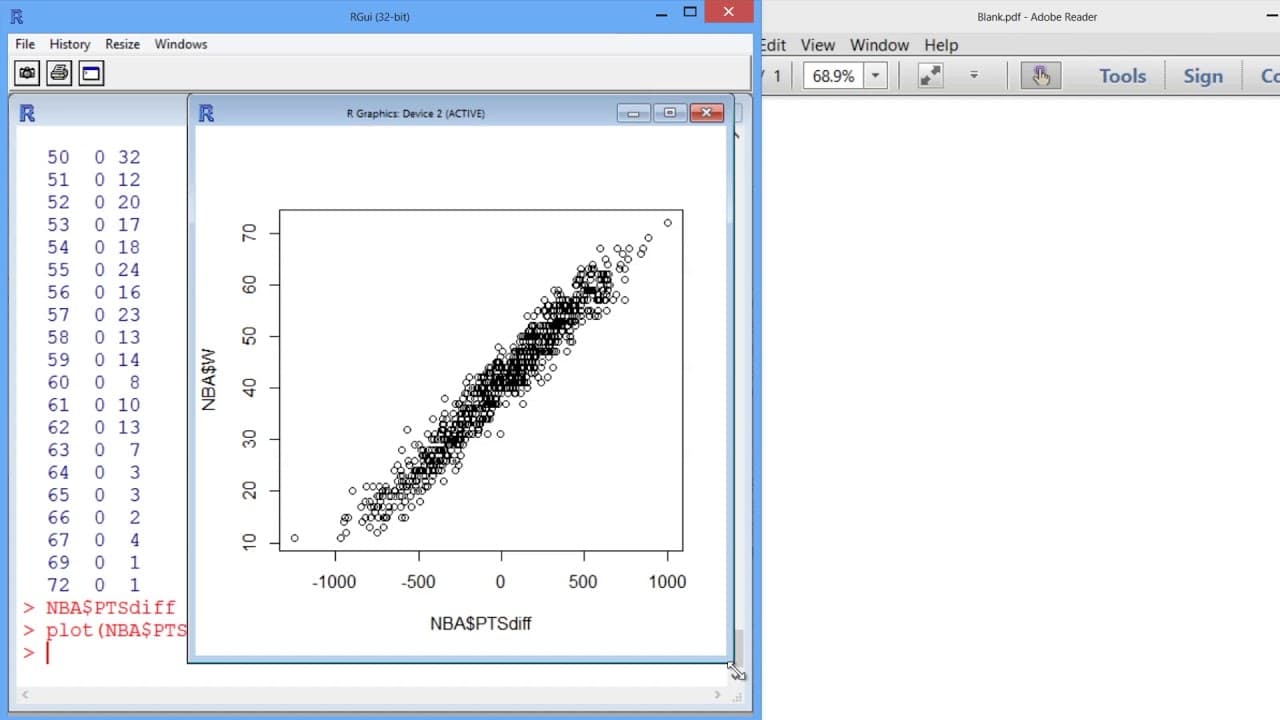
A basketball team needs to win at least 42 games to have a strong chance of making the NBA playoffs, while teams with 35 wins or fewer rarely qualify. Analyzing point differences (points scored minus points allowed) reveals a significant linear relationship with the number of wins, confirmed by a regression analysis showing an R-squared value of 0.9423.
Transcript
The goal of a basketball team is similar to that of a baseball team, making the playoffs. So how many games does a team need to win in order to make the playoffs? Recall that in the lecture we found this number by looking at a graph. Here in R, let's use the table command to figure this out for the NBA. So that's just table(NBA$W, NBA$Playoffs). So... Read More
Key Insights
- 😉 Around 35 wins or fewer, teams rarely make it to the playoffs.
- 😉 Winning about 42 games gives a basketball team a very good chance of making it to the playoffs.
- 💯 There is a strong linear relationship between the point difference (points scored minus points allowed) and the number of wins.
- 😉 Linear regression analysis confirms the strong relationship between the point difference and the number of wins, with an R-squared value of 0.9423.
- 😉 The regression equation for predicting wins based on the point difference is Wins = 41 + 0.0326*PTSdiff.
- 💯 Teams need to score at least 31 more points than they allow in order to win at least 42 games.
Install to Summarize YouTube Videos and Get Transcripts
Explore YouTube Video Summarizer or Get YouTube Transcript Extractor
Questions & Answers
Q: How did they determine the number of wins required to make it to the playoffs?
The number of wins required to make it to the playoffs was determined by analyzing the table of wins and playoff appearances in the NBA. It was observed that teams that win around 42 games have a very good chance of making it to the playoffs.
Q: Can the point difference between points scored and points allowed be used to predict the number of games a team will win?
Yes, the point difference between points scored and points allowed throughout the regular season can be used to predict the number of games a team will win. There is a strong linear relationship between the point difference and the number of wins.
Q: What is the regression equation for predicting the number of wins based on the point difference?
The regression equation for predicting the number of wins based on the point difference is Wins = 41 + 0.0326*PTSdiff. The intercept term is 41 and the coefficient estimate for the point difference is 0.0326.
Q: How many more points than allowed do teams need to score in order to win at least 42 games?
Teams need to score at least 31 more points than they allow in order to win at least 42 games. This is calculated by taking the difference between 42 and 41 (number of wins), and dividing it by the coefficient estimate for the point difference (0.0326).
Summary & Key Takeaways
-
Using the table command in R, the number of wins required for a basketball team to make the playoffs can be determined. Teams that win around 35 games or fewer rarely make it to the playoffs, while teams that win about 42 games have a very good chance of making it to the playoffs.
-
By calculating the difference between points scored and points allowed throughout the regular season, a strong linear relationship between the number of wins and point difference can be observed.
-
Linear regression analysis shows that the point difference is a significant variable in predicting the number of wins, with an R-squared value of 0.9423.
Read in Other Languages (beta)
Share This Summary 📚
Summarize YouTube Videos and Get Video Transcripts with 1-Click
Try YouTube Summary with ChatGPT & Claude or YouTube Transcript Generator
Explore More Summaries from MIT OpenCourseWare 📚


Summarize YouTube Videos and Get Video Transcripts with 1-Click
Try YouTube Summary with ChatGPT & Claude or YouTube Transcript Generator